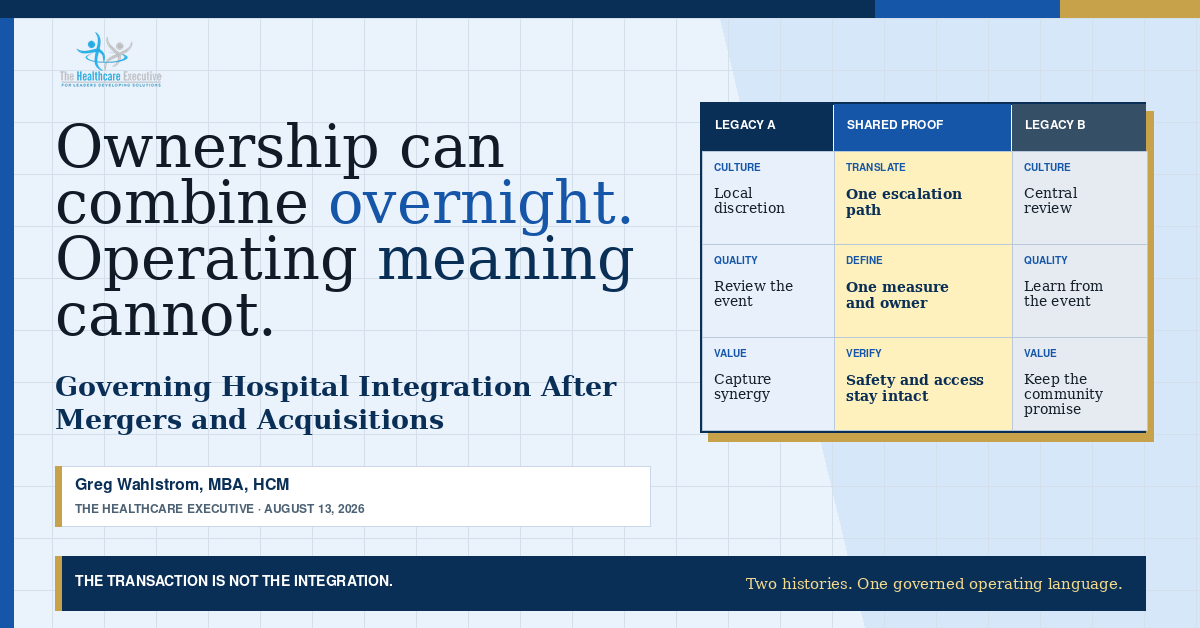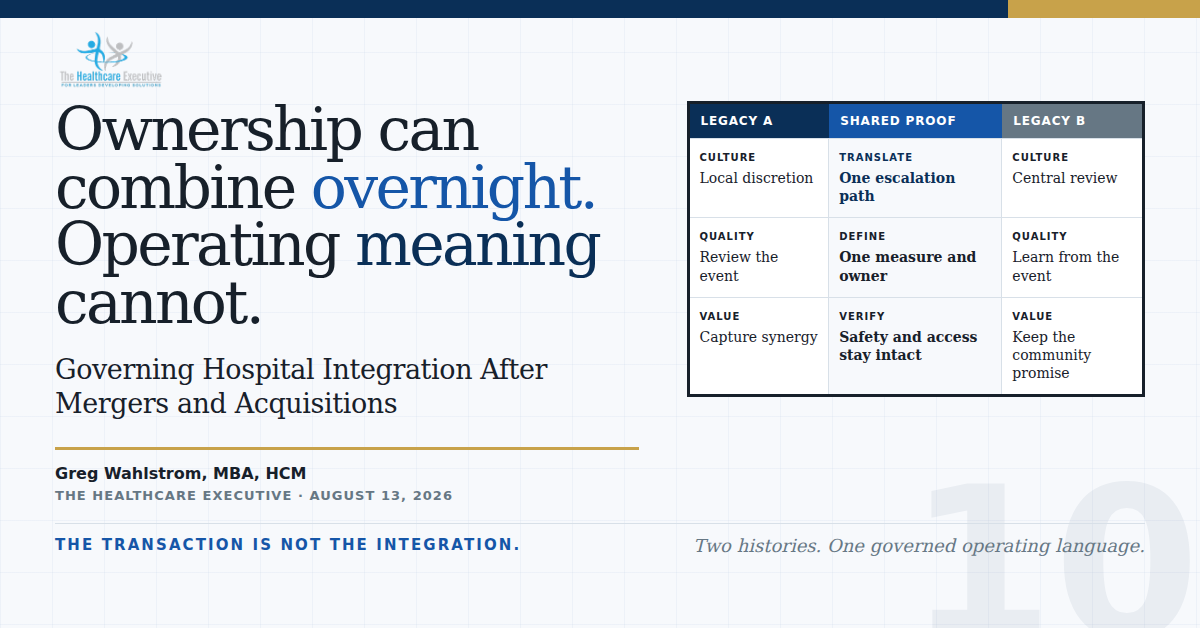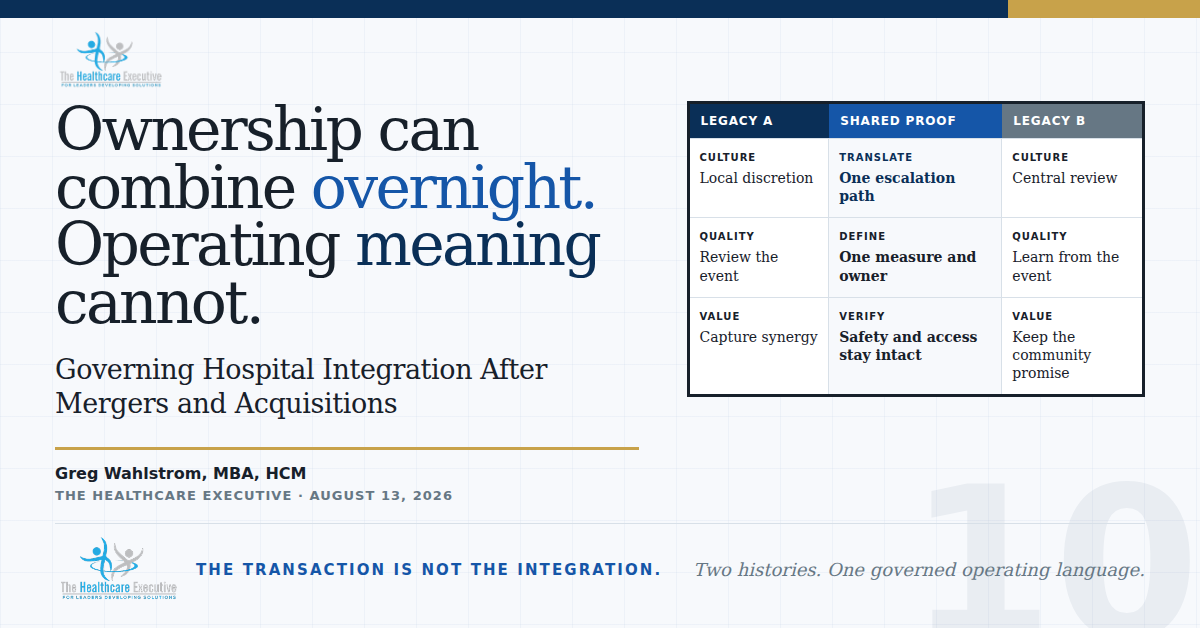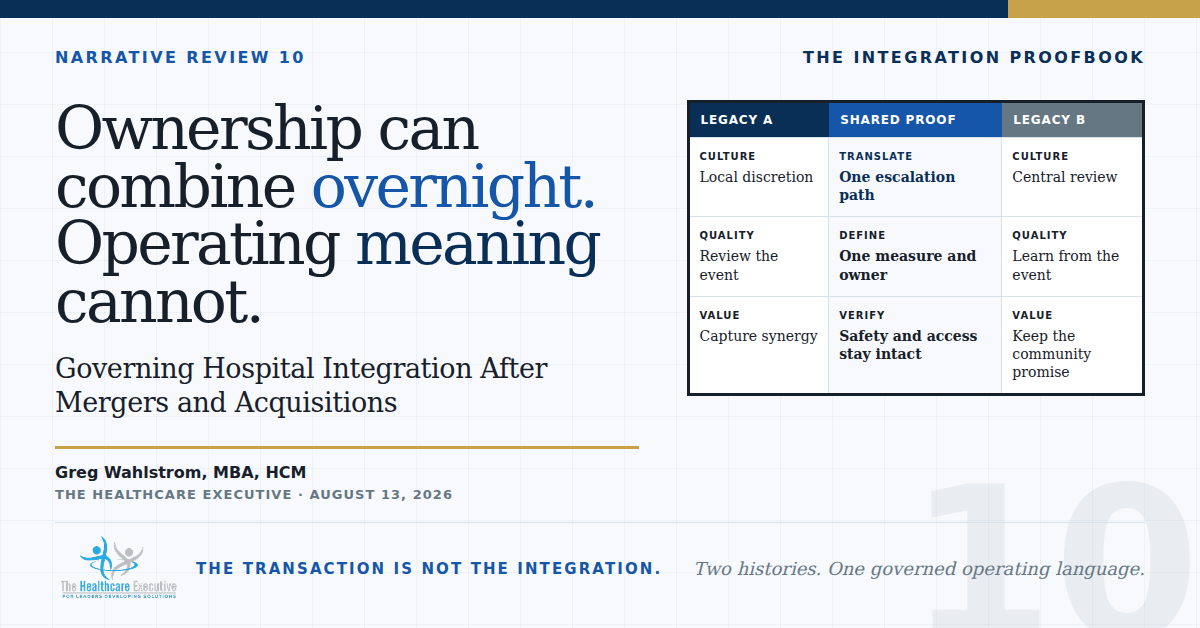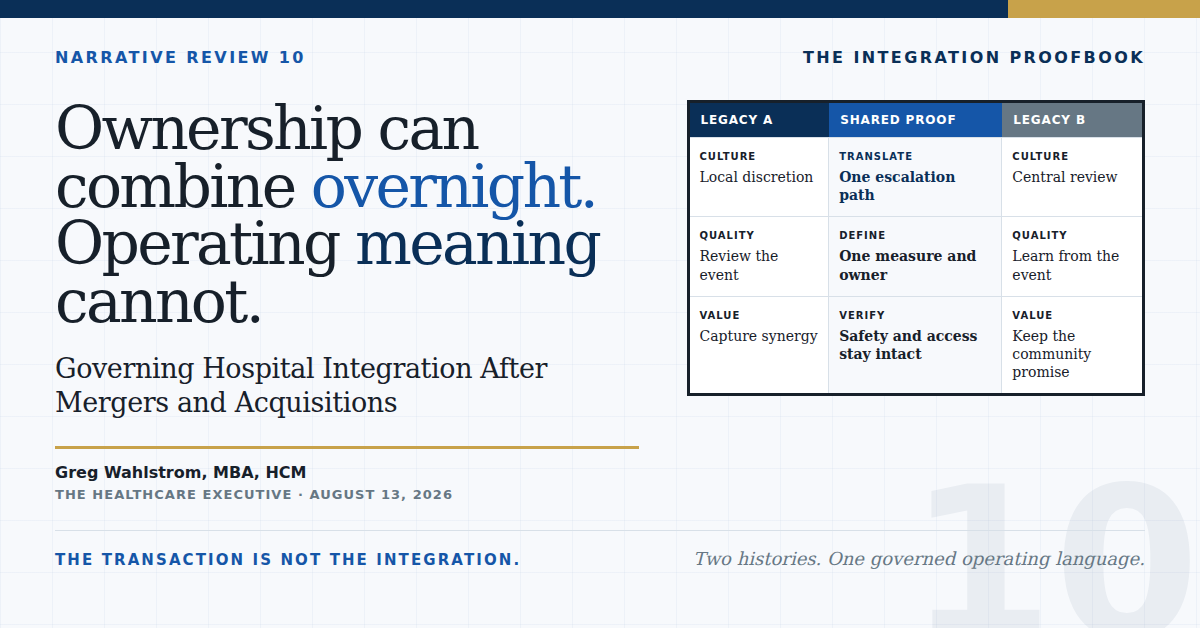


Ownership can combine overnight. Operating cannot.
The transaction is not the integration.
Governing Hospital Integration After Mergers and Acquisitions: Culture, Clinical Quality, Workforce, and Value—a Narrative Review
The Integration ProofbookTwo histories. One governed operating language.
Executive integration brief
Post-merger value is an operating outcome, not a transaction assumption.
Background and Objective: Hospital mergers and acquisitions are commonly justified by scale, access, financial stability, and quality improvement, yet average evidence shows higher commercial prices and little consistent quality gain. Transaction closing does not itself create clinical or operational integration. This narrative review examines how boards and executives can govern post-merger integration across culture, clinical quality, workforce, operations, affordability, and value.
Methods: PubMed/MEDLINE, official competition-policy and health-system sources, and publisher pages were searched through 12 August 2026. Search concepts combined hospital merger or acquisition with quality, safety, price, market concentration, organizational culture, workforce, psychological safety, and post-acquisition integration. Empirical merger studies, systematic reviews, policy analyses, organizational research, and implementation reports were prioritized. Bibliographic details were verified using PubMed, DOI, publisher, or official-source records.
Key Content and Findings: Consolidation changes bargaining power immediately, while quality and efficiency benefits require deliberate integration and may take years. Large observational studies find no average improvement in mortality or readmission after acquisition and possible deterioration in patient experience; price increases are more consistent. A notable single-system study associated full clinical and operational integration with improved mortality and selected safety outcomes, but causality and transferability are limited. Effective governance therefore begins before close with a public value thesis, baseline measures, explicit clinical non-negotiables, cultural and safety due diligence, and a sequenced integration architecture. Decisions should distinguish what must be standardized enterprise-wide from what should remain locally adapted. Workforce stability, psychological safety, data migration, referral patterns, service-line changes, and patient access require prospective safeguards. Benefits must be measured net of implementation cost and without double counting.
Conclusions: Post-merger value is an operating outcome, not a transaction assumption. Boards should hold leadership accountable to a transparent integration scorecard covering quality, access, workforce, affordability, equity, and financial resilience. Standardization should target safety and interoperability; local autonomy should preserve responsiveness and trust. Independent review and clear stop-or-correct thresholds are essential when integration produces unintended harm.
Keywords: hospital mergers; integration; organizational culture; quality; health-care value
Introduction
Hospital and health-system consolidation has reshaped care delivery. US hospital markets became increasingly concentrated during the 2010s (1), and contemporary analyses continue to show that many metropolitan areas are controlled by one or two systems (2). Consolidation can preserve a financially threatened hospital, support capital investment, spread fixed costs, or connect patients to specialized care. It can also reduce competition, increase prices, disrupt clinical teams, centralize services, and create implementation risk.
The empirical record challenges the assumption that ownership change reliably improves care. A national difference-in-differences study of hospitals acquired between 2009 and 2013 found no significant improvement in mortality or readmissions and a modest deterioration in patient experience relative to controls (3). By contrast, a single safety-net hospital undergoing full clinical and operational integration into an academic system experienced improved mortality and selected safety and experience measures over three years (4). These findings are not contradictory. They suggest that consolidation is an exposure, while integration strategy, resources, context, and execution influence outcomes.
Prices show a more consistent pattern. Economic research finds that hospital consolidation often increases negotiated commercial prices (5,6). Cross-market mergers can also raise prices even when merging hospitals do not compete for the same local patients (7). Higher prices do not prove that every transaction lacks social value, but they raise the burden of demonstrating measurable improvements in access, quality, resilience, or equity.
Executives often describe integration in technical workstreams—finance, human resources, information technology, supply chain, and revenue cycle. Those workstreams are necessary, but they can miss the clinical organization. Hospitals are professional, safety-critical institutions with strong local identities, tacit routines, and interdependent teams. Changing leadership, reporting relationships, electronic records, formularies, referral routes, staffing models, or service locations can alter care before formal outcome measures detect the effect.
This review develops an executive governance model for integration from pre-close due diligence through stabilization and benefit realization. It focuses on culture, clinical quality, workforce, operations, affordability, and value. This article is presented in accordance with the narrative review reporting checklist.
Methods
This narrative review was designed for hospital boards, executives, integration leaders, clinical leaders, and policy audiences. Searches were completed on 12 August 2026 using PubMed/MEDLINE for peer-reviewed literature; Federal Trade Commission (FTC), Department of Justice, KFF, AHRQ, and health-system websites for policy and implementation evidence; and publisher and DOI pages for bibliographic verification. Table 1 summarizes the completed strategy and Supplementary Table S1 provides reproducible detail.
Sources were included when they addressed horizontal hospital mergers, acquisitions, vertical integration where transferable, market and price effects, clinical quality, workforce and culture, or post-acquisition implementation. Empirical studies and systematic reviews were prioritized, with organizational research used to interpret mechanisms not well captured in claims data. Selection was purposive, duplicate review and formal risk-of-bias scoring were not performed, and no effect estimates were pooled.
The synthesis used five questions: What value was promised? Which mechanisms could plausibly produce it? Which integration actions are required? What risks could offset it? How will leaders know whether value was realized? This structure separates transaction rationale from measured result.
The completed evidence-synthesis exhibits are presented in Table 2 and Table 3.
| Item | Completed approach |
|---|---|
| Search date | 12 August 2026 |
| Sources | PubMed/MEDLINE; FTC and Department of Justice; KFF; AHRQ; health-system sources; publisher and DOI pages |
| Concepts | hospital merger/acquisition; consolidation; integration; quality; mortality; patient experience; prices; market concentration; culture; workforce; psychological safety; EHR integration |
| Timeframe | January 2000–12 August 2026, with seminal organizational sources included |
| Inclusion | Empirical merger studies, economic and policy analyses, systematic reviews, safety and culture research, implementation reports |
| Exclusion | Transaction announcements without outcomes; unsupported consultancy claims; non-health M&A evidence without a transferable integration mechanism |
| Selection | Relevance screen, full-source review, purposive synthesis, citation chaining, bibliographic verification |
| Other | Causal claims calibrated to design; institutional case reports identified as such; no pooled estimate |
Search completed August 12, 2026.
The transaction is not the integration
Legal close transfers ownership and control. Integration changes how people make decisions, deliver care, use information, allocate resources, and relate to patients and communities. Bargaining leverage can change quickly after close; clinical quality cannot. Standardizing protocols, implementing a common electronic health record (EHR), recruiting leaders, redesigning service lines, and building trust require time and may initially destabilize performance.
Boards should therefore approve both a transaction thesis and an integration thesis. The transaction thesis explains why affiliation is preferable to alternatives such as partnership, shared service, joint venture, organic investment, or closure support. The integration thesis specifies mechanisms: for example, a common sepsis pathway will reduce mortality; a system transfer center will improve tertiary access; consolidated procurement will fund nursing investment; or an integrated EHR will reduce information fragmentation. Each mechanism needs baseline, intervention, owner, timing, cost, outcome, and balancing measure.
Integration proof 03 · Translate the promise
A transaction thesis explains why. An integration thesis explains how.
Ownership can change at close. Clinical and operating value must be built and measured.
Scale, access, stability, and quality are the promised destination.
Named mechanisms show how pathways, transfers, investment, and data will create it.
- Baseline
- Intervention
- Owner
- Timing
- Cost
- Outcome
- Balancing measure
Claims of “synergy” should be decomposed. Revenue synergy may come from referral capture, payer negotiation, coding, service expansion, or increased volume. Cost synergy may come from purchasing, administrative consolidation, staffing, site rationalization, or avoided capital. Quality benefit may come from leadership, clinical standardization, specialist access, infrastructure, analytics, or learning. These mechanisms have different ethical, operational, and antitrust implications and should not be presented as one undifferentiated number.
Integration intensity should match the value thesis. If the objective is shared purchasing, full clinical standardization may create unnecessary disruption. If the objective is quality rescue at an under-resourced hospital, loose affiliation may be insufficient. The safety-net integration study combined early leadership integration, a common EHR and cost system, local ownership of quality metrics, shared targets, dashboards, and targeted interventions (4). Its results suggest that meaningful integration can matter, while its single-site design cautions against assuming replication.
Market power, affordability, and public value
Hospital mergers occur within already concentrated markets. Economic reviews conclude that provider market concentration can increase prices and that quality effects are uncertain (5). Cooper and colleagues documented substantial variation in negotiated hospital prices and linked market structure to spending among privately insured patients (6). Research on cross-market acquisitions found price effects even without direct local overlap (7). Recent evidence similarly associated cross-market mergers, particularly serial acquisitions, with higher prices and no discernible improvement in selected mortality and readmission measures (8).
Boards and executives should not treat antitrust review as the only affordability safeguard. A transaction can be legally permissible and still produce financial harm to employers, patients, or public programs. The integration scorecard should include commercial price growth relative to market, patient out-of-pocket exposure, facility-fee changes, payer mix, uncompensated care, service availability, and financial-assistance use. Price and quality should be reported together.
Competition evidence also informs internal governance. If forecast returns depend mainly on higher negotiated prices rather than measurable efficiency or service improvement, the public value thesis is weak. Executives should distinguish revenue gained through market power from revenue gained through better access or performance. Independent board members should challenge assumptions about referral capture and closure of “duplicative” services when those changes reduce patient choice or increase travel.
Mergers may nevertheless preserve access where stand-alone viability is doubtful. That benefit should be made testable: which services would otherwise close, for how long will they be maintained, what capital will be invested, and how will access be measured? Commitments should survive leadership turnover and should include triggers for public or community notification if plans change.
Integration governance and architecture
A credible integration structure has three layers. The board oversees the value thesis, risk appetite, and public commitments. An executive integration steering committee resolves enterprise tradeoffs, funds work, and owns benefits. Clinical and functional workstreams design and execute changes with local leaders and frontline staff.
The integration management office should maintain one plan linking decisions, dependencies, risks, costs, outcomes, and communication. It should not become a reporting bureaucracy detached from clinical work. Every workstream should include a clinical-safety assessment and workforce impact. Critical changes—EHR conversion, medication systems, laboratory interfaces, staffing, emergency services, transfer pathways, and revenue-cycle transition—need readiness criteria and stop-or-correct authority.
Decision rights require clarity between system and site. A useful framework separates three categories:
Integration proof 05 · Assign the decision
Three rules prevent standardization from becoming reflex.
The best answer may come from the acquirer, the acquired hospital, or a new shared design.
- Enterprise non-negotiables Safety standards, credentialing, incident reporting, privacy, cybersecurity, financial controls, and shared data definitions.
- Standardize when value is demonstrated Pathways, supplies, technology, staffing tools, and administrative processes only when common design improves safety, interoperability, or cost.
- Protect local adaptation Community partnerships, access models, language services, scheduling, and workflows that depend on local population and resources.
Enterprise non-negotiables: patient-safety standards, credentialing, incident reporting, cybersecurity, privacy, core financial controls, and data definitions.
Standardize when value is demonstrated: pathways, supplies, technology, staffing tools, and administrative processes where common design improves safety, interoperability, or cost.
Local adaptation: community partnerships, access models, language services, scheduling, and workflows that depend on local population and resources.
Standardization is not inherently good. It creates value when variation is harmful or interoperability matters; it destroys value when it removes a superior local practice or ignores context. Workstreams should identify whether the acquirer, target, or a newly designed process is best. “Adopt the parent standard” is not an evidence review.
Governance should include community and workforce voice, especially when service location, employment, or access may change. Advisory structures need timely information and a visible route to decisions. Consultation after the decision is public relations, not participation.
| Decision category | Enterprise role | Local role | Required safeguard |
|---|---|---|---|
| Clinical safety standards | Set minimum and common definitions | Implement and identify context risk | Clinical review, readiness gate, event monitoring |
| EHR and data | Establish interoperability, security, core content | Validate workflows and required local variation | Simulation, downtime plan, data continuity |
| Workforce harmonization | Set equitable policy and governance | Identify critical talent and local labor needs | Equity analysis, transparent selection, retention plan |
| Service-line design | Evaluate system capability and volume | Represent community access and referral patterns | Travel/access analysis, public commitments, quality measures |
| Supply and vendors | Leverage scale and resilience | Validate clinical suitability and transition | Substitute approval, training, defect monitoring |
| Culture and leadership | Define observable behaviors and accountability | Preserve local strengths and identify fault lines | Psychological-safety measures, issue-closure tracking |
Every decision category requires an enterprise role, a local role, and a visible safeguard.
Clinical quality and safety through transition
Quality should be a Day 1 integration workstream, not an outcome reviewed after financial and technical conversion. The baseline should include mortality, readmissions, hospital-acquired conditions, medication safety, diagnostic delay, patient experience, access, transfer patterns, incident reporting, and safety culture. Measures should be risk adjusted where appropriate and stratified by site, service, race and ethnicity, language, payer, and geography when feasible.
Acquisition itself can alter measurement. Coding may improve, definitions may change, incident reporting may rise under a stronger safety culture, and EHR conversion may disrupt data continuity. Leaders should preserve source definitions, document breaks in series, and use clinical review alongside statistical measures. A sudden improvement in risk-adjusted mortality after coding changes deserves validation.
Integration proof 06 · One safety language
Every high-risk change passes the same clinical gate.
Leadership, EHR, staffing, supplies, and policy changes should not compound risk without explicit review.
- BaselinePreserve definitions, stratify results, and record breaks in the series.
- ReadinessTrain staff, validate interfaces, reconcile formularies, and test downtime plans.
- Live changeUse site clinical leaders, real-time support, and rapid issue escalation.
- Stop or correctPause when safety, staffing, access, or data integrity crosses its threshold.
Board ruleSchedule pressure never outranks patient safety.
Pre-close clinical due diligence should examine more than public quality scores. It should review peer-review processes, infection prevention, credentialing, staffing, high-risk services, equipment, deferred maintenance, pharmacy, laboratory, blood bank, emergency preparedness, open corrective-action plans, malpractice patterns, and safety-culture findings. Proactive risk assessment can identify safety vulnerabilities that financial diligence may miss (9).
Integration sequencing matters. Simultaneous leadership change, EHR conversion, workforce restructuring, supply substitution, and policy standardization create correlated risk. High-risk changes should be staged unless delay itself is unsafe. Readiness criteria should include trained staff, validated interfaces, reconciled formularies and order sets, downtime plans, simulation, at-the-elbow support, and an executive command structure.
Local ownership is essential. Enterprise targets without site-based clinical leaders can produce compliance behavior rather than improvement. The full-integration safety-net study paired system goals and analytics with local accountability and targeted interventions (4). Executives should create dyad leadership, protected improvement time, and rapid access to enterprise expertise while retaining clear site responsibility.
Culture is work, not slogans
Culture describes shared assumptions and norms about how work is done, whose voice counts, how conflict is handled, and what happens after failure. Mergers bring cultures into contact under unequal power. The acquiring organization’s language may dominate even when the stated aspiration is to “take the best of both.” Staff can interpret rapid replacement of local leaders or practices as evidence that prior contribution is not valued.
Research on mergers emphasizes the interaction of human integration and task integration (10). Sociocultural integration literature identifies cultural fit, dominance, tolerance, leadership style, trust, and the social climate of the transaction as relevant but not uniformly predictive (11). Health-care merger research has documented a slow and uneven convergence of hospital cultures, with new organizational fault lines appearing during change (12). These findings argue against reducing culture to an engagement survey or brand launch.
Integration proof 07 · The unwritten-rules dictionary
Culture becomes governable when behavior is observable.
Values posters cannot reveal whose voice counts, what happens after failure, or whether dissent is safe.
- When safety is uncertain
- Escalate the concern without retaliation and document who owns the response.
- Speaking-up rate and issue closure
- Before workflow changes
- Involve the teams whose clinical work and patients will be affected.
- Frontline participation by site and role
- When sites disagree
- Resolve the conflict in a named forum and publish the rationale within a stated time.
- Decision time and exception pattern
- When local practice is better
- Preserve the capability, test it, and let evidence travel in both directions.
- Local innovations adopted enterprise-wide
Cultural due diligence should occur before close where lawful and feasible. It can examine decision speed, hierarchy, speaking up, teamwork, performance management, physician relationships, community identity, and attitudes toward standardization. Data should be collected by site and professional group because senior-leader perceptions may differ from frontline experience.
Leaders should define a small number of observable integration behaviors. Examples include escalating safety concerns without retaliation, documenting decisions and rationale, involving affected teams before workflow change, resolving intersite conflict within a stated time, and recognizing local innovations. These are more actionable than values posters.
Psychological safety is particularly important during integration. Teams learn when members believe interpersonal risk is safe (13). Health-care status differences can inhibit speaking up, while inclusive leadership supports improvement behavior (14). Integration leaders should explicitly invite dissent, protect messengers, track issue closure, and distinguish constructive challenge from resistance. If bad news stops traveling upward, apparent integration progress may be dangerous.
Workforce stability and professional identity
Transactions create uncertainty about roles, compensation, schedules, benefits, seniority, reporting, credentialing, and location. Delay or ambiguity encourages rumor and preventable departure. Experienced staff carry tacit knowledge about patients, community partners, workflows, and failure modes; losing them can weaken the very organization the buyer intended to improve.
Workforce due diligence should identify critical roles, vacancy and turnover patterns, agency dependence, labor agreements, compensation differences, benefit transitions, leadership spans, and professional-development pathways. Retention plans should focus on scarce and high-knowledge roles rather than indiscriminate bonuses. Stay conversations, transparent role-selection processes, fair severance, and rapid decisions reduce uncertainty.
Integration proof 08 · The workforce trust contract
Retain the capability the transaction intended to improve.
Silence about roles, pay, schedules, benefits, or location creates avoidable departure.
Trust is built when leaders make uncertainty visible, decisions fair, and local expertise consequential.
- Name the uncertaintyCommunicate what is known, what is not decided, who decides, and when staff will hear next.
- Protect critical capabilityUse role-specific retention, stay conversations, and rapid decisions for scarce or high-knowledge work.
- Make selection fairAudit titles, pay, promotion, scheduling, discipline, and job elimination by site, role, and demographic group.
- Let expertise governGive community and professional knowledge a visible route into enterprise decisions.
Teamwork culture has been associated with lower resignation rates among hospital nurses and physicians, particularly nurses (15). Integration should therefore preserve functioning teams when possible and avoid repeatedly reassigning personnel solely to create a symbolic system identity. Cross-site teams can build relationships through joint clinical work, simulation, improvement projects, and peer exchange—not only orientation presentations.
Workforce harmonization requires equity analysis. Converting titles or pay bands can reproduce inequity if the “standard” was built in a different labor market or if target employees enter at lower placement. Leaders should examine compensation, promotion, discipline, schedule access, and job elimination by role and demographic group. Community-based employees should not bear disproportionate synergy extraction while enterprise leadership remains untouched.
Professional identity also matters. Academic and community clinicians may differ in status, productivity expectations, teaching roles, or autonomy. The integration model should specify how local expertise and community practice are represented in governance. Requiring every clinician to adopt the acquirer’s identity without reciprocal learning can erode trust and referral relationships.
Data, technology, and operational integration
A common EHR can improve information continuity and enterprise analytics, but conversion is a clinical transformation with known transition risk. Data mapping, order sets, medication lists, interfaces, patient identity, referral queues, portal access, and downtime procedures require validation. Leaders should preserve historical data access and define how unresolved records and duplicate identities are handled.
Technology integration should follow clinical design. Copying the acquirer’s build may propagate poor workflow; preserving every local customization defeats interoperability. A multidisciplinary governance process should classify content as evidence-based standard, required local variation, or legacy preference. Metrics should include usability, order errors, inbox burden, turnaround time, help requests, and safety events—not merely milestones met.
Operational integration should focus on end-to-end patient journeys. A centralized transfer center may increase access but overload the acquired site or redirect profitable cases away from it. Service-line consolidation may improve volume-outcome relationships but increase travel and reduce emergency backup. Supply standardization may lower price but create training or clinical preference risk. Each workstream needs patient, workforce, access, and financial balancing measures.
Vertical integration evidence offers a caution: organizational ownership does not automatically create clinical integration. A systematic review found mixed quality effects and little consistent efficiency or patient-centered improvement (16). Economic analysis similarly raises concerns about spending and market power (17). Executives should measure whether shared ownership changes care coordination, not assume it.
Integration proof 09 · Translation debt register
Every unresolved translation becomes clinical or operational debt.
A common EHR is not a common operating model until information, workflow, and accountability agree.
Patient identity
Debt if unresolvedDuplicate or fragmented records
Shared ruleOne matching standard with a named exception owner
Proof leaders inspectUnresolved queue and wrong-record events
Clinical content
Debt if unresolvedUnsafe order sets or copied legacy preference
Shared ruleEvidence standard, required local variation, or retired preference
Proof leaders inspectOrder errors, overrides, and safety events
Patient journey
Debt if unresolvedReferral delay, redirected demand, or lost access
Shared ruleEnd-to-end ownership across sites
Proof leaders inspectTransfer time, cancellations, travel, and leakage
Frontline work
Debt if unresolvedWorkarounds, inbox burden, and hidden rework
Shared ruleTechnology follows clinical design
Proof leaders inspectHelp requests, usability, turnaround, and workload
Historical data
Debt if unresolvedBroken trend lines and unverifiable improvement
Shared rulePreserve access and document every definition change
Proof leaders inspectData continuity and breaks in series
Benefits realization and the integration scorecard
Benefits should be baselined before close, with definitions approved by finance, quality, and operations. Each benefit needs a counterfactual: what would likely have happened without the transaction? Simple pre/post comparison can misattribute secular trends, pandemic effects, coding change, or regression to the mean. Time-series or comparison-group designs are preferable when feasible.
Financial benefits must be net of implementation cost. A common error is counting labor reduction, avoided agency cost, and productivity gain from the same staffing change as three benefits. Another is counting released capacity as both cost savings and new revenue without capacity actually being used. The finance team should maintain a benefit ledger with source data, owner, realization date, sustainability test, and double-counting review.
Integration proof 10 · Audit the value
Synergy is not verified until cost and harm are subtracted.
Financial, quality, access, workforce, affordability, and equity measures belong in the same proofbook.
Verified value= realized gain− implementation cost− shifted harm− capability lost
- Counterfactual documented
- Implementation cost deducted
- Double counting removed
- Stop-or-correct threshold named
Quality and access benefits need equal standing. If a service closes, report travel time, transfer delay, leakage, patient cancellations, and outcomes—not only cost. If referral retention improves, report whether patients received care sooner and closer to home. If supply cost falls, report defects, clinician training, and substitution-related incidents. If executive layers are reduced, report decision time and manager span.
Market and affordability measures should be transparent to the board. Evidence that mergers often increase prices means affordability cannot be inferred from operating efficiency (3,5-8). The scorecard should include price growth, out-of-pocket exposure, charity care, payer denials, and community investment. A merger that improves internal margin but worsens affordability may not create public value.
Integration targets should include stop-or-correct thresholds. Examples are deterioration in mortality or infection beyond control limits, unsafe staffing, loss of a critical service, EHR-related serious events, excessive workforce turnover, or access disparity. Reaching a threshold should trigger independent review and authority to pause a workstream. Schedule pressure must not override patient safety.
| Dimension | Core measures | Balancing/assurance measures |
|---|---|---|
| Quality and safety | Mortality, readmissions, infections, serious events, patient experience | Coding shifts, reporting volume, readiness-gate compliance |
| Access and equity | Service availability, wait and transfer time, travel, charity care | Outcomes by site and population; closures or referral displacement |
| Workforce | Critical-role retention, vacancies, absence, safety culture | Turnover by site/group; manager span; workload and agency use |
| Affordability | Commercial price growth, patient out-of-pocket cost, facility fees | Market benchmark; financial assistance; employer/payer impact |
| Operations | EHR reliability, supply performance, cycle times, policy adoption | Workarounds, duplicate work, local exception burden |
| Financial resilience | Net synergy, margin, liquidity, capital delivered | Integration cost, double-counting audit, deferred maintenance |
| Culture and trust | Speaking up, leadership trust, issue closure, local participation | Results by site/role; retaliation and grievance patterns |
Core measures must be read with balancing and assurance measures.
A phased operating model
Pre-close: Define the value thesis, alternatives, baselines, public commitments, culture and safety risks, critical talent, regulatory constraints, and integration cost. Plan Day 1 continuity and identify changes that should not occur simultaneously.
Day 1 to 100: Preserve safe operations, stabilize leadership, maintain payroll and supplies, establish incident and escalation channels, protect critical talent, and communicate decisions and uncertainties. Avoid unnecessary symbolic changes. Launch a clinical integration command structure and monitor a small safety dashboard daily.
Integration proof 11 · Four operating editions
Integration ends with stable capability, not a calendar milestone.
Each edition has a different operating priority and a different test of readiness.
- Edition 01 · Pre-closeDefine the value thesis, alternatives, baselines, commitments, risks, talent, cost, and Day 1 continuity.Proof to advanceRisks have owners and high-risk changes are sequenced.
- Edition 02 · Day 1 to 100Protect safe operations, payroll, supplies, leaders, critical talent, communication, and escalation.Proof to advanceOperations are stable and safety signals travel.
- Edition 03 · Months 4 to 12Implement priority standards, reconcile policies, gate technology change, and build cross-site teams.Proof to advanceSynergy assumptions survive clinical and equity tests.
- Edition 04 · Year 2 and beyondComplete selected standardization, redesign services safely, validate benefits, and publish commitments.Proof to closeControls are reliable, metrics stable, and residual risks funded.
Months 4 to 12: Implement priority clinical standards, reconcile policies and formularies, begin technology and data integration with readiness gates, remove duplicative administration, and build cross-site teams. Test synergy assumptions and correct inequitable workforce effects.
Year 2 and beyond: Complete selected standardization, redesign service lines with access safeguards, validate benefit sustainability, compare performance with the counterfactual, and publish an internal or community-facing account of commitments. Transition work from the integration office into normal governance without losing unresolved risks.
The end of integration should be defined by stable capability, not calendar. A workstream can close when ownership has transferred to operations, controls are reliable, metrics have stabilized, documentation is complete, and outstanding risks have funded plans.
External accountability and independent challenge
Merger evaluation should not rely only on the assumptions used to approve the transaction. Dafny’s econometric work demonstrated the importance—and difficulty—of identifying merger effects against an appropriate counterfactual (18). Later retrospective analyses found average price increases and heterogeneity across transactions, showing why aggregate synergy claims need transaction-specific testing (19). State-supervised certificates of public advantage illustrate that oversight design, durability, and enforceability affect whether claimed public benefits are protected (20).
Internal integration governance should therefore anticipate external questions. Directors should be able to explain why the transaction was necessary, which alternatives were considered, what access and quality commitments were made, what prices changed, which services moved, and whether the measured benefits exceeded cost and harm. Community-facing reporting should use stable definitions and disclose material changes in assumptions.
Policy commentary has long warned that consolidation can affect price, access, and quality through several pathways (21,22). Empirical hospital-quality research has also found heterogeneous effects rather than a universal gain (23). These sources support independent challenge rather than a presumption for or against every transaction. A board may use an external clinical reviewer, safety-culture assessment, independent actuary or economist, community advisory group, or post-close audit committee depending on the material risks.
Integration proof 12 · The independent challenge folio
The board should be ready to show its work.
External questions should test the transaction against evidence, not repeat the assumptions used to approve it.
Why this transaction?
Proof expectedAlternatives considered, documented counterfactual, and a testable public value thesis
Corrective authorityRevisit or narrow the integration thesis
What changed for patients?
Proof expectedServices moved, travel and wait time, safety, experience, and access by population
Corrective authorityRestore a local process or revise the service-line plan
Did value exceed cost and harm?
Proof expectedNet benefits, stable definitions, balancing measures, and no double counting
Corrective authorityAdd resources or halt unsupported extraction
Can staff report defects?
Proof expectedPsychological safety, issue closure, local participation, and retaliation or grievance patterns
Corrective authorityIndependent culture review and leader action
Who can stop the work?
Proof expectedNamed reviewer, explicit thresholds, escalation route, and transparent follow-through
Corrective authorityPause, correct, or renegotiate a commitment
Human integration deserves the same discipline as financial integration. Decades of merger research show persistent gaps between transaction rationale and realized performance and identify the need to study process, context, and implementation (24). Culture should be assessed as patterns of assumptions and behavior that develop over time, not as a list of declared values (25). Independent qualitative review can identify whether staff feel safe reporting integration defects, whether local expertise reaches enterprise decisions, and whether leadership actions match stated commitments.
Corrective authority must be real. If evidence shows worsening access, safety, workforce instability, or affordability, leaders should pause a workstream, restore a local process, add resources, revise a service-line plan, or renegotiate a commitment. Integration governance fails when milestones are treated as irreversible simply because contracts, executive reputations, or capital have been committed.
Post-close review should continue beyond the usual integration-office horizon. Price effects, service consolidation, workforce turnover, and referral shifts may emerge over several years. A three- to five-year evaluation should compare actual outcomes with the pre-close value thesis and a documented counterfactual. Lessons should inform future transactions, including a decision not to acquire when the organization lacks integration capacity.
Strengths and limitations
This review integrates health-economics evidence with clinical-quality, organizational, culture, workforce, and implementation perspectives. It distinguishes transaction effects from integration mechanisms and provides a phased governance model with balancing measures and stop-or-correct thresholds. The search and reference-verification process are documented.
Limitations are important. This was a narrative review without duplicate screening, formal risk-of-bias grading, or meta-analysis. Most merger studies are observational and may be affected by selection, unmeasured differences, concurrent interventions, and changing coding. Average effects can conceal beneficial or harmful individual transactions. Direct evidence on specific integration practices is limited; organizational research from non-health sectors may not transfer fully to hospitals. Price findings reflect particular payer and market contexts. Publicly reported integration examples may favor successful cases, and proprietary cost and workforce data limit independent evaluation.
Conclusions
Hospital mergers create the possibility of scale, investment, and coordinated care, but they do not automatically create value. The more consistent empirical effect is higher commercial price; average quality improvement is not established. A carefully executed full-integration model may improve outcomes in specific settings, but those results must be earned and demonstrated.
Boards should approve a testable public value thesis, establish pre-close baselines, protect clinical continuity and critical talent, define enterprise non-negotiables and local autonomy, and monitor culture and psychological safety. Integration leaders should sequence high-risk changes, validate data, make benefits net and auditable, and use stop-or-correct thresholds. Success is not a closed transaction or a unified logo. It is sustained improvement in quality, access, workforce stability, affordability, equity, and financial resilience.
Publication record
Statements and disclosures
Disclaimer: The views expressed are those of the author and are intended for executive education. They do not constitute legal, antitrust, transaction, accounting, or clinical advice.
Acknowledgments: None.
Reporting Checklist: The author has completed the narrative review reporting checklist.
Funding: None.
Conflicts of Interest: The author has completed the ICMJE uniform disclosure form. The author is President and Chief Executive Officer of The Healthcare Executive. No other conflicts of interest are declared.
Ethical Statement: The author is accountable for all aspects of the work in ensuring that questions related to the accuracy or integrity of any part of the work are appropriately investigated and resolved. This narrative review did not involve human participants or animals; institutional review board approval and informed consent were not applicable.
Data Sharing Statement: No original datasets were generated or analyzed for this narrative review. The completed search strategy is reported in the manuscript and supplementary material.
Evidence record
References
- Fulton BD. Health care market concentration trends in the United States: evidence and policy responses. Health Aff (Millwood). 2017;36:1530-1538. doi:10.1377/hlthaff.2017.0556.
- Godwin J, Levinson Z, Neuman T. One or two health systems controlled the entire market for inpatient hospital care in nearly half of metropolitan areas in 2024. KFF. Published March 27, 2026. https://www.kff.org/health-costs/one-or-two-health-systems-controlled-the-entire-market-for-inpatient-hospital-care-in-nearly-half-of-metropolitan-areas/
- Beaulieu ND, Dafny LS, Landon BE, et al. Changes in quality of care after hospital mergers and acquisitions. N Engl J Med. 2020;382:51-59. doi:10.1056/NEJMsa1901383.
- Wang E, Arnold S, Jones S, et al. Quality and safety outcomes of a hospital merger following a full integration at a safety net hospital. JAMA Netw Open. 2022;5:e2142382. doi:10.1001/jamanetworkopen.2021.42382.
- Gaynor M, Ho K, Town RJ. The industrial organization of health-care markets. J Econ Lit. 2015;53:235-284. doi:10.1257/jel.53.2.235.
- Cooper Z, Craig SV, Gaynor M, et al. The price ain't right? Hospital prices and health spending on the privately insured. Q J Econ. 2019;134:51-107. doi:10.1093/qje/qjy020.
- Lewis MS, Pflum KE. Hospital systems and bargaining power: evidence from out-of-market acquisitions. RAND J Econ. 2017;48:579-610. doi:10.1111/1756-2171.12186.
- Arnold DR. New evidence on the impacts of cross-market hospital mergers on commercial prices and measures of quality. Health Serv Res. 2025;60:e14291. doi:10.1111/1475-6773.14291.
- Folcarelli P, Hoffman J, Janes M, et al. Assessing the impact of hospital mergers and acquisitions on safety culture with proactive risk assessments. J Healthc Risk Manag. 2023;43:26-31. doi:10.1002/jhrm.21537.
- Birkinshaw J, Bresman H, Håkanson L. Managing the post-acquisition integration process: how the human integration and task integration processes interact to foster value creation. J Manag Stud. 2000;37:395-425. doi:10.1111/1467-6486.00186.
- Stahl GK, Angwin DN, Very P, et al. Sociocultural integration in mergers and acquisitions: unresolved paradoxes and directions for future research. Thunderbird Int Bus Rev. 2013;55:333-356. doi:10.1002/tie.21549.
- Shaw J. Tracking the merger: the human experience. Health Serv Manage Res. 2002;15:211-222. doi:10.1258/095148402320589019.
- Edmondson A. Psychological safety and learning behavior in work teams. Adm Sci Q. 1999;44:350-383. doi:10.2307/2666999.
- Nembhard IM, Edmondson AC. Making it safe: the effects of leader inclusiveness and professional status on psychological safety and improvement efforts in health care teams. J Organ Behav. 2006;27:941-966. doi:10.1002/job.413.
- Mohr DC, Burgess JF Jr, Young GJ. The influence of teamwork culture on physician and nurse resignation rates in hospitals. Health Serv Manage Res. 2008;21:23-31. doi:10.1258/hsmr.2007.007011.
- Machta RM, Maurer KA, Jones DJ, et al. A systematic review of vertical integration and quality of care, efficiency, and patient-centered outcomes. Health Care Manage Rev. 2019;44:159-173. doi:10.1097/HMR.0000000000000197.
- Post B, Buchmueller T, Ryan AM. Vertical integration of hospitals and physicians: economic theory and empirical evidence on spending and quality. Med Care Res Rev. 2018;75:399-433. doi:10.1177/1077558717727834.
- Dafny L. Estimation and identification of merger effects: an application to hospital mergers. J Law Econ. 2009;52:523-550. doi:10.1086/600079.
- Brand K, Garmon C, Rosenbaum T. In the shadow of antitrust enforcement: price effects of hospital mergers from 2009 to 2016. J Law Econ. 2023;66:639-669. doi:10.1086/724841.
- Garmon C, Bhatt K. Certificates of public advantage and hospital mergers. J Law Econ. 2022;65:465-486. doi:10.1086/719661.
- Cutler DM, Scott Morton F. Hospitals, market share, and consolidation. JAMA. 2013;310:1964-1970. doi:10.1001/jama.2013.281675.
- Xu T, Wu AW, Makary MA. The potential hazards of hospital consolidation: implications for quality, access, and price. JAMA. 2015;314:1337-1338. doi:10.1001/jama.2015.7492.
- Mutter RL, Romano PS, Wong HS. The effects of US hospital consolidations on hospital quality. Int J Econ Bus. 2011;18:109-126. doi:10.1080/13571516.2011.542961.
- Cartwright S, Schoenberg R. Thirty years of mergers and acquisitions research: recent advances and future opportunities. Br J Manag. 2006;17:S1-S5. doi:10.1111/j.1467-8551.2006.00475.x.
- Schein EH, Schein PA. Organizational culture and leadership. 5th ed. Hoboken (NJ): Wiley; 2017.
Open Supplementary Table S1 · Detailed search strategy
| Source | Search string or navigation path | Limits | Purpose |
|---|---|---|---|
| PubMed/MEDLINE | ("hospital merger"[Title/Abstract] OR "hospital acquisition"[Title/Abstract] OR "health system consolidation"[Title/Abstract]) AND (quality[Title/Abstract] OR mortality[Title/Abstract] OR safety[Title/Abstract] OR "patient experience"[Title/Abstract]) | English; through 12 Aug 2026 | Clinical outcomes |
| PubMed/MEDLINE | ("hospital merger"[Title/Abstract] OR "health system integration"[Title/Abstract]) AND (culture[Title/Abstract] OR workforce[Title/Abstract] OR employee*[Title/Abstract] OR leadership[Title/Abstract]) | English; through 12 Aug 2026 | Culture and workforce |
| PubMed/MEDLINE | (hospital*[Title/Abstract] AND "vertical integration"[Title/Abstract]) AND (quality[Title/Abstract] OR spending[Title/Abstract] OR efficiency[Title/Abstract]) | English; reviews and empirical studies | Transferable integration evidence |
| Publisher/economic journal pages | Hospital merger AND prices; cross-market acquisitions; market concentration | Through 12 Aug 2026 | Price, competition, and public-value evidence |
| FTC/DOJ/KFF | Hospital merger retrospectives, enforcement, and market concentration | Current official and analytic pages | Policy and contemporary market context |
| AHRQ/health-system sites | Merger quality, safety, risk assessment, and full-integration case | Relevant official sources | Implementation context and safety controls |
Completed evidence-synthesis record.
Closing proof
Ownership creates possibility.
Integration must prove value.