




Management Atlas · Law, Ethics & Governance
The Protected Recovery Record
42 C.F.R. Part 2, SUD Privacy, Consent, Breach Duties, and Hospital Accountability, a Narrative Review
September 28, 2026 · 22-minute read
Narrative evidence review
Information can support coordinated treatment and create new exposure for a patient. Part 2 governance begins with the record, the recipient, and the specific purpose of the disclosure.
Full article narration
Executive synthesis
A substance-use treatment record may need to follow a patient through care while remaining protected from uses the patient did not authorize and the law does not permit. Those responsibilities meet in ordinary workflows: a treatment request, a portal invitation, a proxy account, a billing exchange, or a legal demand. A broad sharing decision made for one purpose should not silently become permission for every purpose.
The 2024 Part 2 final rule, with compliance required by February 16, 2026, aligns some treatment, payment, and health-care-operations disclosures with HIPAA while preserving important protections. Twenty-five peer-reviewed sources describe patient preferences, stigma, implementation barriers, and information-sharing design. The executive approach is to classify the record and purpose, explain the actual choice, enforce the resulting authority, and test what recipients and proxies can see.
Start with the record, recipient, and purpose
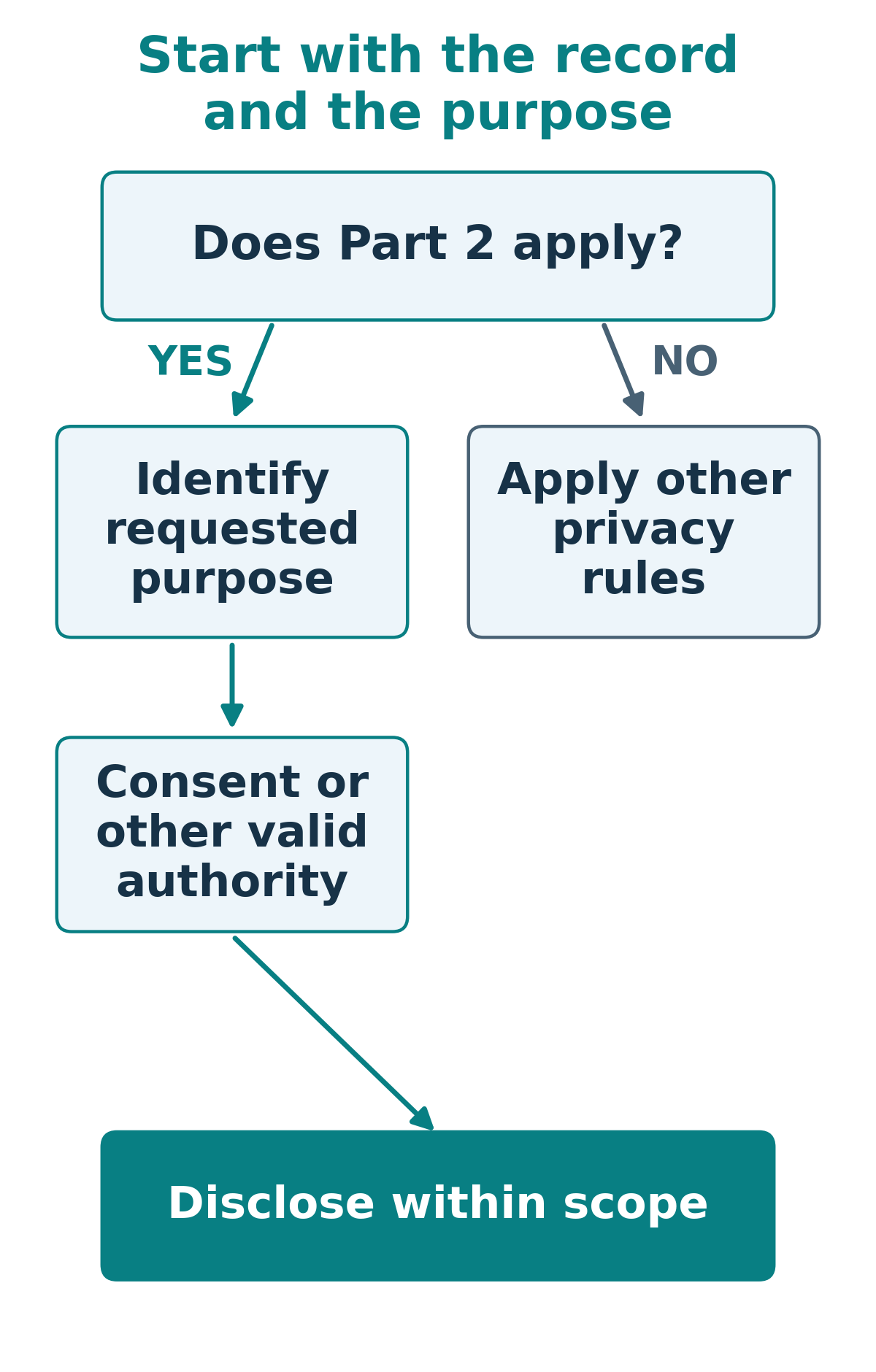
Part 2 protects covered records relating to substance-use-disorder diagnosis, treatment, or referral maintained in connection with a covered program. It does not automatically attach to every mention of substance use in every clinical record. The organization must evaluate program status, the record’s origin, and the applicable provisions. HIPAA, state confidentiality law, minor-consent rules, and other requirements may apply alongside Part 2. 1
Under the final rule, a patient may give a single consent for future treatment, payment, and health-care-operations uses and disclosures. A HIPAA-covered entity or business associate receiving records under that consent may redisclose them as permitted by HIPAA, subject to the rule’s limitations. This creates a more usable route for care coordination, but not an unrestricted authorization. The actual consent, recipient, purpose, and legal conditions remain necessary parts of the decision. 1,2
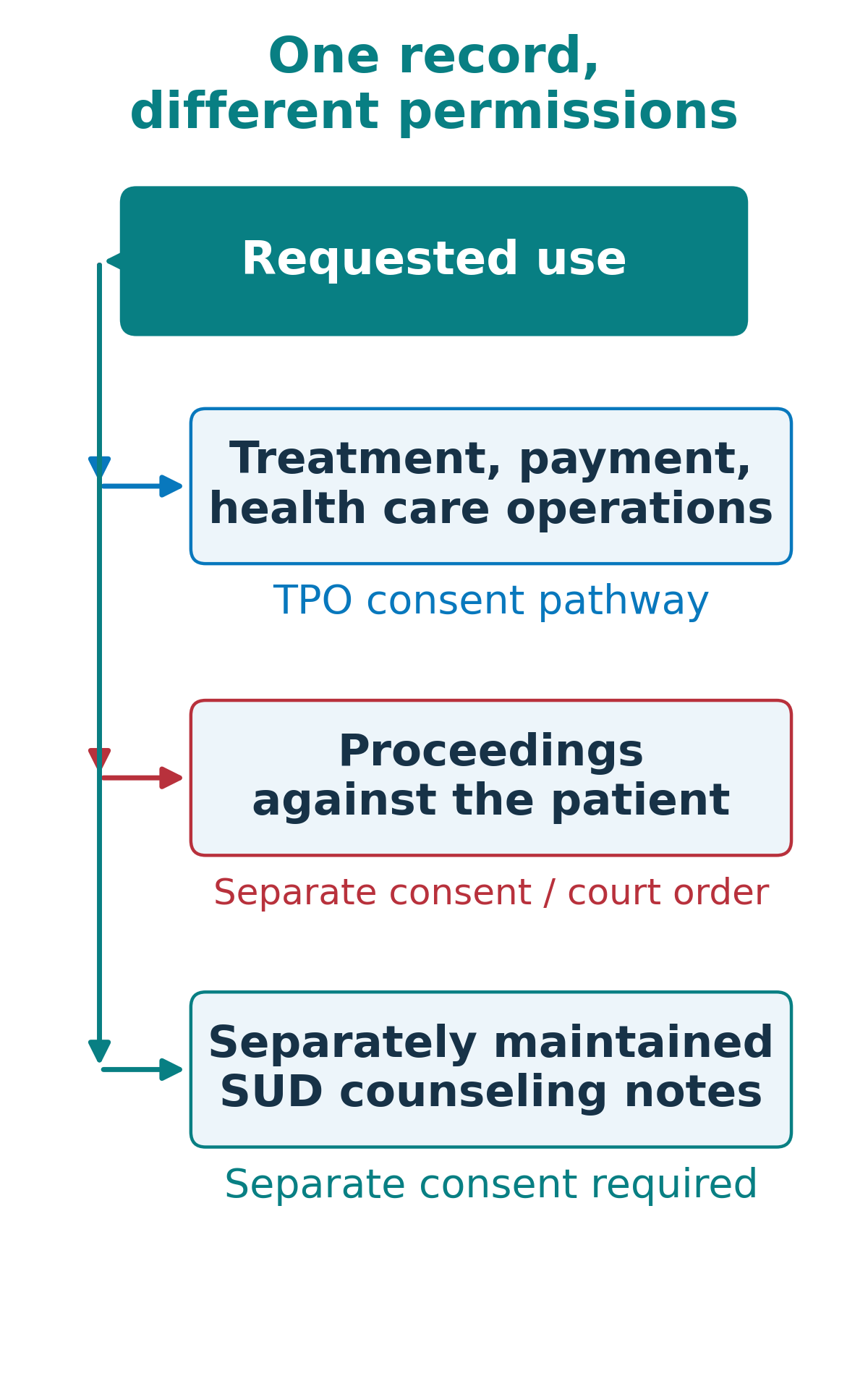
The restrictions on using records in civil, criminal, administrative, or legislative proceedings against the patient remain especially important. A routine treatment, payment, and operations consent is not a universal release for those proceedings. Separately maintained substance-use-disorder counseling notes receive distinct consent treatment. Requests involving these categories should follow a designated review route rather than the ordinary release queue. 1,2
Translate the 2026 transition into permissions
The February 16, 2026 compliance date required organizations to align policies and practice with the final rule. Review consent language, notices, redisclosure handling, breach response, staff instructions, and vendor configurations together. A revised form is incomplete implementation if the portal, interface, or downstream recipient continues to operate under an incompatible assumption. 1,2
The final rule does not require technical segregation of every Part 2 record. That does not remove the need to honor purpose and access restrictions. Hospitals should select controls that reliably enforce the applicable rules in their own systems. They should also distinguish requirements that are operative from provisions whose implementation is tied to later HIPAA rulemaking, including the relevant accounting-of-disclosures transition. 1,2
Map each disclosure pathway with an ordinary example: an emergency clinician seeking treatment information, a health plan requesting payment support, a patient authorizing a family member, or a legal demand naming the patient. Identify the authority, decision maker, information released, recipient, and record retained. The same data field can require a different decision in each pathway. A shared interface should not erase those differences.
What patients and implementation studies tell us
Patients do not share one privacy preference
Recent patient studies provide a more nuanced account than the assumption that people with substance use disorders uniformly oppose information sharing. A qualitative study of patient perspectives described benefits of sharing alongside stigma and gaps in awareness. A survey of 357 Arizona patients found that willingness to share depended on recipient, purpose, trust, and other circumstances. These findings support a conversation that explains the proposed disclosure in concrete terms. A form can record a choice without showing that the patient understood who would receive the record or how it could be used.4,5
Historical implementation barriers remain useful, but are not current law
A 2022 scoping review found that the then-available substance-use data-sharing literature consisted largely of opinion, with limited empirical work and little direct patient involvement. Earlier qualitative studies described inconsistent interpretations of Part 2 and workarounds within integrated systems. A survey of treatment organizations following the CARES Act identified concerns about confidentiality, training, and implementation costs. These records explain why organizations developed fragmented practices. They must be interpreted under the law in force during each study. They do not establish the requirements of the 2024 final rule or prove that every historical barrier persists after the February 2026 compliance date.3,6,7,8
Better record capture can change the denominator
A safety-net health-system study described integrating substance-use treatment information into its electronic health record. The number of identifiable patients increased, while linkage and retention measures moved in different directions. Improved visibility can change who enters a measure and how the measure is calculated. The organization should therefore preserve definitions and cohort rules when evaluating an integration project. A rise in documented retention may reflect improved capture, clinical improvement, or both. The study supports careful measurement of integration, not a causal claim that broader record access alone improved treatment outcomes.11
The disclosure experience extends beyond the electronic record
Interviews with women seeking help during pregnancy described tensions between disclosure, stigma, and perceived consequences. Opioid-substitution treatment clients discussed privacy in pharmacy encounters, with differing preferences about service arrangements. Research involving young British Pakistani and Bangladeshi people and service staff emphasized confidentiality and cultural competence in building engagement. These findings make the physical and interpersonal environment part of the privacy program. Calling out a medication, routing a patient through a visibly labeled service, or explaining a disclosure poorly can affect trust even when electronic permissions are configured correctly.9,10,15
Collecting less data can be a concrete trust decision
Studies of sensitive location information among people who use drugs identified concerns about privacy, safety, and the accuracy or interpretation of geographic data. Rural and urban participants described different contexts for those concerns. A short study of an opioid-related location-tracking application examined user experience and privacy concerns. These are research and application settings, not tests of routine treatment consent. They nevertheless support a practical question before introducing a new data feed: what decision requires this level of detail, who can see it, and how long is it retained? The two geographic studies may include related research populations and should not be treated as fully independent national evidence.12,13,16
Adolescent access needs deliberate proxy design
A study of youth and guardians found gaps in expectations about adolescent confidentiality. A Swedish adolescent survey examined online record access and preferences for control. A US hospital-portal study identified security and privacy risks, including staff advice to share passwords rather than use appropriate proxy mechanisms. These studies support testing the adolescent, guardian, and proxy views separately. The same record can be exposed through portal access, notifications, downloads, or an account shared at home. Age, authority, and applicable state law must be evaluated for the actual patient; an adult consent workflow should not simply be copied into adolescent care.14,24,25
Control, trust, and willingness are related but distinct
Research on health-information exchange describes variation in consent preferences and disclosure decisions. A large Veterans Health Administration survey found racial differences in policy preferences. Other studies examined actual consent decisions, hypothetical patient control, perceived security, and mental-health professionals’ views. These results support transparent options and attention to unequal experiences with institutions. They do not establish that one consent model maximizes clinical benefit for every patient. Survey willingness, perceived outcomes, and actual disclosure behavior should be measured separately, especially when a proposed change broadens access to sensitive records.17,18,19,20,21
Usable explanations and granular choices deserve testing
A 2026 randomized online study in Germany tested privacy fact sheets and participants’ interaction with a simulated record-upload task. It supports testing whether clear explanations change understanding and behavior in that setting, not assuming the same effect in real treatment. Qualitative work on selective electronic-record exchange and a small study of granular privacy preferences found that desired disclosure can vary by recipient and data type. A Hong Kong survey likewise found conditional support for record sharing. The management inference is to test comprehension and workflow burden together. More choices are useful only when patients can understand them and staff can reliably honor the resulting permissions.22,23,26,27
Make consent understandable and observable
Explain who can receive the information, for what purpose, and what meaningful alternatives exist. Use examples that match the patient’s circumstances without pressuring the patient to disclose more than necessary. Check understanding with a neutral question about the expected sharing, rather than a request to repeat a legal phrase. Interpretation and accessible formats are part of making the choice usable.
Test the system with distinct roles. A patient, adult proxy, adolescent guardian, clinician, billing worker, and external recipient may receive different views. Review notifications, downloadable records, search results, interfaces, and printed output as well as the main chart. A control that protects one screen can still fail through an export or a shared password. Record the observed result of each test and the authority it is meant to implement.
Consent changes and revocations need a defined operational route. Staff should know how to record the request, determine its effect, update systems under the organization’s control, and explain any limits concerning prior lawful disclosures. Avoid promising that information already received by another organization can always be recalled. The explanation should describe the actual legal and technical position for the patient.
Govern the exception without normalizing it
A disclosure exception should have a reason, authorized reviewer, scope, and evidence record. Urgency does not justify silently converting an exception into a standing permission. Conversely, uncertainty should not become an indefinite administrative barrier to appropriate care. The escalation route should connect clinical need with privacy expertise quickly enough to support the actual decision.
Vendor and exchange agreements should make responsibilities for permissions, onward disclosure, incident reporting, access logs, and termination clear. Test how the organization retrieves its information and changes access when a relationship ends. A vendor’s statement that it supports HIPAA does not establish that every Part 2 use case is configured correctly.
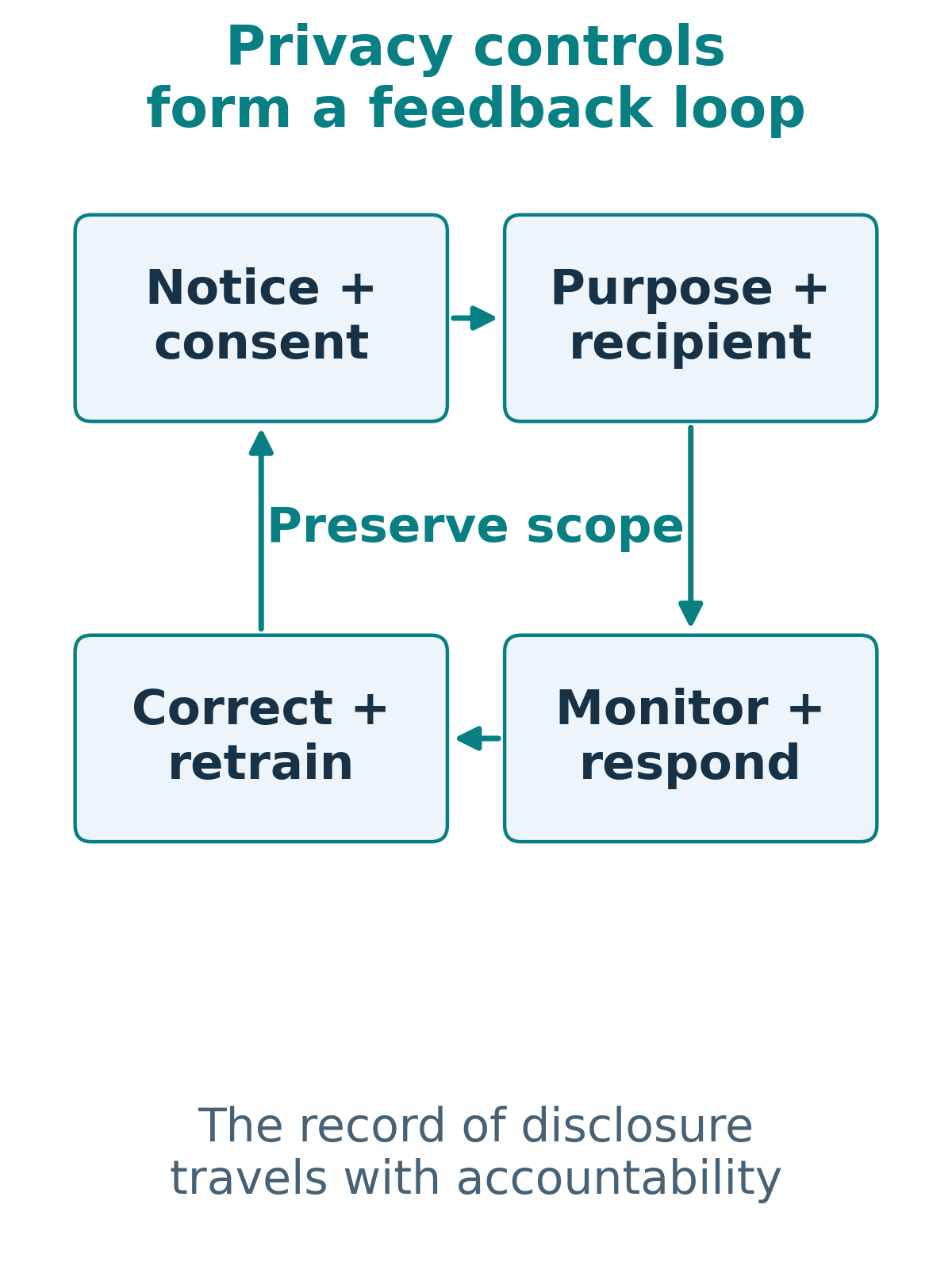
Measure both protection and access: inappropriate disclosures, unresolved permission defects, delayed legitimate requests, patient understanding, and repeated manual workarounds. Separate an actual disclosure incident from a near miss and from a patient concern that needs explanation. The board should see whether repairs reduce recurrence and whether administrative friction is falling without broadening access beyond the applicable authority.
Build a permission map before changing the interface
The following design recommendations are proposed management practices. They are not a substitute for determining which records, programs, recipients, and disclosures fall within Part 2 or another applicable law. A hospital should make those determinations with qualified privacy and legal personnel. The purpose of the operating model is to ensure that a defensible decision remains intact as information moves through ordinary work.
Begin with an inventory of the pathways through which the organization receives, creates, uses, and discloses protected information. Include the clinical record, scanned documents, interfaces, patient portals, referral systems, billing processes, telephone requests, and exported files. A policy that addresses only the main electronic record can leave important pathways unexamined. Identify the owner of each pathway and the point at which a disclosure decision is made.
For each pathway, distinguish the information’s classification from the recipient’s role and the requested purpose. A treatment request and a legal demand can arrive from the same organization while requiring different analysis. Conversely, the same legitimate purpose can involve recipients with different legal relationships to the hospital. A single “trusted partner” label is therefore an incomplete basis for deciding what to send.
Document where authority is established and how it is communicated downstream. If an interface relies on a consent status, identify the source of that status, its update process, and the consequence of an unavailable or conflicting value. If a staff member must review a request, identify the evidence available to that reviewer. The design should make uncertainty visible rather than silently translating a missing value into permission.
Use the inventory to prioritize testing. High-volume automated exchanges deserve attention because one configuration can affect many records. Infrequent but consequential pathways, such as legal demands or proxy access, also deserve deliberate review. Frequency alone is not an adequate measure of risk. A useful prioritization considers the information involved, the potential recipients, the scope of disclosure, and the difficulty of reversing an error.
Make the consent conversation usable in real care
A consent form is part of a conversation, not proof that a person understood the choice. The patient may be distressed, managing withdrawal symptoms, concerned about stigma, or focused on an immediate clinical need. Those circumstances do not support assumptions about capacity or preference; they do support designing explanations that are clear, accessible, and appropriately timed. Staff need a route for assistance when the conversation requires more time or specialized support.
Explain the practical meaning of the proposed permission. Describe the purposes covered, the relevant recipients or recipient categories as required, and the consequences of the choice under the applicable framework. Avoid promising that information can never be redisclosed if the law permits specified redisclosure. Avoid suggesting that a broad permission authorizes every future use. Accuracy about the boundaries is essential to an honest explanation.
Test understanding with an open question rather than a request to repeat a legal phrase. For example, ask the patient to describe what they expect will happen to the information and what they would do if their preference changed. This is a proposed communication technique, not a mandatory federal script. A mismatch between the patient’s expectation and the actual process should prompt clarification before the organization treats the interaction as complete.
Provide a practical route for questions, correction, and changes in permission. Explain applicable limits, including the effect of actions already taken in reliance on a valid authorization or consent where relevant. The exact legal analysis matters; staff should not improvise promises about retrieving every copy already disclosed. Record the request and route it to the personnel who can determine and implement the required response.
Evaluate language and accessibility with the people who use the materials. A form can be short yet ambiguous, or legally complete yet difficult to navigate. Consider translated materials, interpreter access, screen-reader behavior, print readability, and the experience of a person using a mobile device. Track recurring questions as evidence about the design. A high completion rate alone cannot establish that the consent process is understandable or voluntary.
Test permissions with contrasting cases
A useful test set includes both permitted and restricted pathways. Testing only successful exchanges can show that information moves, but not that boundaries hold. Use approved synthetic or otherwise appropriately controlled test records, with privacy and security oversight. Define the expected result before running the test so the team does not rationalize an unexpected disclosure after seeing it.
One illustrative case involves a treatment request supported by the applicable authority. Verify that the intended recipient receives the appropriate information through the intended channel. Check the content, attached documents, metadata, and any notifications generated by the workflow. A successful screen message is insufficient if the transmitted attachment differs from the information the reviewer believed was being sent.
A contrasting case involves a request for use in a legal proceeding. Verify that the system and staff route it for the separate analysis required by the applicable protections rather than relying automatically on a treatment, payment, and operations permission. The test should examine the escalation process as well as the final disclosure decision. Staff should be able to recognize that the purpose changed without needing to resolve complex legal questions themselves.
Another case examines a proxy account. Determine what the proxy can view, which messages or notifications they receive, and whether a change in access is reflected consistently. Do not assume that hiding a note from one screen removes it from every summary, download, or notification. Adolescent and other proxy arrangements require their own applicable legal analysis; one adult-patient configuration should not be generalized to every relationship.
Finally, test a changed or withdrawn permission and an unavailable consent record. Observe how the relevant workflows respond, what staff can see, and whether the request reaches a person authorized to resolve the uncertainty. Record any lag between systems and assess its implications. The goal is to understand the actual behavior under defined conditions, not to claim that a small test set proves universal compliance.
Investigate a disclosure without expanding it
When a possible inappropriate disclosure is reported, preserve the evidence needed for assessment while limiting further unnecessary access. Identify what information may have moved, to whom, through which channel, and under what asserted authority. Qualified privacy and legal personnel should determine the applicable incident and breach obligations. An initial report is a signal for evaluation, not by itself a final legal conclusion.
Assign an incident owner and preserve the relevant versions of the request, consent, configuration, and transmission record. A screenshot of the current interface may not establish what happened before a setting changed. Where appropriate, retain the evidence that explains the system’s behavior at the time. Follow the organization’s approved evidence-handling and security practices rather than distributing sensitive records broadly for informal troubleshooting.
Containment and correction should address the actual pathway. If an automated interface is implicated, determine whether the issue affects a defined set of transactions or a broader population. If a manual process failed, examine the instructions, available evidence, workload, and escalation route. Avoid reducing every incident to “retraining needed” before understanding the mechanism. Equally, do not assume that replacing software resolves a decision process that remains unclear.
Communication with the affected person should follow the applicable obligations and the facts established through review. Use accurate, understandable language about what is known, what remains under investigation, and what action is being taken. Do not promise that every recipient has deleted information unless that result has been established. Trust depends partly on the organization’s willingness to describe uncertainty honestly while continuing the work.
After correction, repeat the relevant test and examine adjacent pathways that share the same cause. A repaired portal setting may leave an export pathway unchanged. Document the scope of the retest and its limitations. The incident can then inform prevention without turning the patient’s record into a widely circulated teaching example. Learning should use the minimum information needed for the purpose and follow appropriate privacy safeguards.
Measure trustworthiness without measuring surveillance
A useful dashboard can focus on the reliability of the organization’s decisions: requests with an identified purpose, exceptions resolved through the designated route, permission changes implemented correctly, and recurring defects after closure. Define the populations and denominators before reporting percentages. These are proposed internal measures, not statutory performance thresholds or a substitute for required compliance activities.
Patient experience deserves a separate place. Ask whether people understood the explanation, knew whom to contact, and felt their questions were answered respectfully. Avoid treating willingness to share as the desired outcome in every case. A well-informed patient may decline a permission that the organization hoped to obtain. The quality of the process should not be judged solely by whether it produces more data sharing.
Consider the privacy implications of the measurement itself. Collecting detailed information about sensitive concerns can create another record requiring protection. Determine what is necessary for improvement, who needs access, and how results will be aggregated or otherwise handled. A dashboard intended to demonstrate trust should not quietly create a broader surveillance process than the improvement question requires.
Leadership should review unresolved tradeoffs explicitly. A more restrictive configuration may impede an appropriate exchange; a more permissive configuration may expose information beyond the applicable authority. The right response requires legal analysis, clinical understanding, patient perspectives, and technical testing. Document the decision and its rationale, then reassess it when the law, workflow, or system changes. This is how a privacy policy becomes a maintained operating capability.
Keep the permission model current after a system change
A successful implementation test describes a particular configuration at a particular time. A software update, new interface, merger, or revised service arrangement can change that configuration. Include privacy review in the relevant change process and identify which permission tests should be repeated before release. The scope should reflect the change: a new document-export function calls for different checks from a revised consent explanation. Preserve the expected behavior and test result so the organization can distinguish an intentional design change from an unnoticed regression.
Give operational staff a clear route to report behavior that differs from the approved design. A clinician who notices unexpected proxy visibility or a records employee who sees an unfamiliar recipient category may detect a problem before a scheduled audit. Evaluate those reports without assuming that the interface is correct because it recently passed testing. Connect confirmed defects to the change register and correction process. Over time, this creates a practical history of which changes affected permissions and how the organization responded. It also helps new personnel understand why a restriction exists instead of removing it as an unexplained inconvenience during the next implementation project.
Review printed and spoken communication alongside digital controls. A carefully configured portal does not govern a fax cover sheet, a voicemail, a mailed envelope, or a conversation at a shared registration desk. Determine which ordinary communications can reveal sensitive information and what approved practices apply. Use realistic examples in staff education without exposing an actual patient’s record. The aim is not to prevent necessary communication, but to ensure that staff recognize the recipient, purpose, and channel before sharing information. When a patient expresses a communication preference, route and implement it through the applicable process rather than leaving it in an isolated note that other teams cannot see. Check whether the preference reaches the relevant scheduling, billing, and clinical workflows. This review connects the legal permission model to the everyday interactions through which a person experiences privacy and decides whether the organization is trustworthy.
Evidence boundaries and executive conclusion
This targeted narrative review uses verified bibliographic records and indexed abstracts, with primary federal sources checked through September 28, 2026. It is not a systematic review or a full-text appraisal of every study. Much of the empirical literature is qualitative, regional, historical, or drawn from non-US systems. Preferences and willingness to share are not equivalent to clinical benefit, lawful authority, or actual disclosure behavior.
The durable operating question is specific: may this recipient receive this record for this purpose, and can the organization explain and enforce that decision? Answering it reliably supports both continuity of care and the trust on which treatment depends.
References
- 42 CFR part 2. Confidentiality of substance use disorder patient records. Accessed September 14, 2026. Official source.
- HHS. Fact sheet: 42 CFR part 2 final rule. Accessed September 14, 2026. Official source.
- Karway, George; Ivanova, Julia; Bhowmik, Anweysha; Murcko, Anita; Saks, Michael; McCarty, Dennis; Campbell, Aimee; Grando, Maria Adela. Recommendations to Inform Substance Use Disorder Data Sharing Research: Scoping Review and Thematic Analysis. Journal of Addiction Medicine (J ADDICT MED), May/Jun2022; 16(3): 261-271. (11p) doi:10.1097/ADM.0000000000000893.
- Aluri, James; Gurule, Evelyn; Siddiqi, Tulha Dobler; Upson, Camryn R.; D’Sa, Adam; Strain, Eric C.; Antoine, Denis G. Privacy, Care-seeking, and Stigma: A Qualitative Investigation of Patient Perspectives on Sharing Substance Use Disorder Treatment Records. Journal of Addiction Medicine (J ADDICT MED), Sep/Oct2025; 19(5): 591-598. (8p) doi:10.1097/ADM.0000000000001460.
- Wei M, Todd M, Campbell ANC, Chern D, Lott E, Whitfield MJ, Stavros N, Greenberg E, Grando A. Balancing Privacy, Trust, and Equity: Patient Perspectives on Substance Use Disorder Data Sharing. International journal of environmental research and public health [Int J Environ Res Public Health] 2025 Apr 15; Vol. 22 (4). doi:10.3390/ijerph22040617.
- McCarty, Dennis; Rieckmann, Traci; Baker, Robin L.; McConnell, K. John. The Perceived Impact of 42 CFR Part 2 on Coordination and Integration of Care: A Qualitative Analysis. Psychiatric Services (PSYCHIATR SERV), Mar2017; 68(3): 245-249. (5p) doi:10.1176/appi.ps.201600138.
- Campbell, Aimee N.C.; McCarty, Dennis; Rieckmann, Traci; McNeely, Jennifer; Rotrosen, John; Wu, Li-tzy; Bart, Gavin. Interpretation and integration of the federal substance use privacy protection rule in integrated health systems: A qualitative analysis. Journal of Substance Abuse Treatment (J SUBST ABUSE TREAT), Feb2019; 97: 41-46. (6p) doi:10.1016/j.jsat.2018.11.005.
- Ivanova, Julia; Saks, Michael; Karway, George; Murcko, Anita; Espino, Candy; Millea, Chase; Soliz, Melissa; Grando, Adela. Perceptions and Concerns of SUD Treatment Organizations Regarding the CARES Act’s Alterations to Patient Confidentiality Regulations. Perspectives in Health Information Management. 2022;19(Spring):1b. Journal record.
- Le, Phuong-Phi; Braunack-Mayer, Annette. Perspectives on privacy in the pharmacy: The views of opioid substitution treatment clients. Research in Social & Administrative Pharmacy (RES SOCIAL ADM PHARM), Aug2019; 15(8): 1021-1026. (6p) doi:10.1016/j.sapharm.2019.02.003.
- Paris R, Herriott AL, Maru M, Hacking SE, Sommer AR. Secrecy Versus Disclosure: Women with Substance Use Disorders Share Experiences in Help Seeking During Pregnancy. Maternal and child health journal [Matern Child Health J] 2020 Nov; Vol. 24 (11), pp. 1396-1403. doi:10.1007/s10995-020-03006-1.
- Tillman AR, Bacon E, Bender B, McEwen D, Blum J, Hoag M, Scott KA, Everhart R, Hanratty R, Podewils LJ, Close C, Mills J, Davidson AJ. Using 42 CFR part 2 revisions to integrate substance use disorder treatment information into electronic health records at a safety net health system. Addiction science & clinical practice [Addict Sci Clin Pract] 2024 Jun 07; Vol. 19 (1), pp. 48. doi:10.1186/s13722-024-00477-3.
- Rudolph AE, Young AM, Havens JR. A rural/urban comparison of privacy and confidentiality concerns associated with providing sensitive location information in epidemiologic research involving persons who use drugs. Addictive behaviors [Addict Behav] 2017 Nov; Vol. 74, pp. 106-111. doi:10.1016/j.addbeh.2017.06.006.
- Rudolph AE, Young AM, Havens JR. Privacy, Confidentiality, and Safety Considerations for Conducting Geographic Momentary Assessment Studies Among Persons Who Use Drugs and Men Who Have Sex with Men. Journal of urban health : bulletin of the New York Academy of Medicine [J Urban Health] 2020 Apr; Vol. 97 (2), pp. 306-316. doi:10.1007/s11524-018-0315-x.
- Bogart, Amanda R.; Richards, Molly; Sheeder, Jeanelle. Youth and Guardian Expectations of Privacy in Adolescent Health Care. Journal of Adolescent Health (J ADOLESC HEALTH), Nov2024; 75(5): 737-742. (6p) doi:10.1016/j.jadohealth.2024.03.016.
- Gray, Paul; Ralphs, Rob. Confidentiality and cultural competence? The realities of engaging young British Pakistanis and Bangladeshis into substance use services. Drugs: Education, Prevention & Policy (DRUGS EDUC PREV POLICY), Apr2019; 26(2): 133-139. (7p) doi:10.1080/09687637.2017.1398714.
- Hassani, Maryam; Young, Sean D. An Evaluation of the User Experience and Privacy Concerns of Individuals Misusing Opioids Using a Location Tracking Mobile Application. Substance Use & Misuse (SUBST USE MISUSE), 2024; 59(3): 336-342. (7p) doi:10.1080/10826084.2023.2270583.
- Ivanova, Julia; Grando, Adela; Murcko, Anita; Saks, Michael; Whitfield, Mary Jo; Dye, Christy; Chern, Darwyn. Mental health professionals’ perceptions on patients control of data sharing. Health Informatics Journal (HEALTH INFORM J), Sep2020; 26(3): 2011-2029. (19p) doi:10.1177/1460458219893845.
- Turvey CL, Klein DM, Nazi KM, Haidary ST, Bouhaddou O, Hsing N, Donahue M. Racial differences in patient consent policy preferences for electronic health information exchange. Journal of the American Medical Informatics Association : JAMIA [J Am Med Inform Assoc] 2020 May 01; Vol. 27 (5), pp. 717-725. doi:10.1093/jamia/ocaa012.
- Yaraghi, Niam; Sharman, Raj; Gopal, Ram; Singh, Ranjit; Ramesh, R. Drivers of information disclosure on health information exchange platforms: insights from an exploratory empirical study. Journal of the American Medical Informatics Association (J AM MED INFORM ASSOC), Nov2015; 22(6): 1183-1186. (4p) doi:10.1093/jamia/ocv086.
- Abdelhamid, Mohamed. Greater patient health information control to improve the sustainability of health information exchanges. Journal of Biomedical Informatics (J BIOMED INFORM), Jul2018; 83: 150-158. (9p) doi:10.1016/j.jbi.2018.06.002.
- Kisekka, Victoria; Giboney, Justin Scott. The Effectiveness of Health Care Information Technologies: Evaluation of Trust, Security Beliefs, and Privacy as Determinants of Health Care Outcomes. Journal of Medical Internet Research (J MED INTERNET RES), Apr2018; 20(4): 1-1. (1p) doi:10.2196/jmir.9014.
- von Kalckreuth N, Feufel MA. Privacy Fact Sheets for Mitigating Disease-Related Privacy Concerns and Facilitating Equal Access to the Electronic Health Record: Randomized Controlled Trial. JMIR human factors [JMIR Hum Factors] 2026 Jan 15; Vol. 13, pp. e71124. doi:10.2196/71124.
- Alaqra AS, Fischer-Hübner S, Framner E. Enhancing Privacy Controls for Patients via a Selective Authentic Electronic Health Record Exchange Service: Qualitative Study of Perspectives by Medical Professionals and Patients. Journal of medical Internet research [J Med Internet Res] 2018 Dec 21; Vol. 20 (12), pp. e10954. doi:10.2196/10954.
- Latulipe C, Mazumder SF, Wilson RKW, Talton JW, Bertoni AG, Quandt SA, Arcury TA, Miller DP Jr. Security and Privacy Risks Associated With Adult Patient Portal Accounts in US Hospitals. JAMA internal medicine [JAMA Intern Med] 2020 Jun 01; Vol. 180 (6), pp. 845-849. doi:10.1001/jamainternmed.2020.0515.
- Hagström, Josefin; Åhlfeldt, Rose-Mharie; Blease, Charlotte; Cajander, Åsa; Rexhepi, Hanife; Moll, Jonas; Kane, Bridget; Scandurra, Isabella; Hägglund, Maria. Security and Privacy of Online Record Access: A Survey of Adolescents’ Views and Experiences in Sweden. Journal of Adolescent Health (J ADOLESC HEALTH), Nov2024; 75(5): 730-736. (7p) doi:10.1016/j.jadohealth.2023.12.027.
- Caine K, Hanania R. Patients want granular privacy control over health information in electronic medical records. Journal of the American Medical Informatics Association (J AM MED INFORM ASSOC), Jan2013; 20(1): 7-15. (9p) doi:10.1136/amiajnl-2012-001023.
- Ong R. Factors affecting patient and public perceptions of the adoption of electronic health record sharing: A Hong Kong study. International journal of medical informatics [Int J Med Inform] 2023 Oct; Vol. 178, pp. 105193. doi:10.1016/j.ijmedinf.2023.105193.