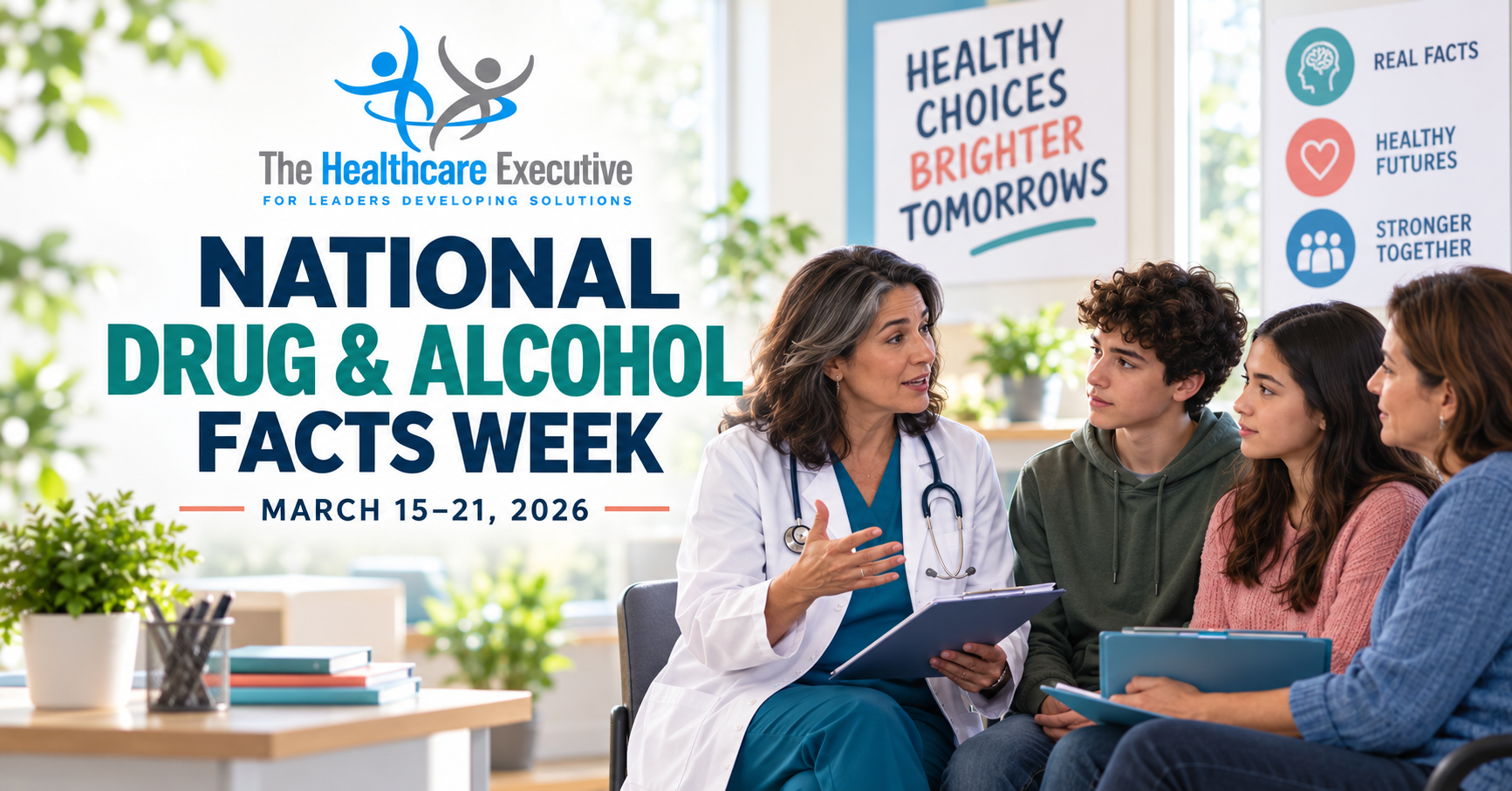


National Drug and Alcohol Facts Week 2026
Use verified science now, while the official federal campaign remains paused.
The facts still matter when the federal campaign is paused.
National Drug and Alcohol Facts Week has traditionally been a National Institute on Drug Abuse observance focused on the science of drug use and addiction among young people. NIDA’s own page now states that the observance “is currently paused,” after thanking participants in the 2025 week. The calendar still marks March 15 to 21, 2026, but health systems should not wait for an official toolkit to do the underlying work: give young people and families accurate, science-based information.
The latest national survey data offer both reassurance and a caution. NIDA reported in December 2025 that Monitoring the Future, based on 23,726 surveys from students in 270 schools, found use of most substances among U.S. teens hovering around the low levels reached in 2021. Yet 41% of 12th graders reported alcohol use in the past 12 months and 20% reported nicotine vaping. Low is not the same as absent, and many teens still need timely, credible answers.
Health systems are well placed to provide those answers. Pediatric, adolescent, primary care, emergency, and behavioral health teams see young people and families at moments when a direct, respectful conversation can matter. The operating question is whether clinicians have a consistent way to ask what matters, share verified information, and connect people to support, rather than relying on individual confidence or a one-week campaign.
Stigma is an operational barrier, not only a communication problem. When young people or parents expect judgment, they share less and seek help later. Leaders can reduce that risk by standardizing respectful language in patient materials and clinical notes, training staff to explain risks without moralizing, and making sure confidentiality practices are clear and consistently applied within local policy and law.
The final link is support. Information without a route to help leaves families stranded. A reliable program connects screening and education to behavioral health services, community partners, and emergency response, including overdose recognition and naloxone access. With the federal observance paused, the systems that keep this route open and measured will be the ones that keep the science reaching young people.
Keep science-based substance use education and routes to support active for young people and families, with a named owner, regardless of the status of the federal observance.
NIDA reports that Monitoring the Future 2025 found 91% of eighth graders, 82% of 10th graders, and 66% of 12th graders abstained from marijuana, alcohol, and nicotine in the past 30 days.
NIDA reports that 11% of eighth graders, 24% of 10th graders, and 41% of 12th graders reported alcohol use in the past 12 months in 2025.
NIDA reports that 9% of eighth graders, 14% of 10th graders, and 20% of 12th graders reported nicotine vaping in the past 12 months in 2025.
Figures are summarized from the authoritative sources linked below. Definitions and denominators should be read with each source.
Build one route from question to support.
Substance use conversations with young people work best when every clinician follows the same simple route.
-
Ask what matters
Use a locally approved, age-appropriate approach to ask young people about substance use and what they want to know.
-
Verify the science
Draw information from NIDA, CDC, and other authoritative sources, and review patient materials regularly for accuracy.
-
Explain without stigma
Share facts in plain, respectful language that avoids judgment and respects confidentiality under local policy and law.
-
Connect to support
Give every clinician a clear referral route to behavioral health and community services, and share overdose response information.
Reliability rule: Every young person identified as needing support should leave with a documented next step and a named contact.
Measure reach, accuracy, and connection.
These instruments are local management prompts; clinical screening criteria remain with the organization’s own protocols.
Screening reach
Track whether adolescent visits include an age-appropriate substance use conversation.
Referral completion
Track whether young people referred for support are actually seen.
Material accuracy
Track whether patient-facing substance use materials have been reviewed against current authoritative sources.
Naloxone access
Track whether families at risk leave with overdose response information and access to naloxone.
Protect the handoffs where young people drop out.
Substance use support often crosses clinical, school, and community boundaries.
From primary care or pediatrics to behavioral health
- Send the reason for referral and what the young person agreed to share.
- Confirm consent and confidentiality expectations under local policy.
- Name who will follow up if the first appointment is missed.
From emergency care to follow-up support
- Document the reason for the visit and any overdose response given.
- Provide naloxone education and a follow-up contact before discharge.
- Notify the primary care or behavioral health team of the visit.
From health system to school and community partners
- Share verified educational materials, not individual patient information.
- Agree how partners refer young people into care.
- Review the partnership together at least once a year.
Confidentiality rules for adolescents vary, so every handoff should follow the organization’s own legal and privacy guidance.
Give the board four questions it can repeat.
A short scorecard keeps youth substance use education and support visible while the federal campaign is paused.
| Signal | Executive question | Accountable owner | Review cadence |
|---|---|---|---|
| Reach | Are we asking young people about substance use in the right visits? | Pediatric and primary care leaders | Quarterly |
| Accuracy | Are our patient materials current with authoritative science? | Behavioral health and patient education leaders | Quarterly |
| Connection | Are referred young people seen promptly by behavioral health? | Behavioral health access leaders | Monthly |
| Safety | Are families at risk leaving with overdose response information? | Emergency and pharmacy leaders | Monthly |
Run a 90-day facts-to-support sprint.
The March calendar date remains a practical anchor even while NIDA’s observance is paused.
Start by reviewing the substance use materials and screening practices already in use for young people. Replace anything outdated with current authoritative sources. Map the referral route from first conversation to support and fix the weakest link. Report the measured change to executive leadership at the end of the cycle.
Days 1–30: Review
- Inventory patient materials and check them against current NIDA and CDC sources.
- Map adolescent screening and referral routes.
- Name an executive sponsor and a behavioral health lead.
Days 31–60: Standardize
- Adopt one respectful-language standard for materials and notes.
- Agree one referral route from primary care to behavioral health.
- Confirm overdose response and naloxone education in emergency discharge.
Days 61–90: Measure
- Report screening reach and referral completion.
- Share updated materials with school and community partners.
- Agree next steps and owners for the coming year.
Verified science should not wait for a campaign.
National Drug and Alcohol Facts Week 2026 falls while NIDA’s observance is paused; health systems can still keep accurate, stigma-free information and routes to support reaching young people and families.
Turn National Drug and Alcohol Facts Week into accountable action.
Use verified science now, while the official federal campaign remains paused.
Leadership focus
Use verified science now: ask what matters, verify the science, explain without stigma, and connect to support.
Workforce lens
Equip pediatric, primary care, emergency, and behavioral health teams with current authoritative materials and training in respectful, stigma-free conversation.
Patient and community lens
Give young people and families accurate, plain-language information, clear confidentiality expectations, and a named route to support.
Equity and access lens
Check whether language, cost, transportation, and behavioral health capacity affect which young people receive education and timely support.
Inspect the operating sequence
NIDA states that National Drug and Alcohol Facts Week is currently paused. Recent survey data show teen substance use remains low, but many young people still use alcohol or nicotine. Our task is to keep accurate science and routes to support available year-round.
- 01Ask what matters
- 02Verify the science
- 03Explain without stigma
- 04Connect to support
Leadership actions for this week
- Name an executive sponsor and frontline operating owner.
- Ask people using and operating the pathway where ownership becomes unclear.
- Test one representative route from first question to acknowledged next step.
- Select one barrier that can be corrected without overstating the evidence.
- Set a review date and define how completion will be verified.
Candidate measures
Define every numerator, denominator where relevant, owner, data source, exclusions, cadence, and limitation locally. These are management prompts, not external benchmarks.
- Share of eligible adolescent visits with a documented substance use screen
- Median days from referral to first behavioral health contact
- Share of patient materials reviewed within the locally defined review period
Department readiness checklist
- The public and staff entry points match the actual approved process.
- A specific role accepts each request, referral, or escalation.
- Handoffs include acknowledgment and a visible unresolved state.
- Language, disability, digital, transportation, and trust barriers receive explicit review.
- Communications do not introduce unsupported themes, statistics, or clinical advice.
- A named leader will review what changed after the observance.
Intended audiences
- Executive and Operational Leaders
- Public Health and Community Partners
- Patient Experience and Access Leaders
Staff communication template
During National Drug and Alcohol Facts Week, our organization will review our youth substance use materials, screening practices, and referral routes. Please share where information is outdated or where young people and families struggle to reach support.
Community communication template
Accurate information about drugs and alcohol helps young people make healthy choices. We encourage families to use trusted science-based sources and to talk with their health care provider about any concerns.
Measurement worksheet
- Signal
- What observable condition will show whether the route works?
- Definition
- What is included, excluded, and counted?
- Owner
- Who reviews the signal and acts on exceptions?
- Cadence
- When will leaders review it?
- Equity check
- Which differences require protected, locally appropriate review?
- Closure
- What evidence will confirm the improvement was completed?
Authoritative resources
- National Drug and Alcohol Facts Week (NDAFW), National Institute on Drug Abuse
- Reported use of most drugs remains low among U.S. teens, National Institute on Drug Abuse
- What to Do If You Think Someone Is Overdosing, CDC
Safety note: CDC lists signs of overdose including unconsciousness or inability to awaken, slow or shallow breathing, discolored skin, and pinpoint pupils, and advises giving naloxone if available, calling 911, keeping the person awake and breathing, laying them on their side, and staying with them until help arrives.
Verification note: NIDA’s National Drug and Alcohol Facts Week page states “Thank you for participating in NDAFW 2025. NDAFW is currently paused.” No 2026 dates, theme, or registration were found on NIDA’s site, and no discontinuation or renaming was stated; the March 15–21, 2026 date is the calendar’s placement.