

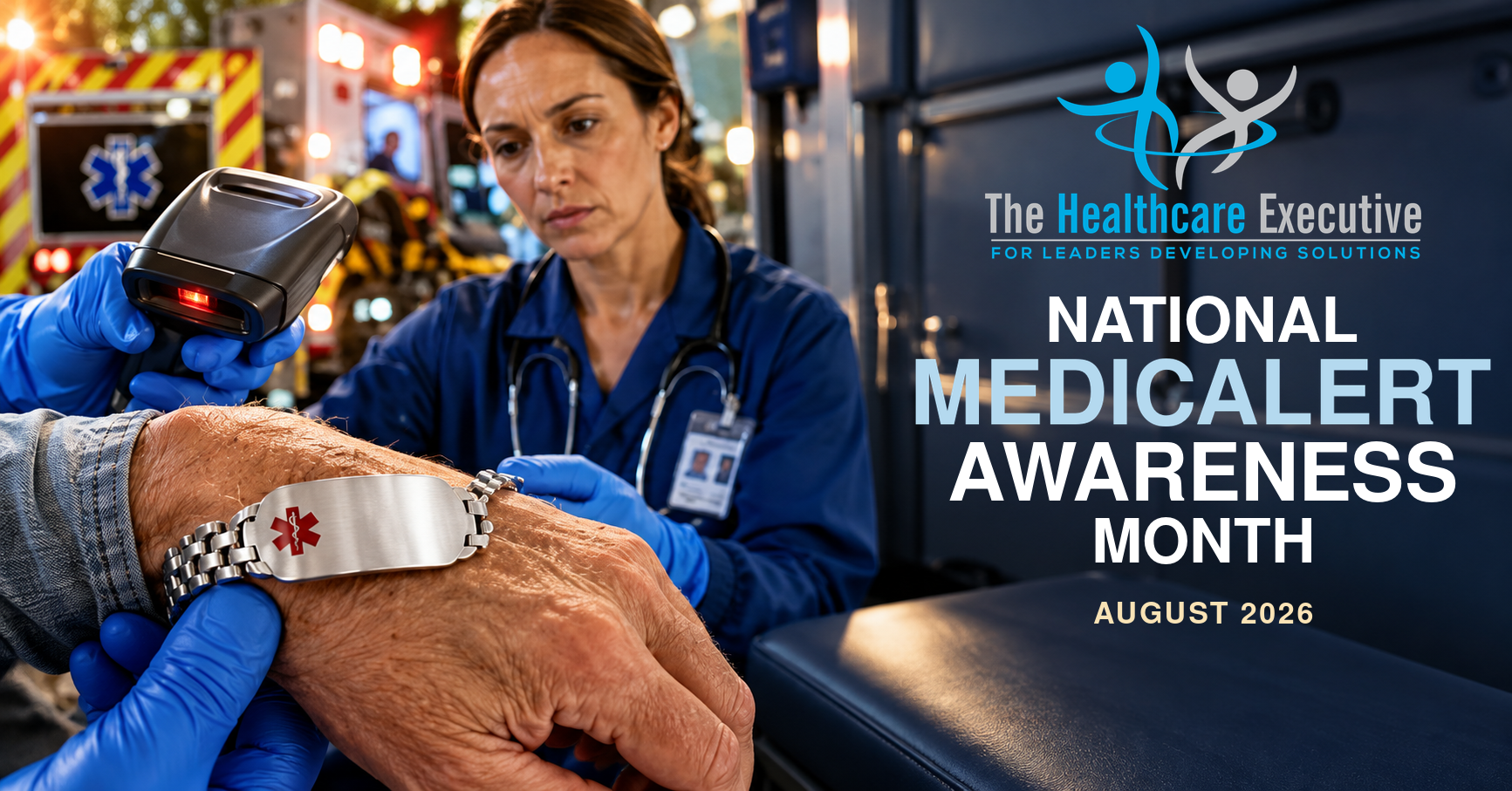
August 1–31, 2026 · Executive evidence brief
National MedicAlert Awareness Month 2026
Treat medical identification as the first visible signal in a larger emergency-information system that must be findable, current, interpretable, secure, and connected to accountable action.
The MedicAlert Foundation identifies August as National MedicAlert Awareness Month. This brief uses the official source only for the observance name, timing, and general awareness purpose. It does not adopt a commercial claim or imply that one product, device, database, or vendor can guarantee an emergency outcome.
Leadership mandate
Make the emergency-information chain observable before a crisis tests it
National MedicAlert Awareness Month creates a practical reason to inspect what happens when a person cannot provide a complete history, when a caregiver is not present, or when time, location, and uncertainty narrow the margin for error. The visible identifier may be a bracelet, necklace, card, phone emergency screen, wallet document, or other patient-held signal. The operating question is larger: can the people responding to the emergency recognize the signal, locate the supporting information, judge its currency, reconcile it with other sources, and translate it into an appropriate next action?
Healthcare organizations should not define success as distributing an item or publishing a reminder. Distribution measures reach, not reliability. A safer system makes five conditions visible. The information must be discoverable at the moment it is needed, accessible under realistic permissions and downtime conditions, current enough to support reconciliation, interpretable by the receiving professional, and connected to a documented action, escalation, or unresolved state.
These conditions matter because the emergency record is rarely one record. Medication information may differ across the patient, caregiver, pharmacy, EHR, transfer document, specialist, and health information exchange. Allergy information may be incomplete or classified inconsistently. A patient may have an advance directive that is not available in the emergency department. A specialty plan may exist but be difficult to locate. A device may reveal a condition without explaining the current treatment plan. Good design does not conceal these differences. It identifies the conflict, names the source, assigns reconciliation, and keeps uncertainty visible.
A 2024 systematic review found a sharp difference between having documented patient wishes and having them available in the emergency department. Across the general adult studies, 19.9% to 27.8% reported some form of documentation, but availability on presentation was 6.8% or less. Rates varied widely in geriatric populations, and overall availability usually remained below half.10 The lesson extends beyond directives: information that exists somewhere is not necessarily information that can support a time-sensitive decision.
Executive decision
Choose one emergency-information pathway and test the full chain from visible signal to verified follow-through. Do not count possession of an identifier as proof that the system works.
Evidence signal
Combine identification with reconciliation, workflow, and learning
The current evidence does not support a single-device solution. The stronger operating signal is that outcomes and data quality depend on coordinated work across roles and settings. A 2026 systematic review and meta-analysis of 19 randomized trials grouped medication-management strategies at admission into reconciliation, supported review, collaborative review, partnered pharmacist medication charting, and real-time information-exchange tools. Medication reconciliation alone showed limited effectiveness for medication errors and adverse drug events, while combined strategies were more effective. The review did not find significant improvement in mortality, readmissions, emergency visits, or length of stay across the reported secondary outcomes.1 A visible identifier should therefore be treated as a trigger for a coordinated process, not a substitute for one.
A 2023 emergency observation-unit study offers a useful but limited example. Thirty-day emergency revisits were observed in 19.1% of the historical no-pharmacist group and 9.9% of the pharmacist group. Sixty-day and 90-day revisits were also lower in the pharmacist period.11 This was a retrospective before-and-after comparison, so the difference cannot be assigned solely to medication reconciliation or the pharmacist. It is nevertheless a strong management signal that dedicated reconciliation capacity belongs inside emergency-flow design.
| Study period | Observed 30-day ED revisits | Interpretive limit |
|---|---|---|
| Historical no-pharmacist group | 19.1% | Single-center retrospective comparison across different years; other changes may have influenced results. |
| Clinical pharmacist period | 9.9% |
Direct studies of patient-held alerts show feasibility and perceived value, but they also show why leaders must avoid overclaiming. In a two-center study of a medical alert card for Hirschsprung-associated enterocolitis, 123 patients received a card and 76 families responded at one year. Among responders, 96% considered the card useful, 89% said they carried it, and 39% had used it on 57 occasions. When shown, respondents reported that it increased staff awareness on 83% of those occasions and prompted contact with the tertiary center on 53%.15 These are parent-reported experiences from a specialty population, not controlled outcome data.
An oxygen-alert wristband pilot reported a significant reduction in inappropriate oxygen prescribing and favorable comfort responses: 42 patients found the wristband comfortable and two did not.16 The small pilot supports recognition and workflow testing, not universal effectiveness. A three-year asplenia follow-up used a multicomponent intervention that included tailored education, medical alert cards, and telephone support. Seventy-nine of 106 participants completed follow-up, and the prevention score improved from a median of 7.60 at six months to 8.08 at three years.2 Because the intervention bundled several components and lacked a concurrent randomized comparison at follow-up, the alert card's independent effect cannot be isolated.

Emergency pathway
Define the route from first signal to closed-loop communication
The emergency-information pathway should begin before the emergency. Primary care, specialty care, pharmacy, care management, and community partners can help people determine what information may be appropriate to carry, where the source record is maintained, how updates occur, and what to do when technology is unavailable. Emergency services and receiving organizations must then design recognition and escalation into real work, not assume every clinician will notice every format.
Children with medical complexity illustrate the need for preplanning. A qualitative study of parents, emergency medical providers, and emergency departments examined Emergency Information Forms containing conditions, medications, and preplanned care recommendations. Parents and providers supported the forms, while workflows, awareness, information currency, and access remained critical design issues.12 An earlier practice review similarly argued that community providers cannot be expected to know every rare condition and described the potential value of a personalized emergency information form.17 The applicable lesson is not to copy a pediatric specialty form into every population. It is to build a governed, condition-appropriate route that responders can recognize and trust.
- Recognize the signalCheck the person, belongings, caregiver report, transfer packet, approved device or screen, and local sources under policy.
- Identify and authenticateConfirm the person and establish whether the information source is linked to the right individual.
- Retrieve and reconcileCompare the alert with the EHR, exchange, pharmacy, caregiver, specialist, and direct assessment; show conflicts.
- Interpret in contextApply current clinical guidance, symptoms, capacity, preferences, permissions, and qualified judgment.
- Act and escalateUse the approved protocol, contact the appropriate expert or surrogate, and keep unresolved risk visible.
- Document and closeRecord source, currency, decision, communication, update need, receiving owner, and acknowledgment.
Design for the uncertain and mismatched case
The highest-value simulation is not the ideal case in which every source agrees. Test a bracelet that lists an allergy while the EHR shows a different reaction; a phone screen that is locked; a QR code that depends on weak connectivity; a caregiver who presents a newer medication list than the transfer packet; a specialty alert that lacks a current contact; or a directive that exists but is not available. The system should not silently select one source. It should mark the conflict, seek the best available verification, document the limit, and route the issue to an accountable owner.
Recognition also needs a human-factors review. Identify which roles are expected to look for medical identification, at what point in the assessment, under which conditions, and how that action is documented. Review whether clothing, mobility equipment, jewelry policies, infection-control procedures, language, disability, skin tone, lighting, urgency, or competing tasks can make an identifier less visible. A process that works only during a planned demonstration is not an emergency process.
Finally, define the completion signal. Completion is not “information viewed.” It may be a reconciled medication history, an acknowledged specialty consultation, a documented allergy clarification, a validated surrogate contact, a transfer message accepted by the next team, or an unresolved issue placed into an exception queue with an owner. The completion signal should match the risk and the local pathway.
Medication and allergy reliability
Use the identifier to start reconciliation, not to end it
Medication history is a high-risk information problem because names, doses, formulations, timing, adherence, recent changes, and discontinued therapies can differ across sources. A 2025 pharmacist-led transitions cohort found that roughly one in four enrolled encounters still had a medication discrepancy identified at discharge. The proportions did not differ significantly by whether the admission history was completed within 24 hours, in the emergency department rather than an inpatient unit, or across more unit transitions.3 The finding supports reconciliation at more than one boundary and cautions against treating an admission list as permanently settled.
A Portuguese emergency-department improvement project provides another useful interpretation lesson. Structured family teleconsultation increased detected unintentional discrepancies from 4.6% in usual practice to 9.4% after usual-medication questions were built into the process.6 A higher detection rate did not mean the process created more errors. It meant the process found more existing discrepancies that could be corrected. Leaders should distinguish a safer detection system from a worsening outcome.
Resource models matter. In a multicenter retrospective study of 208 admitted patients, virtual pharmacy technicians identified 190 unintentional discrepancies. The discrepancy rate per medication was lower for virtual technicians than for other clinicians, 8.6% versus 14.8%, and incomplete histories were 6.7% versus 62.5%. Length of stay, readmissions, and emergency visits were similar.14 The study supports role design and remote capacity where appropriate, but it does not prove that one staffing model will transfer to every hospital.
Team communication can improve the quality of the information collected. A multidisciplinary emergency-department improvement project combined role education with a team huddle. Staff-reported improvement was greatest for having the correct medication, correct dose, and time last taken, with differences of 20.7, 25.6, and 24.5 percentage points respectively.9 Response rates were modest and the study emphasized staff satisfaction, so leaders should pair workflow feedback with direct audits of record accuracy and patient experience.

Treat allergy information as a governed data domain
Allergy and adverse-reaction information is especially vulnerable to fragmentation. A 2023 audit reviewed 264 patients and found 210 documented adverse drug reactions among 102 patients. Only half of the reactions had complete documentation; 30.0% lacked a reaction description, 41.9% lacked severity, and among reactions with descriptions, 66.0% were appropriately classified as allergy or intolerance.13 A label without substance, reaction, severity, date, or confidence can create both underprotection and unnecessary avoidance.
A 2025 informatics study built an allergy-reconciliation module using five mechanisms to compare information across the EHR. In a pilot with 111 primary care physicians, the mechanisms achieved F1 scores from 0.86 to 1.0 and feedback was mostly positive. Yet 56% of the pilot group did not ultimately use the module.5 Technical performance does not equal adoption. Leaders need to measure whether the right clinician sees the discrepancy, understands the recommendation, acts appropriately, and closes the correction across every relevant record.
| Information domain | Required context | Primary stewardship question | Emergency use control |
|---|---|---|---|
| Identity | Name and locally approved matching elements | How is the signal linked to the correct person? | Confirm identity before relying on linked information. |
| Condition or risk | Plain-language label, clinical context, relevant limitation | Who validates the description and retires obsolete wording? | Use as an alert to assess and verify, not as a diagnosis by itself. |
| Medication | Name, dose, route, timing, recent change, source and date | Who reconciles conflicts across patient, caregiver, pharmacy, and EHR? | Keep an unresolved state visible until appropriately reconciled. |
| Allergy or reaction | Substance, reaction, severity, timing, confidence, status | Can allergy, intolerance, side effect, and unknown reaction be distinguished? | Do not infer severity or mechanism from an incomplete label. |
| Device or treatment dependency | Device, key settings or dependency, specialty contact, backup plan | Who maintains current instructions and contact coverage? | Follow approved device and emergency procedures. |
| Preferences and legal documents | Document type, date, jurisdiction, location, surrogate or decision maker | Can the valid document be located and interpreted under local law? | Escalate uncertainty; do not reduce nuanced preferences to an unverified icon. |
| Contacts | Caregiver, surrogate, specialty team, primary care, pharmacy | Which contacts are current and available after hours? | Record attempted and successful communication and the receiving owner. |
| Source and freshness | Origin, last verification, responsible owner, update method | How does the system show stale, conflicting, or unavailable information? | Display provenance and uncertainty at the point of use. |
Preferences, access, and trust
Ensure that important information can be found without stripping away context
Emergency accessibility and privacy are not opposing goals. Both require deliberate governance. Carrying information can increase exposure if an identifier, card, or phone screen reveals more than the person expected. Restricting information too aggressively can make it unusable when the person cannot communicate. The organization should involve patients, caregivers, privacy and security leaders, emergency clinicians, disability and language-access specialists, and community partners in deciding what is visible, what requires authentication, what can be available offline, and what audit trail is appropriate.
The advance-directive evidence shows why availability must be tested. The 2024 systematic review included 22 studies from 1996 through 2021 and found that the existence and emergency availability of documentation were low in the general adult population and usually below 50% even in geriatric populations.10 A separate mixed-method intervention study reviewed 308 older emergency patients after staff education and system changes. Advance care directives were noted in 6.5% of sampled records, below the study's earlier 8%, while goals-of-care documentation increased. Staff familiarity was 25% for advance care directives and 45% for goals of care.8 Awareness activities alone did not make every document findable or usable.
A reliable pathway distinguishes several questions. Does a document exist? Is it available? Is it current and valid in the relevant jurisdiction? Does it apply to the present situation? Who is the legally recognized decision maker if capacity is absent? Has the receiving clinician acknowledged the information? The system should not compress these questions into a single “directive present” checkbox.
Build equitable access into the emergency-information design
Not everyone can purchase the same product, use a smartphone, maintain a portal account, read small engraving, access broadband, speak English, or independently update a health profile. Some people may avoid carrying visible information because of stigma, safety, employment, immigration, or privacy concerns. Others may change living arrangements, caregivers, pharmacies, or health systems frequently. A design that relies on one device or one digital route will create predictable gaps.
Offer multiple approved routes and test them with the people expected to use them. Use plain language, readable typography, qualified interpretation, accessible digital content, and non-digital alternatives. Explain what the organization can and cannot retrieve. Provide a correction route for wrong or outdated information. Ask patients and caregivers what they want a responder to know first, what they do not want displayed openly, and which source should be treated as authoritative. Respectful choice is part of reliability.
Unranked branches: identity and visibility; data quality and currency; access and permissions; workflow and ownership; interpretation and context; follow-through and learning.
Emergency-information operating system
Connect patient-held signals to verified clinical and operational sources
Emergency information should travel through a resilient network of people, processes, and systems. The person and caregiver remain central because they define preferences, experience, and many of the most current details. Emergency medical services and emergency departments need a consistent recognition and escalation process. Primary, specialty, and pharmacy teams maintain and reconcile source information. EHR and exchange teams manage identity matching, provenance, access, downtime, and correction. Executive governance sets the service promise, privacy boundary, resources, accountability, and learning cadence.
Health information exchange may support flow, but connection is not the same as reliable content. A 2025 retrospective study reviewed 452 emergency transfers involving 362 older adults. The mean number of exchanged information items was 1.33, and more exchange was weakly correlated with shorter emergency-department length of stay. There was no significant relationship with hospital length of stay or unexpected emergency revisits.4 The study supports attention to transfer information but does not establish that adding information items causes shorter stays.
Information systems also need a learning loop. In a 2024 pilot across three high-volume EMS systems, providers strongly endorsed outcome review for clinical knowledge and patient care, but only 27% of 211 intervention participants received continuing education credit after completing the required reviews and modules.7 Interest alone did not produce universal participation. Leaders should reduce access friction, protect learning time, connect feedback to real cases, and measure whether corrective action follows.
Protect against stale and unauditable information
Every portable record needs a freshness signal and an update route. “Last reviewed” is more useful when the reviewing role, source, and scope are known. A medication list may be current for long-term medicines but omit a short course. A device note may be current while the emergency contact is not. A specialty plan may remain clinically valid while a phone number has changed. Use field-level stewardship where practical rather than implying the entire profile was verified at once.
Access events should be auditable without creating a barrier that makes emergency use impossible. Define minimum necessary information, authentication appropriate to risk, emergency-access controls, after-hours support, logging, and response to suspected misuse. Test a lost identifier, a wrong-person match, a compromised QR destination, a vendor outage, a network outage, and a cyber incident. A digital route must have a safe degraded mode; a paper route must have a secure update and disposal process.
Vendor evaluation should focus on the service, not the novelty of the object. Ask how identity is matched, how records are updated, how emergency access works, how data are encrypted, what information is public, how access is logged, how users correct errors, what happens at contract termination, how data are exported, how downtime is handled, and whether the organization can test the complete workflow. Procurement should not substitute a feature demonstration for a safety case.

Measurement and governance
Measure whether the information produces a reliable response
A campaign dashboard should not reward activity while hiding reliability. Counts of cards distributed, bracelets ordered, webpages viewed, or staff trained can describe reach, but none establishes that emergency information was recognized, reconciled, or used appropriately. Pair reach with process, safety, equity, experience, and balancing measures. Define every numerator, denominator, inclusion rule, source, owner, review cadence, privacy limit, and interpretation boundary before publishing a number.
| Signal | Executive question | Candidate local measure | Interpretive caution |
|---|---|---|---|
| Recognition | Did the approved signal prompt the expected check? | Locally defined proportion of eligible audited encounters with documented recognition or reason not applicable | Documentation may understate or overstate actual behavior. |
| Availability | Could the team retrieve the supporting information in time? | Retrieval success and time by format, setting, hour, connectivity, and access route | Fast retrieval is not proof that the information is correct. |
| Currency | Was provenance and freshness visible? | Profiles or forms with defined source, last review, and accountable owner | A recent date does not validate every field. |
| Reconciliation | Were conflicts detected, assigned, and resolved? | Discrepancies by domain, source, severity, status, owner, and age | More detected discrepancies may reflect a safer detection process. |
| Action reliability | Did the signal connect to an appropriate clinical or operational response? | Locally adjudicated cases with acknowledged consultation, plan, escalation, or closure | Avoid attributing patient outcomes to one device or alert. |
| Equity and usability | Who cannot use the route as designed? | Protected testing and feedback by language, disability, technology access, setting, and relevant population | Small groups require privacy protection and careful interpretation. |
| Privacy and security | Is access appropriate and auditable? | Emergency-access events, failed matches, inappropriate access, lost identifiers, and corrective actions | Do not publish details that increase re-identification risk. |
| Learning closure | Did a problem lead to a verified system change? | Selected cases with assigned action, completion evidence, and post-change review | Meeting completion is not improvement completion. |
Use a case-review method that protects learning
Select representative cases, not only the most dramatic ones. Include a successful recognition, a missed signal, a wrong or stale record, an access failure, a medication discrepancy, a caregiver concern, a privacy question, and a handoff that did not close. Reconstruct the sequence with the people who performed the work and, when appropriate, the person or caregiver who experienced it. Separate system conditions from hindsight judgments about an individual.
For each case, record what was visible at the time, which sources were available, what conflicted, what decision was made, how uncertainty was handled, who received the next responsibility, and how closure was confirmed. Correct the pathway, training, interface, staffing, contract, or policy condition that contributed to failure. Track the corrective action until the change is observed in practice.
Evidence rule: A process measure can show that a step occurred. It does not prove that the step caused an outcome. Report design limits, competing explanations, missing data, and unintended consequences alongside every performance claim.
90-day implementation agenda
Move from awareness to one verified reliability improvement
Choose a bounded pathway where the full chain can be observed. Examples include medically complex children arriving through EMS, older adults transferred from long-term care, people with documented severe medication reactions, patients dependent on a critical device, or individuals with condition-specific emergency plans. The project boundary should identify the population, settings, information formats, source systems, clinical authority, privacy requirements, operating hours, and exclusions.
Days 1–30: define and observe
- Name the executive sponsor, clinical authority, operational owner, privacy and security lead, data owner, and patient or caregiver adviser.
- Select one emergency-information pathway and document its purpose, limits, eligible population, and source systems.
- Observe recognition, retrieval, reconciliation, escalation, documentation, and handoff during representative shifts.
- Interview people who carry identification and the teams expected to use it.
- Define a balanced baseline with denominators, data-quality checks, privacy protections, and interpretation limits.
- Choose one verified barrier that can be corrected without creating a new clinical, access, or privacy risk.
Days 31–60: co-design and simulate
- Co-design the revised route with patients, caregivers, EMS, emergency staff, pharmacy, informatics, specialty care, language access, and receiving partners.
- Clarify which information is visible, authenticated, offline, or available through emergency access.
- Simulate a mismatched person, stale medication list, incomplete allergy, missing directive, locked phone, unavailable network, and failed specialty contact.
- Test normal, after-hours, downtime, and cyber-response conditions.
- Define stop rules, escalation, correction, and acknowledgment.
- Revise the workflow before a limited launch.
Days 61–90: implement and govern
- Launch in one controlled setting with trained roles, visible owners, and active exception review.
- Monitor recognition, availability, currency, discrepancy detection, access, experience, privacy, and closure.
- Review variation by setting, operating period, language, technology access, and population when privacy and data quality allow.
- Correct failed handoffs and stale records without blaming the person who surfaced the problem.
- Report what changed, what evidence informed the decision, and what remains uncertain.
- Decide whether to sustain, adapt, expand, or stop based on safety, evidence, equity, feasibility, and experience.
Leadership commitment: Before the month closes, assign one emergency-information gap to a named owner, test the revised route under realistic conditions, and set a date to verify that the change works in practice.
Leadership close
The identifier matters most when the system around it is ready
National MedicAlert Awareness Month can raise visibility for a simple and important idea: people may need critical health information to speak for them. The executive responsibility is to make sure that a visible signal reaches a trustworthy source, that conflicting information is reconciled, that context and preferences are preserved, that access is secure and equitable, and that the response has an accountable endpoint.
The best result is not a larger collection of identifiers. It is a more reliable emergency-information service. That service recognizes uncertainty, supports people and caregivers, equips responders, connects settings, protects privacy, learns from failure, and does not claim more than the evidence can support.
Scholarly foundation
Peer-reviewed references
References are ordered newest first. Each source was individually reviewed for peer-review status, applicability, and limitations.
- Emadi T, Yiu CH, Liu S, et al. Medication management strategies at hospital admission: a systematic review and meta-analysis. Clinical and Translational Science. 2026;19(5):e70586. doi:10.1111/cts.70586
- Camp J, Heine V, Bayrhuber M, et al. Longterm efficacy of a patient focused intervention in patients with asplenia: a three year follow-up of the PrePPS trial. Infection. 2025;53(4):1449-1455. doi:10.1007/s15010-025-02472-5
- Pollak TN, Renier CM, Curley JP, Haller IV. Pharmacist-led transitions of care: a cohort study on admission medication history factors and adjustments to the discharge medication list. Hospital Pharmacy. 2025;60(3):239-244. doi:10.1177/00185787241298132
- Kim HJ, Choi S. Association between health information exchange and health outcomes in older patients transferred from long-term care to the emergency department: a retrospective review. Journal of Korean Academy of Fundamentals of Nursing. 2025;32(2):243-252. doi:10.7739/jkafn.2025.32.2.243
- Blackley SV, Lo YC, Varghese S, et al. Building an allergy reconciliation module to eliminate allergy discrepancies in electronic health records. Journal of the American Medical Informatics Association. 2025;32(4):648-655. doi:10.1093/jamia/ocaf022
- Diniz ACAM, Sousa APB, Reis CT, Ramos SMSV, Barreiros PMM, Sousa PJS. Medication reconciliation in an emergency department: a process of continuous improvement. Cogitare Enfermagem. 2025;30:1-12. doi:10.1590/ce.v30i0.97863
- Kaduce M, Fernandez A, Bourn S, et al. Perceptions and use of automated hospital outcome data by EMS providers: a pilot study. Western Journal of Emergency Medicine. 2024;25(6):949-957. doi:10.5811/westjem.21175
- Osman AD, Howell J, Yeoh M, Lam L, Jones D, Braitberg G. Acknowledgement and use of advance care directives and goals of care by emergency department staff: a mixed method post intervention study. BMC Palliative Care. 2024;23(1):1-9. doi:10.1186/s12904-024-01566-5
- Schwieters K, Voigt R, McDonald S, et al. “Let’s Chat!” Improving emergency department staff satisfaction with the medication reconciliation process. Western Journal of Emergency Medicine. 2024;25(4):624-633. doi:10.5811/westjem.18324
- Weber V, Hübner A, Pflock S, et al. Advance directives in the emergency department: a systematic review of the status quo. BMC Health Services Research. 2024;24(1):426. doi:10.1186/s12913-024-10819-1
- Cardinale S, Saraon T, Lodoe N, et al. Clinical pharmacist led medication reconciliation program in an emergency department observation unit. Journal of Pharmacy Practice. 2023;36(5):1156-1163. doi:10.1177/08971900221091174
- Honcoop A, McCulloh RJ, Kerns E, et al. An assessment of information needs and workflows for emergency service providers and caregivers of children with medical complexity. BMC Health Services Research. 2023;23(1):453. doi:10.1186/s12913-023-09366-y
- McLachlan G, Broomfield A, Elliott R. Completeness and accuracy of adverse drug reaction documentation in electronic medical records at a tertiary care hospital in Australia. Health Information Management Journal. 2023;52(2):108-111. doi:10.1177/18333583211057741
- Gadallah A, McGinnis B, Nguyen B, Olson J. Assessing the impact of virtual medication history technicians on medication reconciliation discrepancies. International Journal of Clinical Pharmacy. 2021;43(5):1404-1411. doi:10.1007/s11096-021-01267-6
- Muntean A, Stoica I, Matcovici M, et al. Medical alert card: a valuable tool in the management of Hirschsprung's-associated enterocolitis from parental perspective. Pediatric Surgery International. 2020;36(12):1423-1428. doi:10.1007/s00383-020-04754-5
- Rickards E, Wat D, Kelly CA, Sibley S. Oxygen alert wristbands (OxyBand) and controlled oxygen: a pilot study. British Journal of Community Nursing. 2019;24(7):310-314. doi:10.12968/bjcn.2019.24.7.310
- Hoffman A, Larson IA. Primary care preparation for children with medical complexity for emergency encounters in the community. Pediatric Annals. 2018;47(3):e102-e105. doi:10.3928/19382359-20180221-02