

· Executive Brief
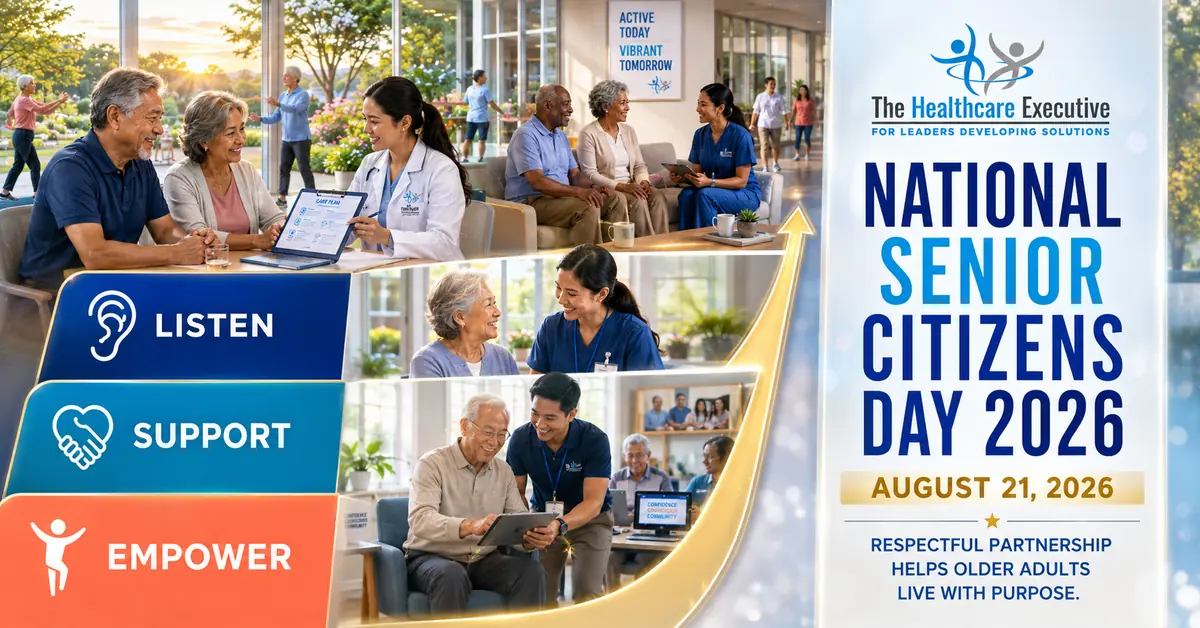
National Senior Citizens Day 2026
Use the observance to review how people find information, enter the right route, and remain connected through follow-through.

Leadership signal
Recognition becomes useful when leaders inspect the real route.
The strongest use of the observance is operational. Map where questions enter, how requests move, when ownership changes, and how unresolved work becomes visible. The goal is not to make a clinical claim. It is to make the organization’s response easier to understand and manage.
Start by distinguishing what is known from what the organization still needs to learn. A campaign plan, communication volume, or meeting count does not establish that a route is usable. Leaders need direct listening, clear ownership, locally defined measures, and a method for keeping exceptions visible.
Executive opening
Independence is a system outcome
Most older adults want to stay in their own homes for as long as they can. A large survey of older adults in China noted that approximately 90% of older adults globally prefer to age in place.[3] That preference shapes demand for primary care, home care, transportation, community programs and family support, and it places much of the work of healthy aging outside hospital walls.
For health systems, the operating challenge is that independence depends on many services that are owned by different organizations. Geriatric primary care, home care agencies, senior centers, housing programs and Medicaid waivers each control a piece of the route. When one piece fails, the result is often an avoidable hospitalization or an earlier move to long-term care. Those transitions are costly for systems and difficult for older adults and their families.
Preferences are also less fixed than policy often assumes. In a 2024 survey of 2,886 French adults over 60, 54% consistently favored home care, while 37% shifted toward a nursing home when its characteristics improved.[9] Professional care quality and living environment influenced choices as strongly as out-of-pocket cost.[9] Quality, in other words, shapes where older adults choose to receive care. Health systems that want to support aging in place therefore have to invest in the quality of every setting, not only in keeping people out of facilities.
National Senior Citizens Day is a useful moment for executives to look at that full route. The sections below summarize current peer-reviewed evidence on primary care, home support, social connection, workforce and measurement of function. They are intended to sit beside the executive guidance already on this page, giving boards and operating leaders a shared factual base for decisions about aging services.
Current evidence
What the research says about function, home care and transitions
Functional decline is common among older adults who already receive home care, and it is measurable. A longitudinal register study of 7,013 Finnish home care clients found that 48% had sensory impairment at baseline.[11] Over 18 months, sensory impairment improved in 7% of clients and worsened in 23%.[11] Moderate to severe dual impairment of vision and hearing was associated with increased cognitive and physical impairment over time.[11] Sensory status is therefore a practical signal for planning home support, not only a clinical detail.
Transitions between home, hospital and long-term care follow patterns that health systems can study. A population-based cohort of 3,424 home care recipients in Quebec used multi-state models to estimate movement between home, hospital, waiting for long-term care placement, long-term care and death.[10] People with chronic conditions were more likely to move directly from home to hospital, while those with dementia were more likely to be waitlisted for or move directly to long-term care.[10]
The same study identified a service gap during the waiting period. Home care services were lower in intensity, with fewer services provided by health care professionals, for patients waiting at home for long-term care placement.[10] That is the group with the highest needs, and the period when support often thins out is the period when risk is rising. Executives can ask whether their own data show a similar pattern. Waitlists for placement are often managed by a different team from home care scheduling, so the drop in support may not be visible to either. Joining those two data sources is a practical first step.
Evidence on home care models is still uneven. A scoping review of publicly funded home care across six high-income countries included 19 sources and identified five distinct models of care.[5] Evaluation evidence was unevenly distributed and largely descriptive, and equity-relevant characteristics were inconsistently reported.[5] Relational aspects of care and workforce conditions were prominent in reported experiences.[5]
Taken together, the evidence suggests that older adults living at home face predictable risks that are visible in routine data. Sensory decline, chronic illness, dementia and waiting for placement are all identifiable. The opportunity for health systems is to use those signals to plan support before a crisis forces a transition.[10][11]
Figure 1
Function is measurable, and simple process changes can improve how often it is measured
Percent of patients or home care clients, as reported in each study. Values are copied from the cited studies [1], [11]; none is estimated.
Data note. The screening values and the sensory values come from different studies and populations, so this is an indirect comparison; the bars show what can be measured, not how the two settings compare.
Limitation. The screening figures come from one clinic over eight weeks; the sensory figures come from register assessments in Finland.
Figure data (4 rows)
| Measure | Value | Population, setting and year as reported | Source |
|---|---|---|---|
| Objective mobility screening completed before improvement | 32% | Geriatrics primary care clinic, baseline before four two-week improvement cycles | [1] |
| Objective mobility screening completed after improvement | 61% | Same clinic after switching to the visual gait speed test, eight-week improvement period | [1] |
| Home care clients with sensory impairment at baseline | 48% | 7,013 Finnish home care clients, national assessment register | [11] |
| Home care clients whose sensory impairment worsened over 18 months | 23% | Same 7,013 Finnish home care clients | [11] |
Continuum of care
Keeping people at home through coordinated support
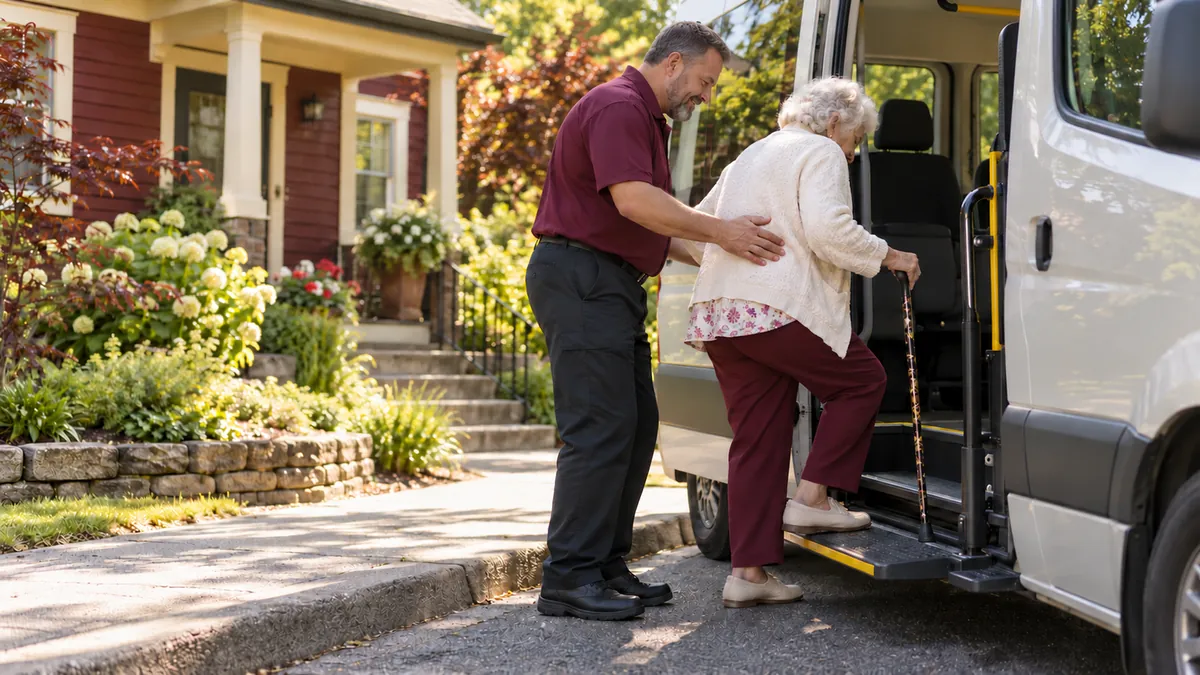
Coordinated approaches can delay transitions that older adults and families often want to avoid. A care approach co-developed with a seniors’ residence and public home care services combined staff training, care reorganization, personalized care based on life stories and stronger collaboration with home care.[7] The approach allowed older adults with higher assistance needs to remain in their home, and relocations to long-term care were delayed by approximately 3 months.[7] The authors noted that further studies are needed to document the financial impact.[7]
Housing-based programs show a similar value. The Support and Services at Home program, located in affordable housing, connects older adults and people with disabilities with community-based services and coordinates care delivery.[4] Using Vermont program data from 2017 to 2023, a modeling study estimated a cost per quality-adjusted life year gained of $8,344 to $4,013, depending on gender and diabetes.[4] The authors described the program as an example of the wrong pocket problem, which makes replication and funding of the model challenging.[4]
Primary care is the anchor for much of this work, and simple process changes can improve it. In a geriatrics primary care clinic, replacing one objective mobility screening test with a visual gait speed test during four two-week improvement cycles increased screening from 32% to 61%.[1] Follow-up mobility actions also improved during the same period.[1] The Age-Friendly Health Systems framework identifies objective mobility screening and follow-up as essential care for older adults, for whom falls are a leading cause of morbidity.[1]
Rehabilitation programs can extend that link into the home. A pilot study of a multicomponent exercise program for 44 older adults receiving home care services reported a completion rate of 77%, with no severe adverse events and satisfaction of 9 out of 10.[6] Group-by-time analyses suggested improvements in physical performance and frailty.[6] The pilot was not randomized, so its results support feasibility rather than effectiveness. Attendance at face-to-face sessions was 83%, and compliance with home-based sessions was 71%, which suggests that home care clients can sustain a structured program when it is tailored to their functional level.[6]
For executives, the continuum question is whether these services connect. Mobility screening is most useful when it triggers a referral, a home exercise program and a home safety review. Coordinated support matters most during the waiting period before placement, when the Quebec data showed home care was lower in intensity.[10]
Figure 3
Why the pathway breaks
People
- Home care workforce shortages
- Nurses unsure whether social needs are part of their role
- Limited family support for some older adults
Process
- Mobility screening missed in primary care visits
- Positive screens without home follow-up
- Support thins while waiting for long-term care placement
Technology
- Smart devices without training or maintenance support
- Unreliable rural internet
- Limited shared data across home care and primary care
Environment
- Distance to services
- Deficiencies in housing conditions
- Community programs not designed for language minorities
Policy
- State variation in waiver coverage
- Savings accrue to a different payer than costs
- Rigid care time allocations
Measurement
- Sensory and mobility status not tracked over time
- Equity characteristics inconsistently reported
- Home care models evaluated descriptively
Unranked qualitative cause-and-effect diagram for the outcome in the box: Older adults lose independence or move to hospital or long-term care earlier than needed Causes are assembled from the cited literature [1], [2], [3], [4], [5], [8], [10], [11], [12], [13], [15]; categories are not weighted and their order carries no meaning.
Data note. Qualitative; no frequencies are implied.
Limitation. Causes drawn from published studies may not all apply locally; validate them with frontline teams.
Figure data (6 rows)
| Category | Causes drawn from the cited literature |
|---|---|
| People | Home care workforce shortages; Nurses unsure whether social needs are part of their role; Limited family support for some older adults |
| Process | Mobility screening missed in primary care visits; Positive screens without home follow-up; Support thins while waiting for long-term care placement |
| Technology | Smart devices without training or maintenance support; Unreliable rural internet; Limited shared data across home care and primary care |
| Environment | Distance to services; Deficiencies in housing conditions; Community programs not designed for language minorities |
| Policy | State variation in waiver coverage; Savings accrue to a different payer than costs; Rigid care time allocations |
| Measurement | Sensory and mobility status not tracked over time; Equity characteristics inconsistently reported; Home care models evaluated descriptively |
Access
Distance, coverage and technology shape who can age in place
Access to home and community services varies with geography. In the survey of 11,601 older adults in Sichuan, perceived quality of home and community-based services significantly predicted intentions to age in place.[3] Rural older adults were sensitive to quality deficits, provider shortages, distance and service unavailability, while urban respondents were more affected by provider shortages and distance barriers.[3] The authors concluded that improving accessibility and provider availability is essential to support aging-in-place preferences.[3]
Coverage policy is another access lever, and it varies sharply across states. An analysis of recent Medicaid home and community-based services waivers found that 39 states and the District of Columbia (78.4%) implemented 66 waivers targeting older adults.[2] Smart devices were permitted most frequently in the personal emergency response category (62.1%).[2] Explicit references to smart devices appeared in 39.4% of waivers across 19 states.[2]
Technology can extend support, but it introduces its own barriers. In a focus group with 11 staff, occupational therapists and home builders from three federally funded home modification grantees, participants reported early adoption of smart speakers, doorbell cameras, motion-activated lights and smart plugs.[13] Barriers included older adults’ digital literacy, privacy concerns and device maintenance burden, unreliable internet in rural areas, and organizational limits in training, staffing and funding.[13]
Those findings suggest that technology access depends on support structures. Participants emphasized progressive adoption, hands-on training and low-maintenance technology, and some grantees partnered with university programs to provide training for older adults.[13] Without that support, smart devices can widen gaps between older adults who have reliable internet and help at home and those who do not. The waiver analysis described caregiver workforce shortages as part of the reason smart devices are attracting policy attention.[2]
Access strategies for older adults therefore need to combine coverage, workforce and technology. Each element depends on the others, and gaps in any one of them can leave a covered service unused. A covered device that no one installs, explains or maintains does not improve access. Leaders can ask which older adults in their service area are least able to use new tools, and what human support will accompany them.[13][2] They can also map transportation to primary care and community programs, since distance remained a barrier for both urban and rural respondents in the Sichuan survey.[3]
Executive guidance · System route
Map the path from first contact to verified follow-through.
Use this route as a discussion framework. Replace each stage with the organization’s approved process, qualified roles, current service capacity, and applicable requirements. Do not infer a clinical protocol from the observance title.
The route at a glance
- Listen
- Clarify entry
- Coordinate the partner route
- Protect transitions
- Verify and learn
Reliability rule: Every stage needs a named owner, an observable status, an approved escalation path, and a defined signal that shows whether responsibility moved or remained unresolved.
Listen
Gather questions and friction points from people using the route, frontline teams, and community-facing staff. Separate observed barriers from assumptions.
Clarify entry
Publish a plain-language first step and identify who receives requests through each approved channel.
Coordinate the partner route
Align internal teams and external partners around one current message, real entry point, receiving owner, escalation path, and follow-through signal.
Protect transitions
Use acknowledgment and status visibility when responsibility moves between services, locations, or organizations.
Verify and learn
Review unresolved work, repeat contacts, and avoidable handoffs. Use the findings to improve the route rather than blame individuals.
Figure 2
The system route as one flow
The five stages of the system route described in this brief, drawn as one flow with a learning loop back to the start. The stages are the page’s original executive guidance, not a clinical protocol.
Data note. Shows sequence and handoffs only; it carries no counts or rates.
Limitation. Local processes may add, merge or reorder stages under organizational policy.
Figure data (5 rows)
| Stage | What the stage requires |
|---|---|
| Listen | Gather questions and friction points from people using the route, frontline teams, and community-facing staff. Separate observed barriers from assumptions. |
| Clarify entry | Publish a plain-language first step and identify who receives requests through each approved channel. |
| Coordinate the partner route | Align internal teams and external partners around one current message, real entry point, receiving owner, escalation path, and follow-through signal. |
| Protect transitions | Use acknowledgment and status visibility when responsibility moves between services, locations, or organizations. |
| Verify and learn | Review unresolved work, repeat contacts, and avoidable handoffs. Use the findings to improve the route rather than blame individuals. |
Equity and trust
Inclusion, family support and the limits of formal services
Community programs for older adults are not equally welcoming to everyone. A six-month ethnographic study examined how a senior center community and its staff welcomed Spanish-speaking older adults.[15] Being culturally proactive, considering values and interests, offering regular activities and cross-group participation encouraged cohesion and communal habits of inclusion.[15] Those tailored approaches benefited Spanish-speaking older adults, and the author identified roles for occupational therapy in supporting them.[15]
Family support shapes how secure older adults feel at home. A register study of 5,759 older adults receiving home care in one Finnish well-being services county found that strong and supportive family relationships were associated with a higher sense of security (odds ratio 1.614).[12] Male gender, no deficiencies in housing conditions and having had no falls during the past 90 days were also associated with a higher sense of security.[12] Home care support services did not play a contributing role.[12]
That finding has equity implications. Older adults without strong family networks may experience less security even when they receive the same formal services. The authors recommended involving families in care planning as a strategy to support security and wellbeing.[12] For people without family nearby, health systems may need to identify other sources of reliable support, such as community partners and volunteers. Those arrangements should be recorded in the care plan with the same clarity as a family contact, so that home care staff know whom to call. A support network that exists only in a staff member’s memory is not a reliable control.
Housing and income also matter. The housing-based support program operates in affordable housing, which makes it a route to reach older adults who may lack resources to arrange private support.[4] Its authors argued that greater system efficiency and equity will require ways to incorporate programs outside the health care system.[4] The scoping review of home care models found that equity-relevant characteristics were inconsistently reported.[5]
For executives, an equity review of aging services means stratifying access and outcomes by language, income, housing, geography and family support. It also means asking whether community programs are designed to welcome groups that have historically been excluded, rather than waiting for them to arrive.[15] Stratified data will often show that the older adults with the fewest resources are also the least visible in program participation counts.
Human infrastructure
Relational care needs time and clear roles
The aging-in-place model depends on a home care workforce that is already stretched. The waiver analysis framed smart device coverage as a response to rising caregiver workforce shortages.[2] The scoping review found that workforce conditions were prominent in reported experiences across home care models.[5] Workforce planning for older adults is therefore not a separate issue from access; it is the main constraint on it.
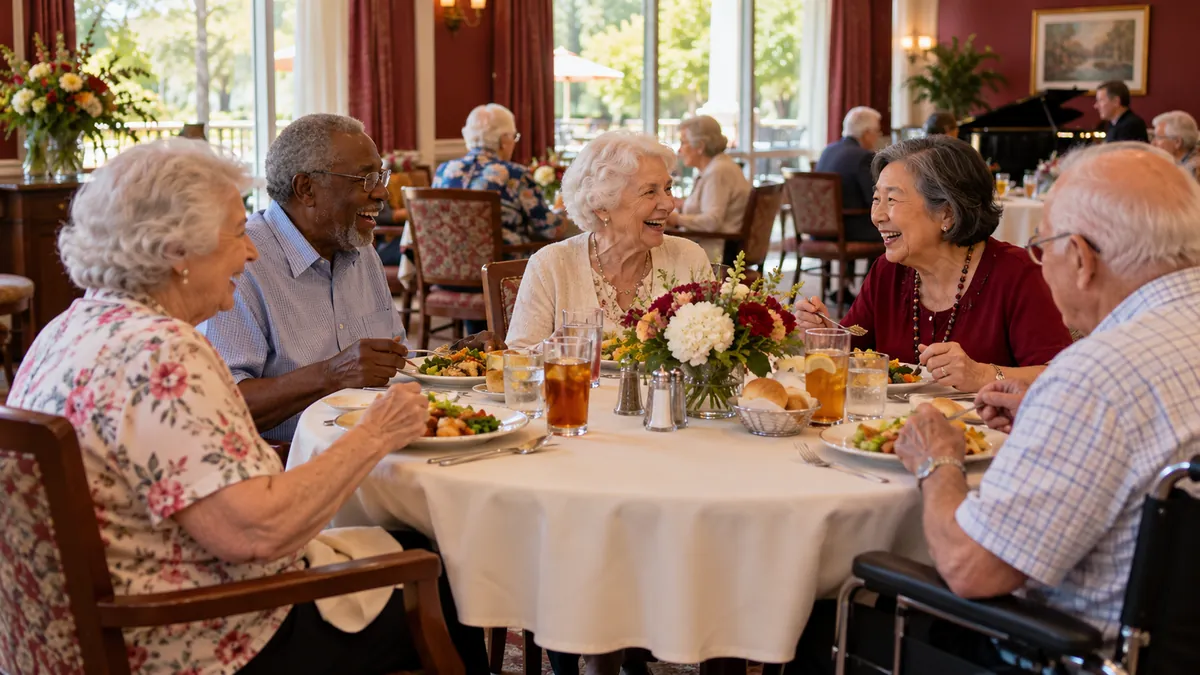
Role clarity is part of the workforce challenge. A qualitative study in Norway combined interviews with eight older adults, 13 relatives, 15 home care nurses and 17 care administrators.[8] Older adults valued companionship with home care staff, highlighting trust, kindness and meaningful conversation.[8] Home care nurses were uncertain whether meeting social needs fell within their responsibilities, while administrators saw social needs as a shared responsibility, primarily for families, neighbors and volunteers.[8]
The authors concluded that social needs should be viewed as part of relational care embedded in daily interactions, not as separate tasks.[8] When care time constraints become too rigid, essential social interactions often go unrecognized and undervalued in service allocations.[8] For leaders, that means visit lengths and task lists shape loneliness and trust as much as they shape efficiency. Older adults in the study described small acts of kindness as central to their experience of care, and the authors argued these acts are necessities rather than extras.[8] Scheduling rules that remove all slack time can therefore undermine the relationships that make home care work.
Community-based staff and volunteers can extend the workforce. An educational presentation delivered at three community senior centers to 44 older adults increased knowledge about aging memory, perceived benefits of screening and self-efficacy to seek screening.[14] The intervention was well received by participants.[14] Senior centers can therefore serve as trusted channels for health education, which reduces demand on clinical staff for the same task.
Experienced professionals also need support to lead change. The mobility screening project relied on clinic staff to adopt a new test and follow-up process within eight weeks.[1] The exercise pilot used one weekly physiotherapist-led session plus home-based sessions.[6] Both models show how a small amount of specialized professional time can be multiplied through workflow design and home-based follow-through. That approach matters when geriatric specialists are scarce, because it lets their expertise reach more older adults without requiring more specialist visits.
Executive guidance · Operating dashboard
Measure whether the operating route works as intended.
Do not publish a number until the organization defines its numerator, denominator where relevant, owner, source system, exclusions, review cadence, and limits. The candidates below are management prompts, not benchmarks or reported results.
Four operating signals
Each signal pairs an executive question with one candidate local measure, set out below.
Executive guidance · Signal
Entry-point clarity
Can people and staff identify the approved first step without searching across conflicting instructions?
- Candidate local measure
- Locally defined contact, routing, and repeat-contact signals by channel and service.
Executive guidance · Signal
Ownership reliability
Does a specific team accept each request and make its status visible?
- Candidate local measure
- Requests without an owner, aged work, transfers, and escalations using locally approved definitions.
Executive guidance · Signal
Partner-route reliability
Do participating teams share one current route and understand who owns each dependency?
- Candidate local measure
- Locally defined conflicting instructions, unaccepted handoffs, unresolved dependencies, repeat contacts, and partner feedback.
Executive guidance · Signal
Improvement closure
Does the organization correct recurring friction and report what changed?
- Candidate local measure
- Selected barriers, assigned actions, completion status, and post-change review.
Figure 4
The operating system behind the dashboard
The four operating signals from this brief’s dashboard, each tied to the candidate owner named in the executive scorecard, around one accountable route. Drawn from the page’s original executive guidance.
Data note. Structural diagram; no measured values.
Limitation. Owners are candidates to be confirmed locally.
Figure data (4 rows)
| Operating signal | Candidate owner |
|---|---|
| Entry-point clarity | Executive sponsor and operational lead |
| Ownership reliability | Operational owner and participating teams |
| Partner-route reliability | Sending and receiving owners |
| Improvement closure | Improvement owner and executive sponsor |
Executive guidance · Handoff workflow
Keep work owned when it crosses a boundary.
A handoff is reliable only when the sending party knows who is expected to receive the work, the receiving party acknowledges responsibility, and any unresolved exception remains visible. Local policy and qualified judgment control the actual process.
How responsibility moves
Lane A
From message to accepted ownership
- Confirm the approved message and intended audience.
- Publish the actual entry point and receiving role.
- Acknowledge receipt using the locally approved method.
- Escalate when ownership or response remains unclear.
Lane B
From accepted ownership to verified follow-through
- Record the next accountable owner and visible status.
- Name the sending and receiving owners, shared information, current status, and unresolved dependency.
- Keep unresolved work visible across boundaries.
- Confirm closure or document the continuing exception.
Executive guidance · Executive scorecard
Ask questions that connect intent, ownership, and results.
The scorecard keeps review focused on decisions. Leaders should set definitions locally, examine variation without overclaiming cause, and pair quantitative signals with the experience of people who use and operate the route.
Who reviews what
- Executive sponsor and operational lead
- Operational owner and participating teams
- Sending and receiving owners
- Improvement owner and executive sponsor
Candidate owners named in the scorecard, confirmed locally.
| Operating signal | Executive question | Candidate owner | Suggested review point |
|---|---|---|---|
| Entry-point clarity | Can people and staff identify the approved first step without searching across conflicting instructions? | Executive sponsor and operational lead | At campaign launch and close |
| Ownership reliability | Does a specific team accept each request and make its status visible? | Operational owner and participating teams | At a locally defined cadence |
| Partner-route reliability | Do participating teams share one current route and understand who owns each dependency? | Sending and receiving owners | At a locally defined cadence |
| Improvement closure | Does the organization correct recurring friction and report what changed? | Improvement owner and executive sponsor | Until action is verified |
Figure 5
Control points for reliable aging-in-place support
| Control point | Risk if missing | Owner | Evidence of control |
|---|---|---|---|
| Objective mobility screening in geriatric primary care | Falls risk and functional decline go unrecognized | Primary care medical director | Share of eligible visits with a completed screen and documented follow-up action |
| Sensory status review in home care assessments | Vision and hearing decline accelerates cognitive and physical impairment unnoticed | Home care clinical lead | Sensory status recorded at each reassessment with referral when it worsens |
| Support plan during the wait for long-term care | Service intensity drops when needs are highest | Post-acute and home care executive | Service hours and professional visits tracked for people on placement waitlists |
| Family and caregiver involvement in care planning | Older adults feel less secure at home | Care coordination manager | Documented family or alternate support contact in each care plan |
| Technology support for covered devices | Devices are funded but not used | Home modification and care management partners | Installation, training and maintenance completed for each covered device |
| Inclusive community program design | Language minorities and isolated older adults are not reached | Community partnerships lead | Participation reported by language and neighborhood |
Control points derived from the cited evidence [1], [2], [10], [11], [12], [13], [15] and this brief’s executive guidance.
Data note. Each row is a control to verify, not a measured result.
Limitation. Owners and evidence of control must follow local policy and applicable requirements.
Public communication
Talking about aging with respect and realism
Public messages on National Senior Citizens Day often celebrate older adults in general terms. A stronger message explains what the organization is doing to support independence and what older adults and families can expect when they need help. It also names the services that exist, how to reach them and who will follow up, because older adults and families often learn about home support only during a crisis.
Trusted community settings are effective channels for that message. The senior center education study showed that a single structured presentation, with a vignette and time for questions, increased knowledge, perceived benefits of screening and self-efficacy among older adult participants.[14] Messages delivered by known staff in familiar places may reach people who would ignore a mailed brochure. The inclusion study adds that regular, culturally proactive activities encouraged cohesion and communal habits of inclusion.[15]
Clear, respectful communication can reduce delay without pressuring people. Messages that describe home support as a way to protect independence, rather than as a sign of decline, may fit how older adults think about their homes. Involving families in planning conversations is consistent with evidence that family relationships are associated with a higher sense of security.[12]
Communication should also reflect real preferences rather than assumptions. The French preference study found that a large share of older adults would consider a nursing home if quality and living environment improved.[9] Messages that present home as the only acceptable option may not match what many older adults want. Honest information about all options supports informed choice. In that study, 37% shifted their choice when nursing home characteristics improved, so preferences should not be treated as fixed.[9]
Leaders should be careful about claims. Many aging-in-place studies are small pilots, single-site projects or qualitative studies, and some evaluations have not yet documented financial impact.[6][7] A credible message for this day could pair recognition with one concrete commitment, such as a mobility screening improvement, a home support partnership or a review of services during the wait for long-term care. Reporting on that commitment a year later would show older adults and families that the observance is tied to action.

Executive guidance · 90-day plan
Move from listening to a verified improvement in 90 days.
The time boxes below are a management framework, not a clinical timeline. Adjust them to risk, scope, governance, resources, stakeholder participation, and applicable review requirements.
Ninety days, three moves
- Days 1–30See the current route
- Days 31–60Build the reliable path
- Days 61–90Make the change visible
Days 1–30 · Listen and map
See the current route
- Name an executive sponsor and an operational owner.
- Listen to people using the route and representative frontline teams.
- Map how National Senior Citizens Day communications connect to real entry points, owners, transitions, and escalation.
- Select one recurring barrier that the organization can responsibly address.
Days 31–60 · Design and test
Build the reliable path
- Define the trigger, receiving owner, required information, acknowledgment, escalation, and closure signal.
- Validate the design with every sending and receiving team involved.
- Test one internal or partner handoff and correct a verified communication, dependency, or ownership gap.
- Test the route in more than one representative setting or operating period where practical.
Days 61–90 · Implement and verify
Make the change visible
- Launch the redesigned route with a small set of locally defined measures.
- Review unresolved work and recurring friction using a learning approach.
- Correct implementation barriers and record who owns each remaining dependency.
- Report what changed, what evidence was reviewed, and what still requires live oversight.
Figure 6
The 90-day plan on one timeline
The 90-day plan from this brief drawn as a timeline: each action sits in the 30-day window the plan assigns it. The full wording of each action is in the figure data and in the plan above.
Data note. Time boxes are a management framework, not a clinical timeline.
Limitation. Durations are uniform 30-day windows; real tasks may span windows.
Figure data (12 rows)
| Window | Action |
|---|---|
| Days 1–30 · Listen and map | Name an executive sponsor and an operational owner. |
| Days 1–30 · Listen and map | Listen to people using the route and representative frontline teams. |
| Days 1–30 · Listen and map | Map how National Senior Citizens Day communications connect to real entry points, owners, transitions, and escalation. |
| Days 1–30 · Listen and map | Select one recurring barrier that the organization can responsibly address. |
| Days 31–60 · Design and test | Define the trigger, receiving owner, required information, acknowledgment, escalation, and closure signal. |
| Days 31–60 · Design and test | Validate the design with every sending and receiving team involved. |
| Days 31–60 · Design and test | Test one internal or partner handoff and correct a verified communication, dependency, or ownership gap. |
| Days 31–60 · Design and test | Test the route in more than one representative setting or operating period where practical. |
| Days 61–90 · Implement and verify | Launch the redesigned route with a small set of locally defined measures. |
| Days 61–90 · Implement and verify | Review unresolved work and recurring friction using a learning approach. |
| Days 61–90 · Implement and verify | Correct implementation barriers and record who owns each remaining dependency. |
| Days 61–90 · Implement and verify | Report what changed, what evidence was reviewed, and what still requires live oversight. |
Executive guidance · Leadership close
Carry one accountable improvement beyond the campaign window.
Recognition matters. It becomes durable when leaders also listen, clarify the route, support the people operating it, close an identified gap, and report the result without claiming more than the evidence supports.
Leadership commitment
Listen to the people closest to the route, assign one barrier, and verify the change.
Executive action kit · Day observance
Turn National Senior Citizens Day into accountable action.
Use the observance to review how people find information, enter the right route, and remain connected through follow-through.
Leadership focus
Use this observance to examine trustworthy information, prevention access, and community connection. Select one verified barrier, assign an accountable owner, and carry the improvement beyond the campaign window.
Workforce lens
Ask whether staffing, role clarity, training, tools, workload, and escalation support the people operating the information, access, coordination, and follow-through pathway.
Patient and community lens
Make the approved first step clear. Test whether a person can move from information to an acknowledged next action without navigating conflicting instructions.
Equity and access lens
Review language, disability, transportation, digital access, geography, trust, and other barriers using protected feedback and locally appropriate data.
Five-minute briefing
Inspect the operating sequence
Listen with people using the pathway, frontline teams, operational leaders, and community partners. Find one a message, request, referral, or handoff that does not reach an accountable owner, then test the locally approved route from entry through acknowledged follow-through.
- Listen
- Clarify entry
- Coordinate the partner route
- Protect transitions
- Verify and learn
Leadership actions for this week
- Name an executive sponsor and frontline operating owner.
- Ask people using and operating the pathway where ownership becomes unclear.
- Test one representative route from first question to acknowledged next step.
- Select one barrier that can be corrected without overstating the evidence.
- Set a review date and define how completion will be verified.
Candidate measures
Define every numerator, denominator where relevant, owner, data source, exclusions, cadence, and limitation locally. These are management prompts, not external benchmarks.
- Locally defined contact, routing, and repeat-contact signals by channel and service.
- Requests without an owner, aged work, transfers, and escalations using locally approved definitions.
- Locally defined conflicting instructions, unaccepted handoffs, unresolved dependencies, repeat contacts, and partner feedback.
Department readiness checklist
- The public and staff entry points match the actual approved process.
- A specific role accepts each request, referral, or escalation.
- Handoffs include acknowledgment and a visible unresolved state.
- Language, disability, digital, transportation, and trust barriers receive explicit review.
- Communications do not introduce unsupported themes, statistics, or clinical advice.
- A named leader will review what changed after the observance.
Intended audiences
- Executive and Operational Leaders
- Public Health and Community Partners
Staff communication template
During National Senior Citizens Day, our organization will connect awareness with a practical review of the information, access, coordination, and follow-through pathway. Use approved information, identify the correct entry point, confirm ownership when work moves, protect privacy, and escalate unresolved barriers through local channels.
Community communication template
National Senior Citizens Day is an opportunity to share trustworthy information and make the next step easier to find. Use our approved channels for information and support. If a request changes hands, our goal is to keep ownership and follow-through visible.
Measurement worksheet
- Signal
- What observable condition will show whether the route works?
- Definition
- What is included, excluded, and counted?
- Owner
- Who reviews the signal and acts on exceptions?
- Cadence
- When will leaders review it?
- Equity check
- Which differences require protected, locally appropriate review?
- Closure
- What evidence will confirm the improvement was completed?
- Editorial review
- Completed
- Source records
- 2 listed under Authoritative resources
- Review standard
- Sourced facts remain separated from original executive guidance
- Clinical boundary
- No new statistical or clinical claim was added by this action kit
Sources and content boundary
Authoritative resources
Use note: All operating models, measures, scorecard questions, and action steps are original executive guidance. This article supports leadership planning and education. It does not replace clinical judgment, emergency procedures, legal advice, professional standards, organizational policy, or applicable federal, state, and local requirements.
Peer-reviewed references
References
Fifteen peer-reviewed sources, newest first. Each was individually verified through authenticated academic research databases. Bracketed numbers in the text link here; the original executive guidance on this page carries no citations because it is guidance, not a sourced claim. Sources last checked in those databases on .
- 1.Carlson RM, Belzer C. Improving Delivery of an Age-Friendly Health System in a Geriatrics Primary Care Clinic: Mobility Focus. Journal of Gerontological Nursing. 2026;52(3):9-13. https://doi.org/10.3928/00989134-20251112-06
- 2.Zawada S, Fogus M, Mills E, Fortune E, Cepoi L. State Variation in Smart Device Eligibility for Aging-in-Place Services: Recent Trends in Medicaid Section 1915(c) Waiver Coverage for Older Adults. Clinical Interventions in Aging. 2026;21:629091. https://doi.org/10.2147/cia.s629091
- 3.Wang S, Liu Y, Yang Y. Perceived quality of home- and community-based services and urban-rural disparities in aging-in-place intentions: evidence from Chinese older adults. BMC Geriatrics. 2026;26(1):125. https://doi.org/10.1186/s12877-025-06936-z
- 4.Atherly A, Doerner C, Yan R, Schollmeyer J, Genge L, van den Broek-Altenburg E. Cost-Effectiveness of the Support and Services at Home (SASH) Program for Cardiovascular Risk Factors: A Community-Based Approach to Healthy Aging in Place. Health Services Research. 2026;61(2):e70100. https://doi.org/10.1111/1475-6773.70100
- 5.Macdonald M, Litvack D, Litvack R, Carrasco P, Stec N, Hancock K, et al. Models of publicly funded home care for community-dwelling older adults across six high-income health systems: a scoping review. BMC Geriatrics. 2026;26(1). https://doi.org/10.1186/s12877-026-07870-4
- 6.Ruiz-Fernández A, Irazusta J, Rezola-Pardo C, Latorre Erezuma U, Goirigolzarri-Garaizar A, Ugalde-Aranzabal N, et al. Multicomponent physical exercise program among community-dwelling older adults who are users of home care services: a quasi-experimental pilot study. Disability and Rehabilitation. 2026;48(12):3826-3841. https://doi.org/10.1080/09638288.2025.2597357
- 7.Gagnon-Roy M, Rahimaly S, D’amours M, Delli-Colli N, Mailhot-Bisson D, Abdulrazak B, et al. Aging-in-Place (Vieillir Chez Soi, VCS) in a Seniors’ Residence: Co-Development, Implementation, and Evaluation of a Care Approach to Delay Transitions in Long-Term Care. Canadian Journal on Aging. 2026;45(1):131-141. https://doi.org/10.1017/s0714980825100391
- 8.Tingvold L, Ingstad K, Devik SA. Social needs in home care for older adults: A qualitative exploration of recognition, expectations and opportunities. Geriatric Nursing. 2026;69:103979. https://doi.org/10.1016/j.gerinurse.2026.103979
- 9.Cheneau A, Sicsic J, Rapp T. Home over institution? New insights on older adults’ care preferences from a mixed-methods study in France. PLOS ONE. 2026;21(3):e0345491. https://doi.org/10.1371/journal.pone.0345491
- 10.Dufour I, Courteau J, Randlett M, Deschênes C, Brou SE, Mailhot-Bisson D, et al. A multi-state transition model among older adults receiving home care services: a population-based cohort study. BMC Geriatrics. 2026;26(1). https://doi.org/10.1186/s12877-026-07150-1
- 11.Pesonen T, Siira H, Väisänen V, Edgren J, Aaltonen M, Lotvonen S, et al. Changes in Home Care Clients’ Sensory Impairment Status and Its Association With Functioning Over 18 Months: A Longitudinal Register-Based Study. Journal of Aging and Health. 2026;38(5/6):325-336. https://doi.org/10.1177/08982643251344053
- 12.Palonen M, Turja T, Aaltonen M, Edgren J, Kaunonen M. The Sense of Security and Associated Factors Among Older Home Care Clients: A Register Study. Scandinavian Journal of Caring Sciences. 2026;40(1):e70187. https://doi.org/10.1111/scs.70187
- 13.Hu H, Clarke M, Hughes M, Sharma P, Fried J, Singh P, et al. Smart Home Technology Integration in Home Modification Programs Serving Older Adults: Focus Group Study With Program Grantees. JMIR Aging. 2026;9:e89729. https://doi.org/10.2196/89729
- 14.Lundquist TS, Ready RE, Coyne AE. Community Senior Center Intervention to Address Factors Related to Memory Screening Engagement. Health Education & Behavior. 2025;52(1):38-48. https://doi.org/10.1177/10901981241267204
- 15.Lavalley R. Occupation’s Role in Inclusion of Spanish-Speaking Older Adults in a Senior Center. OTJR: Occupational Therapy Journal of Research. 2023;43(1):74-80. https://doi.org/10.1177/15394492221093311
Claim-to-source matrix
What each source supports
Every sourced claim in the new sections maps to the references that support it, the section where it is used, and the limitation a reader should keep in mind. Original executive guidance carries no sources because it is guidance, not a finding.
| Claim group | Sources | Years | Used in | Limitation |
|---|---|---|---|---|
| Preference to age in place and influence of service quality | [3] [9] | 2026 | Executive opening | Cross-sectional surveys in Sichuan, China and France; stated preferences rather than observed moves. |
| Sensory impairment and functional decline among home care clients | [11] | 2026 | Current evidence | Finnish register data; association rather than effect of sensory change. |
| Transitions between home, hospital and long-term care | [10] | 2026 | Current evidence | Administrative data from Quebec; model estimates depend on recorded states. |
| Models of publicly funded home care | [5] | 2026 | Current evidence | Scoping review of 19 sources; evidence largely descriptive. |
| Coordinated care to delay long-term care relocation | [7] | 2026 | Continuum of care | Single seniors’ residence; financial impact not documented. |
| Cost-effectiveness of housing-based support | [4] | 2026 | Continuum of care | Markov model using Vermont program data; cardiovascular outcomes only. |
| Mobility screening improvement in geriatric primary care | [1] | 2026 | Continuum of care | Eight-week improvement project in one clinic. |
| Home-based exercise for home care clients | [6] | 2026 | Continuum of care | Quasi-experimental pilot with 44 participants allocated by preference. |
| Medicaid waiver coverage of smart devices | [2] | 2026 | Access | Document analysis of waiver text; coverage terms may not reflect devices actually funded. |
| Smart home technology in home modification programs | [13] | 2026 | Access | Single focus group with 11 participants from three grantees. |
| Inclusion of Spanish-speaking older adults in a senior center | [15] | 2023 | Equity and trust | Six-month ethnography in one senior center. |
| Family support and sense of security | [12] | 2026 | Equity and trust | Cross-sectional register study; relatively low effect sizes. |
| Social needs and relational care in home care | [8] | 2026 | Human infrastructure | Two combined qualitative studies in Norway. |
| Senior center education on memory screening | [14] | 2025 | Human infrastructure | Pre-post design with 44 participants and short follow-up. |
About the author
Greg Wahlstrom
MBAHCM
President and Chief Executive Officer, The Healthcare Executive
View Greg’s profile©2014 – 2026 The Healthcare Executive. All rights reserved.