
August 1–31, 2026 · Executive evidence brief
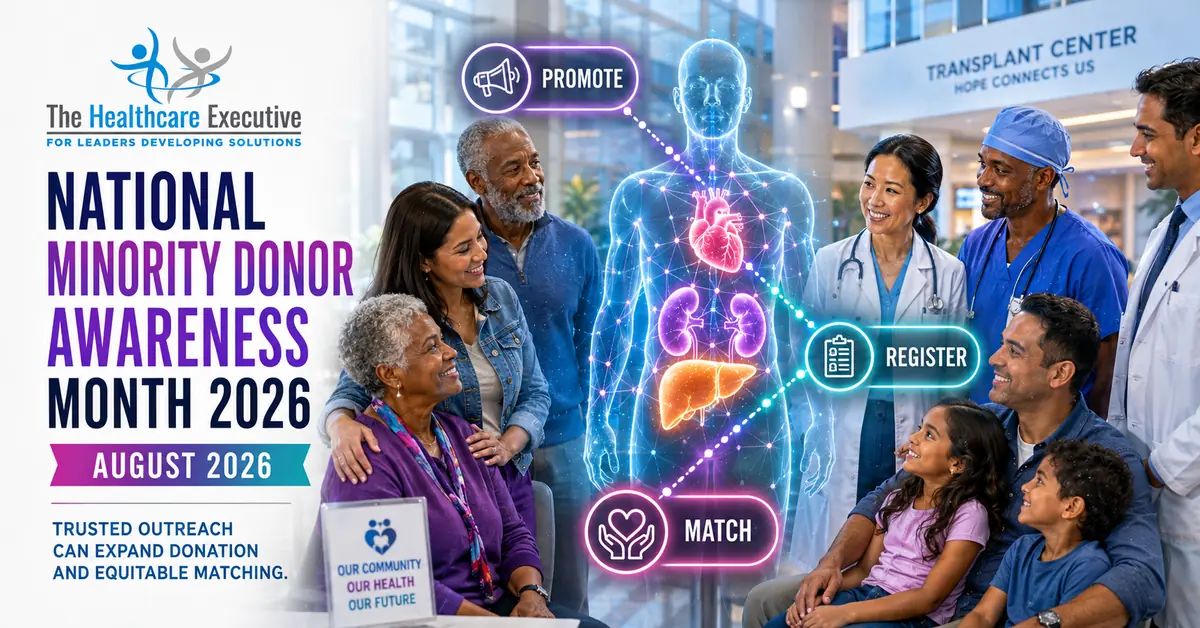
National Minority Donor Awareness Month 2026
Move beyond awareness volume. Build a voluntary, trustworthy, and measurable route from community conversation to donor registration, transplant referral, evaluation, matching, informed choice, and accountable follow-through.
Donate Life America identifies August as National Multiethnic Donor Awareness Month and explains that the initiative stems from National Minority Donor Awareness Week, founded in 1996. OrganDonor.gov continues to list August as National Minority Donor Awareness Month. This page retains its approved title and hero while using current multiethnic terminology when describing the collaborative observance.
Leadership mandate
Connect awareness to the whole pathway, not to a single campaign count
National Minority Donor Awareness Month can prompt a useful public conversation about organ, eye, tissue, marrow, and blood stem cell donation. For healthcare executives, however, the observance should also prompt a systems question: after awareness increases, can people find trustworthy information, ask questions in a language and setting that works for them, record a voluntary decision, reach transplant evaluation when clinically appropriate, complete complex requirements, receive a fair matching process, and remain supported when ownership moves between organizations?
Those are related but distinct routes. A public donor-registration pathway is not the same as a living-donor evaluation. Deceased-donation authorization is not the same as a transplant-center referral. Marrow registry matching is not the same as solid-organ allocation. Tissue and eye donation have their own eligibility and recovery processes. A respectful campaign can acknowledge the shared values of informed choice and community benefit while clearly explaining that eligibility, timing, compatibility, legal authority, clinical assessment, and operational roles differ.
Executives should resist reducing success to impressions, social engagement, event attendance, brochure distribution, or new registrations. Those measures can describe reach, but they do not show whether information was understood, questions were answered, referrals were accepted, evaluations began, financial and logistical barriers were addressed, handoffs were acknowledged, or people experienced the process as trustworthy. The management task is to make the pathway observable without turning personal decisions into performance pressure.
A 2025 kidney-transplant cohort of 15,673 referred adults in the Ohio River Valley illustrates why the entry-to-evaluation transition deserves scrutiny. In adjusted analyses, Black patients had a lower likelihood of starting evaluation than White patients, and patients with Medicaid or Medicare had a lower likelihood than those with employer insurance. Among people who began evaluation, differences in waitlisting also remained for Black patients and those with public insurance.3 These observational findings do not explain any individual's experience and do not establish a single cause. They do show that a referral count alone is an incomplete access measure.
A scoping review reached a similar system-level conclusion across 14 U.S. studies. White men generally had the greatest access at multiple points in the kidney-transplant pathway, while women from racial and ethnic minority groups often had the lowest access, particularly for living donor kidney transplantation. The pattern was not uniform across every study or stage.8 Leaders therefore need intersectional review, adequate denominators, locally governed data, and direct listening. A broad category can hide different experiences by gender, insurance, language, geography, disability, age, caregiver support, or stage of care.
Executive decision
Select one real donation or transplant pathway and inspect it from first contact through acknowledged follow-through. Keep informed choice separate from campaign performance, and make every unresolved transition visible to an accountable owner.
Evidence signal
Measure what happens before consent, registration, matching, and treatment
Process equity cannot be inferred from an endpoint alone. A lower authorization rate may reflect differences in who was approached, when the conversation occurred, whether a qualified interpreter was available, how the request was framed, what the family understood, or whether earlier interactions built or reduced trust. The same principle applies to transplant access. Waitlist composition reflects upstream referral, evaluation start, completion, clinical eligibility, social and financial support, insurance, transportation, administrative requirements, and patient choice.
A 2025 retrospective study of 4,528 pediatric organ-donation referrals found that 30% of next of kin were approached. Compared with White non-Hispanic families, adjusted odds of an approach were lower for Hispanic, Black, and other-race families. Among families who were approached, 61% consented, and adjusted odds of consent were again lower for those three groups.5 The study does not show why those differences occurred, and it should not be used to characterize community willingness. It identifies two operational checkpoints, approach and consent, that require separate denominators and careful review.
| Checkpoint | Study denominator | Observed proportion | What leaders may ask |
|---|---|---|---|
| Next of kin approached | All 4,528 referred pediatric cases | 30% | Were clinical criteria, timing, staff availability, language access, and approach decisions applied consistently? |
| Consent documented | Only families who were approached | 61% | Was the conversation understandable, respectful, timely, supported, and free from pressure? |
The evidence chart is a diagnostic signal, not a target. Setting a quota for approaches or consent could distort judgment and undermine autonomy. A safer response is to audit definitions, eligibility decisions, missingness, time stamps, interpretation services, requester training, documentation, and family experience. Review cases in which no approach occurred as well as cases in which a conversation took place. The question is whether each eligible situation received a consistent, respectful process, not whether each family made the same choice.
Endpoint interpretation also matters after transplantation. A 2024 cohort of 463 people who underwent allogeneic hematopoietic stem cell transplantation reported different 36-month survival estimates across Hispanic, White, and Black groups, while finding no other significant differences and noting the potential influence of selection into transplantation.9 Because the cohort contains only people who reached transplant, it cannot reveal who never received referral, evaluation, a donor option, or treatment. Outcome dashboards should therefore sit beside access and process measures rather than substitute for them.
Executives can use three evidence disciplines throughout the observance. First, state the denominator and stage for every measure. Second, distinguish observed difference from explained cause. Third, pair quantitative review with protected qualitative listening. A dashboard may reveal where a gap appears; it rarely explains the full experience or identifies the correct solution by itself.
Voice, trust, and informed choice
Build trustworthy conditions instead of asking communities to supply trust
Trust is not a demographic trait and should not be framed as a community deficit. It is shaped by current and historical experiences, the behavior of institutions, the clarity of information, whether questions are welcomed, whether a person sees consistent follow-through, and whether care remains respectful after a decision. Leaders can influence those conditions by making commitments observable: use plain language, disclose uncertainty, explain roles, provide qualified language access, protect privacy, separate care from donation pressure, and document what happens after concerns are raised.
A 2026 cross-sectional study of 416 African American patients undergoing kidney-transplant evaluation found that favorable attitudes toward living donor kidney transplantation and trust in kidney doctors were associated with intent to discuss living donation. Trust in hospitals and the health system and reported interactions were not significant in that statistical model.1 The findings do not prove that increasing trust will cause a discussion or donation. They suggest that the relationship with the clinical team and the quality of the living-donation conversation deserve attention during evaluation.
A 2025 U.S. survey of 201 Black and White adults found that donor status was related to trust in doctors and trust in care for one's racial group, but not to religious service attendance or religious norms. Black participants reported lower trust in care for their racial group, while the difference in trust in doctors was not significant.6 A modest cross-sectional survey cannot represent every faith tradition, racial group, or local community. It does challenge a common shortcut: leaders should not assume that religiosity explains a person's decision or substitute a generalized cultural narrative for a direct, respectful conversation.

Community-based programs can strengthen knowledge and confidence, but outreach exposure does not guarantee registration. In a 2023 nonrandomized program, 40 promotoras received web-based education and communication-skills support. Their communication confidence increased, while knowledge and support measures did not change significantly. Twenty-five promotoras then held 52 discussions with 375 attendees; reported knowledge of registration steps and belief that registration was easy increased, and 21 attendees submitted a registration.13 The study used participants as their own controls and should be treated as preliminary program evidence.
A randomized trial involving 1,353 participants in Black-owned barbershops found that targeted and tailored videos did not differentially increase organ-donor registration compared with a generic video. The approaches did increase brochure taking and readiness or willingness stage.16 This distinction is important. Awareness, information seeking, willingness to discuss, documented choice, and completed registration are separate outcomes. A single message may move one stage without moving another.
Design engagement as a continuing service rather than a one-time persuasion event. Give community partners a direct route for unanswered questions, updates when policies or service capacity change, a way to report harmful or confusing language, and evidence that feedback led to action. Compensate community expertise when appropriate. Do not ask trusted messengers to absorb institutional failures or to promise access they cannot control.
What trustworthy outreach does
Explains options and limits, welcomes questions, offers current multilingual and accessible information, identifies the next step, separates care from pressure, and makes follow-through visible.
What trustworthy outreach avoids
Using fear, grief, obligation, or identity as leverage; assuming beliefs from a category; overstating compatibility or outcomes; hiding costs or uncertainty; and treating registration as the only meaningful result.
Access pathway
Protect every transition from awareness to evaluation, matching, and support
A reliable pathway begins by distinguishing the public decision to register as a donor from the clinical process of receiving a transplant or becoming a living donor. Public communication should tell people what action is available and where to ask questions. Clinical operations should define how a referral is received, who confirms eligibility for evaluation, what information is required, who helps with scheduling and testing, how financial or logistical barriers are addressed, and how a person learns the outcome of each step.
Reviews of living donor kidney transplantation describe barriers at individual, interpersonal, and structural levels, including knowledge and socioeconomic conditions, social support and clinician communication, and race-based kidney-function calculation. The authors advocate race-free GFR estimation and multidisciplinary responses.12 A 2023 review similarly argues that broad interventions may not reach the people most affected by access barriers and calls for targeted and system-level changes across kidney-transplant care.14 Together, these reviews support a pathway design that does not place the entire navigation burden on patients and families.
- Inform without pressureUse current, accessible information; explain choices, limits, privacy, and the difference between registration, authorization, evaluation, and matching.
- Receive the question or referralName a real entry point, minimum required information, response standard, and alternate route for language, disability, digital, or after-hours needs.
- Acknowledge ownershipConfirm that a specific role accepted the request; keep rejected, incomplete, and redirected work visible with a reason and next step.
- Evaluate and supportApply current clinical criteria while addressing education, scheduling, transportation, financial, caregiving, and communication needs.
- Match or identify alternativesUse the governed allocation or registry process; explain uncertainty, timing, compatibility limits, and clinically appropriate alternatives.
- Close the loop and learnCommunicate the outcome, document the next owner, protect follow-up, review exceptions, and correct recurring barriers.
Matching science creates a distinct equity challenge in hematopoietic stem cell transplantation. A 2025 World Marrow Donor Association analysis examined 3,654 patients who lacked an 8/8 matched unrelated donor across 16 registries representing 42.7 million potential donors and cord blood units. Rare haplotypes were the primary barrier; haplotypes and genotypes among patients in the Registry of Unmet Need were roughly 100 times less common than those among controls. Potential matches were recruited later for 782 cases, often outside the initiating country.2 Strategic recruitment can improve future options, but the authors also caution against delaying viable alternative-donor approaches for a current patient.
A 2024 review notes that people with rare HLA types and non-White European ancestry have less than a 70% chance of finding a fully matched unrelated donor and describes haploidentical transplantation as an important alternative because a partially matched family donor may be available for nearly all patients. The review summarizes improved regimens with high engraftment and lower transplant-related mortality in cited studies.10 Those figures are review-level summaries, not promises for an individual. Executives should support timely alternative-donor evaluation, complete and diverse registry recruitment, and clear counseling that does not imply ancestry alone determines a match.
A Florida cohort of 238 White and 57 Black children who underwent hematopoietic stem cell transplantation from 2010 through 2019 found that HLA-mismatched donors were used for 53% of White children and 71% of Black children. Reported 24-month survival was similar, 61% and 60%, while the matched Black subgroup was too small for stable conclusions.17 The study should not be read as evidence that mismatch is unimportant or that access was equal. It shows why donor-source, treatment, and outcome measures must be interpreted together with sample size and the population that reached transplantation.
| Evidence signal | Observed finding | Responsible leadership interpretation | What not to claim |
|---|---|---|---|
| Registry of Unmet Need | Rare haplotypes were the primary barrier among 3,654 patients without an 8/8 unrelated match; some potential matches were recruited later. | Support strategically diverse recruitment and cross-border registry collaboration while preserving timely evaluation of clinically appropriate alternatives. | Do not promise that recruitment will produce an available match for a current patient. |
| Alternative-donor review | Haploidentical transplantation may extend donor options when a fully matched unrelated donor is unavailable. | Ensure current specialist counseling compares feasible options, timing, risks, and uncertainties for the individual. | Do not treat review-level outcome summaries as a universal standard or guarantee. |
| Florida pediatric cohort | HLA-mismatched donors were used more often for Black children in the observed cohort; reported 24-month survival was similar across the two groups. | Review donor source, access, treatment, outcomes, sample size, and upstream selection together. | Do not infer equal access, biological cause, or equivalence of donor approaches from this cohort. |
Local pathways should also protect living-donor candidates from coercion and avoid treating one person's willingness as another person's entitlement. Evaluation must preserve independent clinical judgment, confidential withdrawal routes, understandable risk communication, and practical support. A 2025 implementation study of APOL1 genetic testing in living-kidney-donor evaluation identified organizational support, alignment with clinical work, informed-decision goals, and culturally sensitive counseling as facilitators. Time demands and the need for stronger guidelines were barriers.7 With only 11 nephrologists at two centers, the study is an implementation signal, not a universal testing standard.
Access review should capture unresolved work, not only completed milestones. A referral that never begins evaluation, a laboratory step repeatedly rescheduled, a candidate who cannot reach the center, a request for interpretation that is not fulfilled, or a financial question awaiting an answer is operational data. Assign a disposition and owner to each exception. The system should never classify silence as informed refusal or administrative loss as patient choice.
Communication and authorization
Make cross-cultural communication a governed capability
Communication quality is not achieved by translating a brochure after the pathway has been designed. It requires qualified language access, role-specific training, timing standards, understandable explanations, space for questions, documentation of preferences, and feedback from the people receiving the communication. It also requires candor about uncertainty. A family authorization conversation, a living-donor discussion, a marrow-registry recruitment event, and a transplant evaluation do not have the same purpose or emotional context.
A 2025 review of cross-cultural organ-donation requests found only nine eligible studies after screening 427 abstracts and 46 full texts. Across this small international literature, foreign birth, language barriers, and high religiosity were associated with lower approach or consent in included studies. Interpreter use showed a negative association in some reports, family satisfaction was lower in some settings, and racially discordant request communication was rated less favorably.4 Those associations should not be interpreted to mean that interpreters cause lower consent or that racial concordance guarantees trust. Interpreter use can mark a more complex communication context. The limited evidence base supports better design and study, not a demographic script.
Qualitative evidence can help leaders see operational conditions that are hard to capture in a rate. In Ontario focus groups with 10 organ and tissue donation coordinators, participants described timing and provider ambivalence as barriers and discussed value-positive language and education as possible strategies.18 The study reflects a small group and a specific legal context. Its practical value is the reminder that the requester does not operate alone. The behavior of referring and treating teams can shape whether the conversation is timely, coordinated, and supported.
Unranked categories: trust and history; referral and approach; language and communication; matching and evidence; practical support; and data and governance. Review local evidence before assigning cause or selecting an intervention.
The fishbone is deliberately qualitative. It should be completed with people who have used the local pathway, donor families, transplant candidates and recipients, living donors and candidates, community partners, coordinators, language-access professionals, social workers, clinicians, data stewards, and frontline staff. The group should ask which conditions are present locally, how they are known, what remains uncertain, and who has authority to act.
A 2022 survey of 121 Asian American physicians in Queens found that donor registration was associated with family discussion, knowledge that HLA did not need to match, and advising patients to register. Only 22% of respondents reported being registered.15 The sample was small and the confidence intervals were wide. The study does not support assuming that physician knowledge automatically becomes personal action. It does reinforce that accurate information, family conversation, and clinician behavior can be separate targets for education.
Communication governance should include a content owner, clinical and legal review as appropriate, version control, expiration dates, interpreter and translation workflows, accessibility checks, staff preparation, escalation for unanswered questions, and a rapid correction mechanism. Train staff to say what is known, what is not known, and who can answer the next question. A translated message without an accessible service route is an incomplete intervention.
Operating system
Coordinate community, clinical, registry, and governance roles
Donation and transplantation depend on multiple organizations that may use different systems, definitions, schedules, and accountability structures. A person or family experiences the pathway as one journey even when the work crosses a community organization, primary or specialty care, organ procurement organization, transplant center, laboratory, donor registry, insurer, transportation provider, interpreter service, and follow-up team. Leaders should design for those boundaries explicitly.
A prospective qualitative study involving 44 stakeholders at two programs preparing to implement a Hispanic Kidney Transplant Program identified a moral imperative, personal motivations, and patient education needs as facilitators. Concerns about payer incentives, limited knowledge of disparities and disaggregated data, and possible coercion were barriers.19 The study examined implementation preparation, not program effectiveness. Its management lesson is that an equity program needs governance, data, trust protections, and clear ethical boundaries before public launch.

The operating system needs a shared definition of closure. For community outreach, closure may mean that a question reached a qualified responder, not that the person registered. For a transplant referral, closure may mean the center accepted the referral, communicated what is needed, and assigned navigation. For a living-donor inquiry, closure may mean confidential contact with the independent donor team. For a family authorization conversation, closure may mean respectful communication and documented support regardless of the decision. For a registry search, closure may mean a documented matched or alternative-donor plan.
Every handoff should include the sending role, receiving role, minimum information, acknowledgment, expected next action, escalation route, and unresolved state. If the receiving team cannot accept the work, the system should record why and who communicates the next option. An unaccepted referral should not disappear into a generic work queue, and a community partner should not have to discover a broken route through repeated calls.
Governance also protects data interpretation. Race and ethnicity data can be incomplete, inconsistently recorded, or too sparse for stable estimates. Ancestry, HLA variation, social conditions, and self-identified race are not interchangeable. Review data definitions with affected communities, privacy and compliance leaders, statisticians, and clinical experts. Use suppression and aggregation rules where needed. Do not publish unstable rankings or treat category differences as biological explanations.
Measurement and accountability
Use a balanced view that protects autonomy and reveals operational loss
A useful measurement system separates awareness, experience, access, process reliability, clinical appropriateness, and outcome. It does not reward consent, registration, or living donation as if they were staff-controlled outputs. It asks whether people received a consistent opportunity to understand and choose, whether referrals and questions reached the correct owner, whether practical support was available, whether matching and alternatives were pursued appropriately, and whether exceptions led to learning.
In England, a 2024 mixed-methods study drew on 12 surveys with 19,011 respondents, quarterly surveys totaling 45,439 people around a soft opt-out law change, and 30 interviews. General support remained near 80% but was lower among ethnic-minority respondents; awareness of the law averaged 58% overall and 31% among minority ethnic respondents. The law change was not associated with a material shift in attitudes or preferences, while interviews highlighted family, community, and misinformation.11 Legal or policy change does not remove the need for understandable communication and family engagement.
Measurement should therefore include comprehension and experience, not merely exposure. It should also examine who is missing. A denominator based only on completed evaluations cannot show people who did not start. A family-experience survey sent only after authorization misses people who declined or were never approached. A registry-recruitment count does not reveal whether recruits completed typing, remained contactable, or were available when matched. Each dashboard should state its inclusion rules and blind spots.
| Pathway stage | Accountable operating owner | Locally defined signal | Required equity and quality check | Interpretation boundary |
|---|---|---|---|---|
| Awareness and questions | Communications lead with community partners and clinical content owner | Current materials, accessible formats, question route, response and unresolved-question status | Language, disability access, digital access, channel, geography, and partner feedback | Reach and engagement do not establish comprehension, trust, registration, or clinical access. |
| Referral received | Transplant access or referral-management owner | Receipt, acknowledgment, missing information, disposition, redirect reason, and time to next action | Review variation by protected and access-relevant factors when data quality, privacy, and sample size permit | A referral count does not establish evaluation start, eligibility, patient preference, or waitlisting. |
| Evaluation and support | Multidisciplinary transplant-program owner | Evaluation started, required steps, incomplete tasks, support needs, deferral, decline, and communication | Insurance, transportation, schedule, caregiving, language, disability, and navigation barriers | Incomplete evaluation should not be labeled refusal without direct confirmation. |
| Donor or family communication | Independent donor team or donation-request leadership, depending on pathway | Approach eligibility, timing, qualified communication, interpreter access, questions, experience, and support | Review both approached and non-approached cases; include declined and accepted experiences | Consent is a personal decision, not a quality quota. Process quality must be assessed separately. |
| Matching and alternatives | Registry, histocompatibility, and clinical transplant leadership | Search status, data completeness, match status, alternative options, timing, communication, and next owner | Rare haplotypes, ancestry-relevant representation, search geography, data quality, and delay risk | Registry size or recruitment alone does not guarantee a match, availability, or transplant. |
| Handoff and follow-up | Named sender and receiver with executive escalation owner | Acceptance, next action, unresolved exception, repeat contact, and closure verification | Review where ownership is lost and which groups experience repeated or delayed transitions | A sent message is not a completed handoff. Closure requires acknowledgment or an owned exception. |
Build the scorecard around decisions, not decoration
Start with a small set of signals that can change a management decision. Define numerator, denominator, exclusions, source, owner, cadence, missingness, stratification rules, and escalation before publishing a rate. Pair each outcome signal with a process and balancing measure. For example, a faster referral acknowledgment should be reviewed with wrong-route redirects, repeat contacts, staff workload, interpreter availability, and patient experience. A larger number of approaches should be reviewed with eligibility consistency, timing, family experience, and staff adherence to autonomy protections.
Use statistical and ethical caution with small groups. Suppress or combine cells when privacy or stability requires it, but do not let suppression erase a recurring concern. Protected case review and qualitative listening may be safer and more informative than a public percentage. When a gap appears, verify the source data, examine the process, listen to affected people, and test a plausible change. Do not assign cause from a dashboard alone.
Leading signals
Current information, qualified language access, referral acknowledgment, evaluation task visibility, support response, search status, alternative-donor review, handoff acceptance, and exception ownership.
Balancing signals
Experience, comprehension, privacy events, coercion concerns, wrong-route redirects, repeat contacts, delays, workload, unavailable services, unstable estimates, and unresolved questions.
Outcome signals
Completed voluntary registration, evaluation start and completion, waitlisting when appropriate, donor options identified, transplant access, and follow-up, each with its correct denominator and limitations.
Learning signals
Exceptions reviewed, recurring conditions identified, community feedback acted on, handoff failures corrected, policy or content updated, and verification that the change works in practice.
90-day action plan
Choose one pathway, learn with the people using it, and verify one change
The observance can begin a controlled improvement cycle, but it should not trigger a broad campaign before service readiness is known. Select one bounded pathway: community donor-registration questions, kidney-transplant referral to evaluation start, living-donor inquiry, pediatric donation approach readiness, marrow-registry recruitment and follow-up, or another locally important route. Name the population, settings, clinical authority, community partners, source systems, privacy boundaries, operating hours, and exclusions.
Make stop conditions explicit. Pause or redesign if outreach directs people to a service that cannot respond, if qualified language access is unavailable, if measurement creates privacy risk, if staff cannot separate informed choice from performance pressure, if partner roles are unclear, or if the intervention delays a clinically appropriate alternative. A short, well-governed pilot is more useful than a highly visible campaign attached to an unreliable route.
Days 1–30: define and listen
- Name the executive sponsor, clinical authority, pathway owner, ethics and privacy leads, data steward, community partners, and people with lived experience.
- Define the specific route and distinguish registration, authorization, referral, evaluation, matching, and treatment.
- Map every entry point, handoff, rejection, redirect, unresolved state, and closure signal.
- Listen to participants who completed, declined, paused, or never reached the next stage.
- Audit language access, accessibility, content currency, staffing, capacity, and partner agreements.
- Create a baseline with correct denominators, missingness, privacy protections, and interpretation limits.
Days 31–60: co-design and test
- Select one verified barrier and define the smallest plausible change.
- Co-design the route with community partners, coordinators, clinicians, social work, language access, data teams, and affected people.
- Define acknowledgment, next action, escalation, exception ownership, and stop rules.
- Simulate an incomplete referral, unavailable interpreter, unreachable candidate, conflicting information, declined participation, rare-match search, and failed partner handoff.
- Confirm that communication remains voluntary and does not make access promises the organization cannot keep.
- Use a readiness review before any public expansion.
Days 61–90: implement and verify
- Launch in one controlled setting with trained roles and visible real-time support.
- Monitor access, process, experience, balancing, privacy, and workload signals.
- Review both completed and unresolved cases, including people who were not approached or did not start evaluation.
- Correct harmful content, failed routing, missing support, and unaccepted handoffs promptly.
- Report what changed, which evidence informed it, what the local data can and cannot show, and what remains unresolved.
- Decide whether to sustain, adapt, expand, or stop based on safety, autonomy, equity, feasibility, and experience.

Leadership commitment: Before the month closes, assign one verified donation or transplant access barrier to a named owner, test the revised route with affected people and partner teams, and set a date to confirm that the change works without weakening autonomy, privacy, safety, or service capacity.
Leadership close
Make access, voice, and follow-through visible
National Minority Donor Awareness Month is most useful when awareness opens a trustworthy route rather than ending with a message. People need clear information, room to ask questions, voluntary choice, an accountable next step, and support when the pathway becomes complex. Community partners need current resources and a responsive institutional counterpart. Clinical and operational teams need defined roles, realistic capacity, reliable data, and protection from goals that could distort judgment.
The executive responsibility is not to produce uniform decisions. It is to create fair conditions for informed decisions and clinically appropriate access, then to see where the system loses people, information, ownership, or trust. Measure stages separately, interpret group differences cautiously, learn with the people affected, and carry one verified improvement beyond the campaign window.
Scholarly foundation
Peer-reviewed references
References are ordered newest first. Each source was individually reviewed for peer-review status, applicability, and limitations.
- Arriola KRJ, et al. Understanding the role of trust in healthcare and intentions to pursue live donor kidney transplant among African American end stage kidney disease patients. Journal of Racial and Ethnic Health Disparities. 2026;13(1):93-103. doi:10.1007/s40615-024-02229-0
- Maiers M, et al. The Registry of Unmet Need: a World Marrow Donor Association analysis of patients without an HLA match. HLA. 2025;105(5):e70255. doi:10.1111/tan.70255
- Kelty EA, et al. Sociodemographic barriers to starting the kidney transplantation evaluation process and waitlisting in the Ohio River Valley. American Journal of Nephrology. 2025;56(6):675-687. doi:10.1159/000546108
- Phillips S, et al. Communication strategies to enhance organ donation requests across cultures: a review of the literature. Journal of Communication in Healthcare. 2025;18(3):160-173. doi:10.1080/17538068.2025.2462424
- O'Connor KS, et al. From referral to consent: unveiling racial disparities at critical stages of pediatric organ donation. Pediatric Transplantation. 2025;29(4):e70099. doi:10.1111/petr.70099
- Reinhart RJ. Exploring facets of trust and religiosity in organ donation for Black and White Americans. Journal of Religion and Health. 2025;64(4):2576-2594. doi:10.1007/s10943-024-02173-7
- Merle JL, et al. Contextual factors of implementing APOL1 genetic testing into living kidney donor clinical evaluation. Bundesgesundheitsblatt. 2025;68(7):758-768. doi:10.1007/s00103-025-04068-8
- Gompers A, et al. Intersectional race and gender disparities in kidney transplant access in the United States: a scoping review. BMC Nephrology. 2024;25:36. doi:10.1186/s12882-023-03453-2
- Garcia CR, et al. Evaluating socioeconomic, racial, and ethnic disparities in survival among patients undergoing allogeneic hematopoietic stem cell transplants. Journal of Racial and Ethnic Health Disparities. 2024;11(3):1330-1338. doi:10.1007/s40615-023-01611-8
- Graham ML, Litzow MR. The use of haploidentical stem cell transplant as an alternative donor source in patients with decreased access to matched unrelated donors. Hematology. 2024;29(1):2338300. doi:10.1080/16078454.2024.2338300
- Boadu D, et al. Subgroup differences in public attitudes toward organ donation before and after the introduction of a soft opt-out system in England. BMC Health Services Research. 2024;24:1447. doi:10.1186/s12913-024-11821-3
- El-Khoury GY, Yang TC. Reviewing racial disparities in living donor kidney transplantation: a socioecological approach. Journal of Racial and Ethnic Health Disparities. 2024;11(2):928-937. doi:10.1007/s40615-023-01573-x
- Gardiner HM, et al. Direct and indirect effects of a web-based educational and communication skills intervention, Promotoras de Donación. Journal of Medical Internet Research. 2023;25:e37140. doi:10.2196/37140
- Zhang X, Mathur AK. Breaking barriers and bridging gaps: enhancing kidney transplant care for Black and Hispanic patients. Transplant International. 2023;36:11455. doi:10.3389/ti.2023.11455
- Li MT, et al. Factors that influence organ donor registration among Asian American physicians in Queens, New York. Journal of Immigrant and Minority Health. 2022;24(2):394-402. doi:10.1007/s10903-021-01182-y
- Wall SP, et al. Targeting versus tailoring educational videos to increase organ donor registration in Black-owned barbershops. Journal of Health Communication. 2022;27(1):37-48. doi:10.1080/10810730.2022.2035021
- Horn B, et al. Race as a factor in donor selection and survival of children undergoing hematopoietic stem cell transplantation in Florida. Pediatric Blood & Cancer. 2021;68(10):e29180. doi:10.1002/pbc.29180
- Anthony SJ, et al. Family veto in organ donation: experiences of Organ and Tissue Donation Coordinators in Ontario. Canadian Journal of Anesthesia. 2021;68(5):611-621. doi:10.1007/s12630-021-01928-0
- Gordon EJ, et al. Implementing culturally competent transplant care: a prospective qualitative study. Health Expectations. 2020;23(6):1450-1465. doi:10.1111/hex.13124