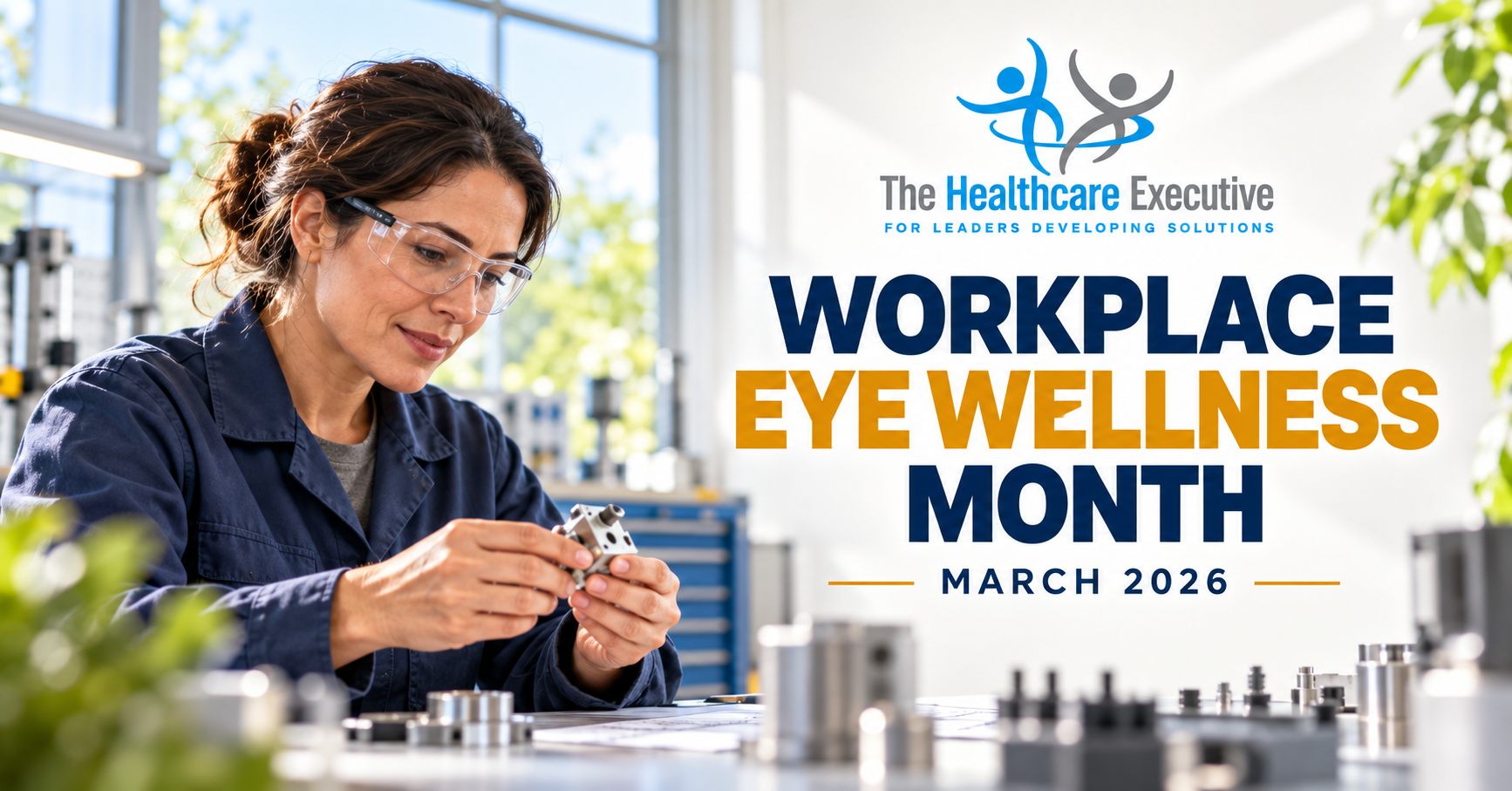


Workplace Eye Wellness Month 2026
Build eye safety into hazard control, protective equipment, digital work design, incident response, and access to care.
Eye safety is a hazard-control system, not a poster.
NIOSH reports that every day about 2,000 U.S. workers receive medical treatment because of eye injuries sustained at work. Health systems see this burden from two sides. Their emergency departments, urgent care clinics, and occupational health services treat injured workers from the community, and their own workforce faces splash, chemical, mechanical, and screen-related exposures across clinical, laboratory, facilities, and office settings.
The Bureau of Labor Statistics counted 18,510 eye-related injury or illness cases that led to at least one day away from work in 2020, with contact with objects or equipment accounting for most of them. Those cases are not random. They cluster around specific tasks, materials, and locations, which means leaders can find them in incident data and address them with ordinary hazard analysis.
OSHA states that eye and face protection must be provided whenever necessary to protect against chemical, environmental, radiological, or mechanical irritants and hazards. Providing protection is the starting point. The operating questions are whether the right protection is available at the point of use, whether it fits and is compatible with prescription eyewear, and whether supervisors treat its use as a condition of doing the task.
Digital work is part of the same system. Prevent Blindness, citing VSP Vision Care’s 2026 workplace report, notes that only 34 percent of workers say their company encourages eye breaks. Clinical documentation, imaging review, command centers, and revenue cycle work all depend on screens. Workstation design, lighting, and scheduled breaks belong in the same ergonomic reviews that already cover posture and repetitive motion.
Workplace Eye Wellness Month, declared each March by Prevent Blindness, is a practical moment to connect these pieces. Look at eye incidents by department and task, confirm that first aid for chemical splashes is available where exposures happen, and make sure employees know how to get timely eye care after an injury and for routine vision needs.
Review the last 12 months of workforce eye incidents by department and task, and assign an owner and a corrective action to the highest-frequency hazard within 30 days.
NIOSH reports that every day about 2,000 U.S. workers receive medical treatment because of eye injuries sustained at work.
The Bureau of Labor Statistics reports 18,510 eye-related injury or illness cases with at least one day away from work in 2020, 11,980 of them from contact with objects or equipment.
Prevent Blindness, citing VSP Vision Care’s 2026 Workplace Vision Health Report, notes that only 34 percent of workers say their company encourages eye breaks.
Figures are summarized from the authoritative sources linked below. Definitions and denominators should be read with each source.
The route from hazard to protected sight
Four steps turn eye safety into a managed part of daily operations.
-
Find the hazards
Use incident reports, job hazard analyses, and walk-throughs to identify tasks with splash, chemical, particle, impact, or radiation exposure.
-
Control and protect
Apply engineering and work-practice controls first, then provide fitted eye and face protection at the point of use, including options compatible with prescription lenses.
-
Design digital work
Include screen placement, lighting, glare, and scheduled breaks in ergonomic reviews for screen-intensive roles.
-
Respond and follow up
Make first aid, emergency evaluation, and follow-up eye care easy to reach after an injury, and feed each incident back into hazard control.
Reliability rule: No task with an identified eye hazard proceeds until the required protection is available at the point of use and the worker has been shown how to use it.
What leaders should watch
Four instruments show whether eye safety is working across the organization.
Eye incident rate
Track workforce eye injuries and exposures by department, task, and cause.
Protection at point of use
Check that required eye and face protection is stocked and used where hazards exist.
Emergency readiness
Confirm that first-aid capability for chemical eye exposure is present and inspected where chemicals are handled.
Digital work review
Monitor whether screen-intensive roles receive ergonomic review that includes vision factors.
Handoffs that close the loop after an eye injury
An eye injury should move quickly to care and then back into prevention.
From the work area to first aid and emergency care
- Start first aid immediately using posted guidance for the type of exposure.
- Send the substance name or product label with the worker when a chemical is involved.
- Notify the supervisor and employee health of the event and destination.
From emergency or urgent care to employee health
- Share the diagnosis, treatment, and any work restrictions.
- Schedule required follow-up with eye care specialists.
- Confirm return-to-work criteria and protective equipment needs.
From employee health to safety leadership
- Report the task, location, and cause to the safety committee.
- Assign a corrective action and an owner.
- Verify the fix and share the learning with similar work areas.
An incident is closed when the hazard has a verified control, not when the worker returns to duty.
A quarterly scorecard for workplace eye safety
Four questions keep leadership attention on hazards, protection, response, and access.
| Signal | Executive question | Accountable owner | Review cadence |
|---|---|---|---|
| Hazards | Do we know which tasks and locations produce most workforce eye incidents? | Occupational safety and employee health leaders | Quarterly |
| Protection | Is required eye and face protection available and used at the point of hazard? | Department managers and safety officers | Monthly |
| Response | Are first-aid equipment and escalation routes ready where exposures can occur? | Facilities, laboratory, and environmental health leaders | Quarterly |
| Access | Can employees reach timely eye care after an injury and for routine vision needs? | Employee health and benefits leaders | Quarterly |
A 90-day plan
Use Workplace Eye Wellness Month to launch one measurable improvement cycle.
Start with the data you already have. Pick the two or three tasks that produce the most eye incidents. Apply controls in order, beginning with engineering and work-practice changes. Audit protection and first-aid readiness where it matters, and report results to the safety committee.
Days 1–30: See the hazards
- Pull 12 months of workforce eye incidents by department, task, and cause.
- Walk the highest-frequency areas with frontline staff and safety officers.
- Establish baselines for incident rate, protection availability, and first-aid readiness.
Days 31–60: Control and equip
- Implement corrective actions for the top hazards with named owners.
- Stock fitted eye and face protection, including prescription-compatible options, at the point of use.
- Add vision factors to ergonomic reviews for screen-intensive roles.
Days 61–90: Sustain and report
- Audit protection use and first-aid equipment in high-hazard areas.
- Confirm employees know how to reach eye care after an injury.
- Publish a short progress summary to executive and safety leadership.
Most workplace eye injuries have a knowable cause.
Workplace Eye Wellness Month is a reminder that eye safety depends on hazard control, protective equipment, digital work design, prepared response, and access to care. Each of those can be measured and improved.
Turn Workplace Eye Wellness Month into accountable action.
Build eye safety into hazard control, protective equipment, digital work design, incident response, and access to care.
Leadership focus
Build eye safety into hazard control, protective equipment, digital work design, incident response, and access to care.
Workforce lens
Give frontline staff fitted, available eye protection, clear first-aid guidance at the point of exposure, and a simple way to report hazards.
Patient and community lens
Make sure injured workers from the community, as well as employees, can reach timely emergency and follow-up eye care.
Equity and access lens
Compare eye incident rates and access to protection across roles, shifts, languages, and contracted staff, and act on the gaps.
Inspect the operating sequence
Eye injuries at work cluster around specific tasks and hazards, which makes them manageable with ordinary safety discipline. This quarter we will target our highest-frequency eye hazards, audit protection at the point of use, and add vision to ergonomic reviews.
- 01Find the hazards
- 02Control and protect
- 03Design digital work
- 04Respond and follow up
Leadership actions for this week
- Name an executive sponsor and frontline operating owner.
- Ask people using and operating the pathway where ownership becomes unclear.
- Test one representative route from first question to acknowledged next step.
- Select one barrier that can be corrected without overstating the evidence.
- Set a review date and define how completion will be verified.
Candidate measures
Define every numerator, denominator where relevant, owner, data source, exclusions, cadence, and limitation locally. These are management prompts, not external benchmarks.
- Eye incidents per 100 full-time-equivalent employees, by department
- Share of audited high-hazard locations with required protection available and in use
- Share of chemical-use areas with a documented, current first-aid equipment inspection
Department readiness checklist
- The public and staff entry points match the actual approved process.
- A specific role accepts each request, referral, or escalation.
- Handoffs include acknowledgment and a visible unresolved state.
- Language, disability, digital, transportation, and trust barriers receive explicit review.
- Communications do not introduce unsupported themes, statistics, or clinical advice.
- A named leader will review what changed after the observance.
Intended audiences
- Executive and Operational Leaders
- Public Health and Community Partners
Staff communication template
During Workplace Eye Wellness Month, our organization will review eye hazards across our work areas and make sure the right protection is available where you need it. Please report any missing or ill-fitting eye protection to your supervisor or safety officer.
Community communication template
March is Workplace Eye Wellness Month, a reminder that many eye injuries at work can be prevented. Ask your employer about the eye protection your job requires, and talk with an eye care professional about your vision needs.
Measurement worksheet
- Signal
- What observable condition will show whether the route works?
- Definition
- What is included, excluded, and counted?
- Owner
- Who reviews the signal and acts on exceptions?
- Cadence
- When will leaders review it?
- Equity check
- Which differences require protected, locally appropriate review?
- Closure
- What evidence will confirm the improvement was completed?
Authoritative resources
- Workplace Eye Wellness Month 2026, Prevent Blindness
- Prevent Blindness Declares March as Workplace Eye Wellness Month, Prevent Blindness (via PR Newswire)
- Healthy Vision Month, National Institute for Occupational Safety and Health
- Workers suffered 18,510 eye-related injuries and illnesses in 2020, U.S. Bureau of Labor Statistics
- Eye and Face Protection, Occupational Safety and Health Administration
- First Aid for Eye Emergencies, Prevent Blindness
Safety note: Prevent Blindness advises that for a chemical splash, the eye should be flushed immediately with water or another drinkable liquid for at least 15 minutes, followed by prompt emergency care. For cuts or punctures, it advises not washing the eye or removing a stuck object, shielding the eye without pressure, and seeking emergency care immediately.
Verification note: Prevent Blindness lists Workplace Eye Wellness Month for March 1–31, 2026 and announced the observance in a news release citing VSP Vision Care’s 2026 Workplace Vision Health Report. No official 2026 theme was found on the pages reviewed.