Healthcare Supply Chain Resilience: An Executive Operating System


- Posted by Greg Wahlstrom, MBA, HCM
- Posted in Article, Operations, Quality & Safety
Healthcare Supply Chain Resilience: An Executive Operating System
Resilience is not a larger storeroom. It is the governed ability to protect clinically essential products, detect disruption early, make disciplined allocation decisions, and restore supply without compromising care.
Move supply chain resilience into the clinical operating model
A shortage becomes an enterprise event when it changes who can be treated, how care is delivered, where staff spend time, or whether a patient can safely move through the system.
The original version of this article correctly emphasized lessons from the pandemic: just-in-time inventory can amplify vulnerability, supplier concentration matters, transparency is limited, and leaders need stronger relationships with vendors. Those lessons remain valid. The executive standard is now higher. Health systems need an operating system that links clinical criticality, product data, sourcing, contracting, inventory, emergency management, finance, quality, and frontline practice.
Supply chain risk is often discussed through purchasing categories, fill rates, price variance, and inventory turns. Those measures are necessary, but they do not reveal the full exposure. A single low-cost component can stop a high-value procedure. A substitute may be available but unfamiliar to clinicians. A distributor may report adequate supply while upstream manufacturing depends on one facility, one region, one raw material, or one transportation route. A health system may hold inventory but lack accurate location, expiration, or utilization data.
The executive question is therefore not, “Do we have enough supplies?” It is, “Can we maintain minimum safe clinical capability when a critical product, supplier, facility, utility, transportation lane, or information system fails?” That question changes governance. It requires the chief operating officer, chief medical officer, chief nursing officer, chief financial officer, quality leadership, pharmacy, emergency management, and supply chain to share one definition of essential service and one escalation structure.
Federal agencies are also treating medical-product supply as a resilience issue. The HHS Office of Supply Chain Optimization identifies vulnerabilities, monitors risk, analyzes markets and demand, and supports sourcing resilience. The FDA describes its supply-chain role as collaboration across government, regulated industry, providers, and other partners. Hospital leaders need comparable coordination inside their own organizations.
Define essential care
Name the services, procedures, medications, devices, and support functions that must remain available during disruption.
See the network
Connect item, supplier, manufacturer, geography, distributor, location, contract, inventory, and utilization data.
Set thresholds
Use clinically informed triggers for conservation, substitution, allocation, transfer, communication, and executive escalation.
Create optionality
Qualify alternate products, domestic and international sources, routes, storage modes, and care-delivery pathways before a crisis.
Rehearse decisions
Run compound scenarios that include a supply failure, demand surge, technology disruption, and workforce constraint.
Prove recovery
Track whether corrective actions changed purchasing, inventory, clinical practice, supplier performance, and response time.
Map the dependencies behind every essential product
Resilience begins when leaders can see beyond the contracted supplier to the full chain that produces, moves, stores, and uses a product.
Most health systems have partial visibility. Contracting systems show vendors and prices. enterprise resource planning systems show purchase orders. distributors show allocations and fill rates. clinical systems show procedures and utilization. pharmacy, laboratory, facilities, information technology, and emergency management may maintain separate inventories or continuity plans. The risk lies in the gaps between those systems.
An executive network map should begin with the patient service, not the item master. For each essential service, identify the products and support resources required to deliver minimum safe care. Then trace each product through manufacturer, production location, raw-material dependency, distributor, transportation route, storage requirement, facility location, point of use, substitute, and clinical owner. Include digital dependencies such as ordering platforms, interfaces, scanning, warehouse systems, automated dispensing, and cybersecurity controls.
Source and production
Raw materials, components, manufacturing sites, quality systems, labor, utilities, and geopolitical exposure.
Flow and control
Contracts, distributors, logistics, inventory, data, allocation rules, and response ownership.
Use and consequence
Service lines, procedures, standards of care, substitutes, competencies, and patient impact.
The map should distinguish verified information from assumptions. Many organizations know their tier-one supplier but not the actual manufacturer, production geography, or common upstream dependencies shared by “different” vendors. Two contracted suppliers may rely on the same factory or component. Dual sourcing is not true diversification when both sources fail for the same reason.
The U.S. Government Accountability Office review of supply-chain resilience describes national efforts to strengthen collaboration and information sharing while also identifying coordination challenges. Health systems face a smaller version of the same problem. No department owns every data element, so governance must define who integrates the evidence and who resolves disagreement.
Leaders should also map time. Document normal lead time, disruption lead time, allocation behavior, shelf life, conversion time, substitute approval time, and the duration for which the system can maintain essential care. A product with seven days of inventory and a two-day replenishment cycle has a different risk profile from a product with seven days of inventory and a six-month manufacturing recovery.
For infrastructure and hazard dependencies that can disrupt a hospital campus and its suppliers at the same time, see Climate Change and Healthcare: Preparing Facilities for Environmental Challenges. Supply resilience and facility resilience should share scenarios, escalation criteria, and executive ownership.
Segment products by patient consequence, not purchase price
The highest-spend item is not necessarily the highest-risk item. Criticality depends on what happens to care when supply is constrained and how quickly the system can adapt.
A useful segmentation model combines five factors: clinical consequence, time to harm, demand volatility, supply concentration, and substitute readiness. Clinical consequence asks whether a shortage delays convenience, reduces efficiency, changes quality, closes a service, or creates immediate risk of serious harm. Time to harm asks how long the organization can operate before the consequence occurs. Demand volatility reflects whether use is stable, seasonal, outbreak-driven, or dependent on case mix. Supply concentration addresses manufacturers, locations, and logistics. Substitute readiness measures whether an alternative is approved, available, interoperable, stocked, and familiar to users.
Immediate patient consequence
Products essential to emergency, surgical, respiratory, pharmacy, laboratory, or other time-sensitive care with limited substitutes.
Material capacity consequence
Products whose shortage reduces throughput, cancels procedures, forces transfers, or significantly changes staffing and workflow.
Operational consequence
Products with workable alternatives that increase labor, cost, waste, training needs, or cycle time.
Manage through standard controls
Products with broad availability, low switching burden, limited patient impact, and short replenishment cycles.
The tier should determine the control. Tier A products may require executive ownership, verified upstream mapping, multiple qualified sources, higher safety stock, substitute simulation, conservation protocols, and regular board visibility. Tier D products can rely on standard purchasing and inventory controls. Applying the same policy to every item wastes capital and management attention. Applying a low-intensity policy to a life-critical item hides risk.
Medication and device shortages require distinct expertise. FDA notes that medical-device shortages can arise from manufacturing and quality problems, geopolitical conditions, natural disasters, transportation delays, public-health emergencies, and discontinuations. Its medical device supply-chain and shortage resources provide an external signal, but health systems still need local clinical translation. A national shortage notice does not tell a hospital which cases depend on the product, which locations hold stock, or whether staff can safely use an alternative.
Substitution should be treated as a change in care, not a purchasing transaction. The review should include clinical efficacy, safety, compatibility, packaging, concentration, preparation, workflow, equipment, infection prevention, documentation, billing, training, waste, and patient communication. A nominal substitute can create new risk if units of measure differ, connectors are incompatible, instructions are unclear, or staff must change familiar routines under pressure.
| Decision factor | Executive question | Evidence required | Escalation signal |
|---|---|---|---|
| Clinical consequence | What care becomes unsafe, delayed, or unavailable? | Service-line validation, procedure mapping, safety review | Essential service at risk |
| Time to harm | How long can the organization operate safely? | Usable inventory, burn rate, conservation options | Projected breach of minimum operating level |
| Supply concentration | Where could a common failure disable multiple sources? | Manufacturer, site, geography, component, route | Single point of failure or correlated sources |
| Substitute readiness | Can clinicians safely switch today? | Approval, inventory, training, compatibility, simulation | Unapproved or untested substitute |
| Recovery time | How long would normal supply take to restore? | Supplier recovery plan, production and transport assumptions | Recovery exceeds safe operating horizon |
Buy optionality, transparency, and recovery capability
A low unit price can be expensive when it concentrates risk, obscures upstream dependencies, or leaves the organization without enforceable information during disruption.
Strategic sourcing should separate routine commercial negotiation from resilience requirements. For clinically critical products, requests for proposal and contract reviews should address manufacturing locations, alternate sites, component dependencies, quality history, business-continuity plans, cyber controls, transportation modes, allocation methods, surge capacity, notification expectations, and recovery objectives. The goal is not to demand confidential details that suppliers cannot share. It is to establish enough transparency to make an informed risk decision.
Supplier diversity must be tested for independence. Two distributors do not equal two manufacturers. Two manufacturers in the same hazard zone may not provide geographic diversification. A domestic source can still depend on imported ingredients or components. An international source may have stronger redundancy than a nominally local source. Leaders should resist slogans and evaluate the actual failure modes.
Domestic sourcing can be one component of a balanced portfolio. HHS efforts to strengthen the public-health industrial base include support for domestic production and scalable capacity. The ASPR industry roundtable on domestic manufacturing emphasizes resilient, scalable, and sustainable production of critical medical components. Hospital leaders should translate that policy direction into product-level analysis rather than assuming every domestic option is available, affordable, or independent.
Clinical gate
Is the product essential, and are specifications tied to real clinical requirements rather than habit?
Risk gate
Are sources independent across manufacturing, geography, components, logistics, and digital systems?
Economic gate
Does total value include inventory, waste, switching, disruption, quality, labor, and avoided service loss?
Assurance gate
Can the supplier demonstrate notification, continuity, recovery, performance, and corrective action?
Contracts should define the information and behaviors required during disruption. Examples include prompt notice of production or quality events, allocation methodology, access to substitute products, reporting on fill rate and lead-time changes, participation in incident calls, data standards, and post-event corrective action. Contract language cannot create supply that does not exist, but it can reduce delay, ambiguity, and unequal access to information.
Inventory strategy should follow product criticality and recovery time. Safety stock is appropriate when it bridges a plausible disruption, storage conditions are controlled, expiration is manageable, and demand is measurable. It is not a substitute for diversified sourcing or operational readiness. Excess inventory can tie up cash, consume space, expire, and create false confidence. The stronger approach combines segmented inventory targets, rotation, demand sensing, supplier intelligence, and predefined conservation.
Total value analysis should include the cost of disruption. A contract that saves two percent on a product but exposes a high-margin service line to repeated cancellations may destroy value. Finance and supply chain should estimate the cost of deferred cases, premium freight, emergency purchases, overtime, training, waste, quality events, patient transfers, and reputational damage. The estimate need not be perfect. It needs to be good enough to compare resilience investments with the consequences they are designed to avoid.
Predefine the decisions that become difficult under pressure
The first hours of a shortage should not be spent debating ownership, locating inventory, or discovering that a proposed substitute changes clinical practice.
Every health system needs a shortage response pathway that distinguishes routine backorders from enterprise threats. The initial signal may come from a manufacturer, distributor, FDA notice, clinician, pharmacy, inventory system, or external risk-monitoring service. Signals should enter one triage process. The triage team validates the issue, identifies affected products and locations, estimates time to impact, and determines whether the event can be managed within supply chain or requires clinical and executive escalation.
The response should use staged thresholds. A watch stage increases monitoring and verifies data. A conservation stage limits nonessential use and redistributes inventory. A substitution stage activates approved alternatives and targeted education. An allocation stage applies ethically and clinically governed priorities when demand exceeds supply. A service-change stage modifies scheduling, location, transfer, or scope of care. A recovery stage returns the organization to standard practice while reconciling inventory, cost, quality, and lessons learned.
A hurricane interrupts production of a high-use sterile fluid
A manufacturer reports storm damage, a distributor begins allocation, and several facilities increase orders at the same time. The control tower shows eleven days of usable inventory at the enterprise level, but two hospitals will reach minimum operating levels in four days because stock and demand are uneven.
Allocation requires explicit ethics and governance. Purchasing history, political influence, or local negotiating strength should not determine access to a scarce product. Criteria should reflect patient need, clinical urgency, benefit, alternatives, and equity. Legal, ethics, quality, and clinical leaders should review high-consequence rules before a crisis and document decisions during the event.
Communication should be role-specific. Executives need consequence, time horizon, decision, owner, and financial exposure. Clinicians need what is changing, why, when, which patients are affected, what alternatives are approved, and where to ask questions. Patients may need clear information when products, scheduling, or location changes. Suppliers need accurate demand and a single enterprise point of contact. Messages should avoid speculation and acknowledge uncertainty.
After-action review must change the operating system. Document whether signals arrived early enough, data were accurate, owners responded, substitutes worked, communications reached users, quality remained stable, and suppliers met expectations. Correct item data, contracts, stocking policies, clinical standards, training, and escalation rules. A retrospective that produces slides but no control changes does not improve resilience.
The FDA’s annual drug-shortage reporting illustrates the value of early manufacturer notification and coordinated mitigation. The FDA supply-chain reports and publications should inform external monitoring. Local leaders should pair those signals with enterprise utilization and patient-consequence data.
Build a decision system, not a decorative dashboard
The control tower earns value when it helps leaders recognize a threat earlier, choose an action faster, coordinate consistently, and learn whether the action protected care.
Technology can connect item-master, contract, procurement, inventory, distribution, clinical utilization, case scheduling, supplier, transportation, regulatory, and external risk data. Predictive analytics can identify demand shifts, abnormal lead times, allocation patterns, or concentration. Automation can accelerate alerts and reconciliation. Artificial intelligence can help synthesize large volumes of unstructured supplier and risk information. None of those capabilities replaces governance, data quality, clinical interpretation, or human accountability.
The foundation is disciplined data. Standardize product identifiers, units of measure, manufacturer information, substitute relationships, contract terms, location, expiration, and clinical ownership. Reconcile inventory across warehouses, nursing units, procedural areas, pharmacies, laboratories, clinics, and emergency caches. Define which system is authoritative for each field. Assign owners for correction. Poor data transmitted faster is still poor data.
Cyber resilience belongs in the supply-chain design. Ordering, warehouse, transportation, dispensing, scanning, and supplier portals can fail during a cyber incident. Leaders should know which transactions can continue manually, how inventory will be located, which suppliers can receive alternate orders, how deliveries will be authenticated, and how the organization will reconcile activity when systems return. For physical and digital continuity principles, see The Future of Hospital Design: Creating Adaptive and Resilient Facilities.
Targets should reflect clinical context. A high inventory level is not automatically good when products expire quickly. A low level is not automatically unsafe when replenishment is reliable and alternatives are ready. Leaders should review measures together and investigate exceptions. The dashboard should display the evidence behind the signal and the owner responsible for action.
Board reporting should remain concise. Show the top enterprise exposures, trend in critical-product coverage, unresolved single points of failure, significant events, capital or contracting decisions, and corrective actions. Avoid overwhelming directors with thousands of items or operational detail. Their role is to test whether management understands material risk, has set tolerances, funds controls, and verifies performance.
Establish the control tower in 90 days
The first 90 days should create one governance model, expose the most consequential dependencies, and prove that the organization can make and execute a coordinated decision.
Set the operating model
- Name an executive sponsor and multidisciplinary resilience council.
- Define essential clinical services and minimum safe capability.
- Select an initial group of high-consequence products.
- Agree on criticality, risk, and escalation criteria.
- Inventory current data, committees, policies, contracts, and dashboards.
- Identify one near-term exposure that requires immediate control.
Expose dependencies
- Trace selected products through manufacturer, site, component, distributor, route, location, and clinical use.
- Validate inventory, demand, lead time, shelf life, and recovery assumptions.
- Review substitutes with clinical, quality, infection prevention, and technology leaders.
- Assess supplier independence and contract notification requirements.
- Build the first executive risk view and assign accountable owners.
- Correct priority item and location data.
Exercise and govern
- Run a compound disruption scenario involving supply, demand, technology, and workforce.
- Measure signal-to-decision time and execution consistency.
- Approve conservation, substitution, allocation, and communication pathways.
- Set board and executive reporting cadence.
- Fund the highest-value sourcing, inventory, data, and training controls.
- Publish corrective actions, deadlines, owners, and the next test date.
Questions for the executive team
- Which essential services have product dependencies that are not fully mapped?
- Which critical products depend on one manufacturing site, region, component, or logistics route?
- Where does enterprise inventory visibility differ from what frontline teams can actually access and use?
- Which substitutes are approved on paper but not stocked, compatible, documented, or rehearsed?
- How do allocation decisions incorporate clinical urgency, patient benefit, alternatives, and equity?
- What information must suppliers provide before and during disruption, and is that expectation contractual?
- Which technology failures would prevent ordering, locating, distributing, or documenting supplies?
- What supply risk should the board see regularly, and what evidence demonstrates control effectiveness?
Leaders should not wait for perfect data. Begin with a limited portfolio of high-consequence products and improve the system through use. The goal is not a one-time inventory project. It is a repeatable management discipline that expands across categories, facilities, and service lines while preserving focus on patient consequence.
Resilience is the ability to keep the clinical promise when supply conditions change
Healthcare executives should treat supply chain as an enterprise continuity capability. Visibility, criticality, optionality, response, and assurance must operate together.
The strongest system is not the one with the most inventory or the most technology. It is the one that knows what care must be protected, sees material risk early, makes transparent decisions, equips clinicians to adapt safely, and learns faster than the threat evolves.
References for implementation
- HHS ASPR: Office of Supply Chain Optimization
- HHS ASPR: Industry Roundtable on Domestic Manufacturing
- FDA: Supply Chain Role
- FDA: Supply Chain News, Reports and Publications
- FDA: Medical Device Supply Chain and Shortages
- GAO: Drug Shortages and HHS Coordination
- GAO: Supply Chain Resilience and International Cooperation
- AHRMM: Building More Resilient Supply Chains
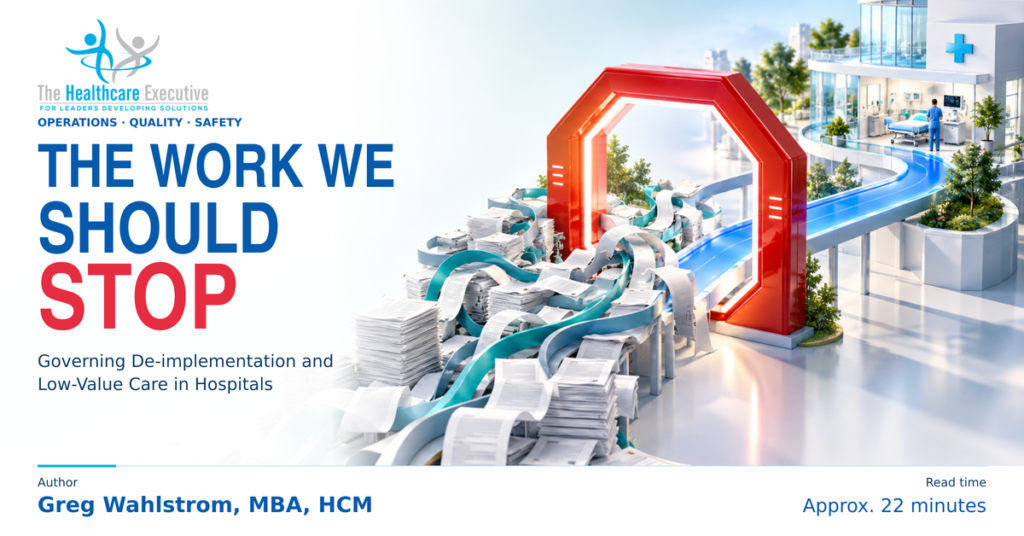
The Work We Should Stop: Governing De-implementation and Low-Value Care in Hospitals
A hospital de-implementation framework for reviewing low-value care, protecting necessary work, testing changes, and checking safety and capacity.
Read analysis
Strategic Leadership for Sustainable Safety in Healthcare Management: Culture, Reliability, and Executive Accountability, a Narrative Review
A current peer-reviewed narrative review translating safety culture, just culture, high reliability, reporting, leadership, and system learning into executive controls.
Read analysis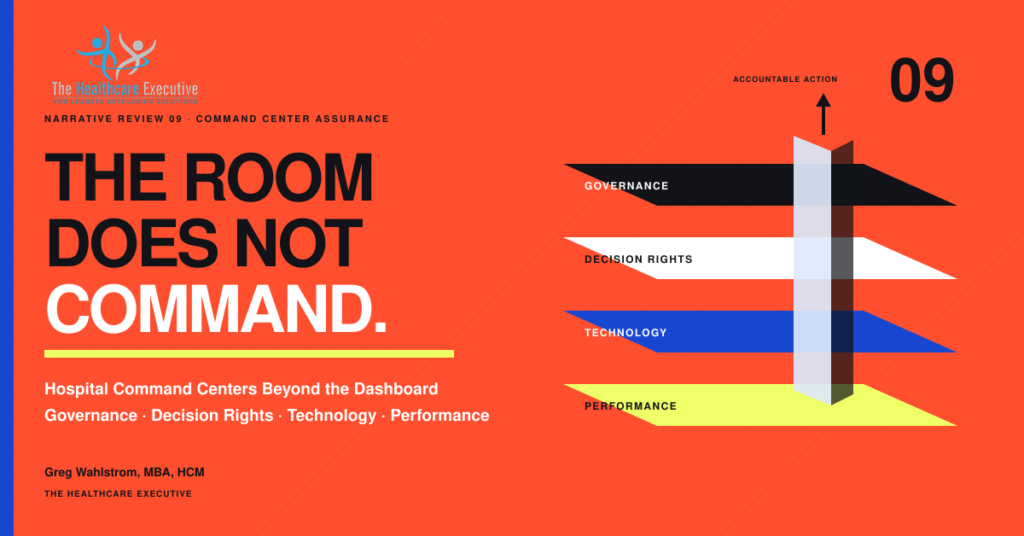
Hospital Command Centers Beyond the Dashboard: Governance, Decision Rights, Technology, and Performance—a Narrative Review
A narrative review of hospital command centers, including governance, decision rights, patient flow, technology, performance, and executive assurance.
Read analysis